
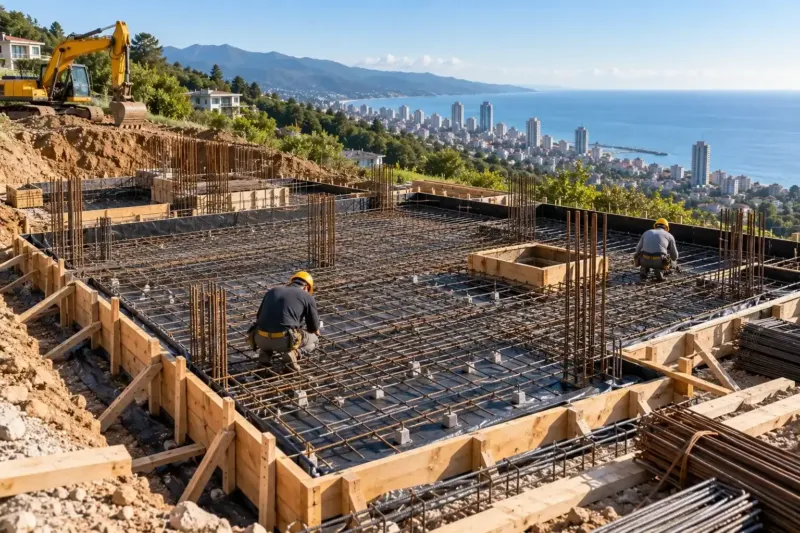
Foundation waterproofing in Batumi: new houses and wet basements
We choose foundation waterproofing in Batumi by the water at the house: damp ground, storm run-off or pressurised groundwater by the sea. The layer goes on the outside, joints are sealed with waterstops and entries with sealed sleeves, and drainage and a paved apron are built with it. The price is from 78 ₾ per m² of surface; drainage and plinth insulation are extra.
from 78 ₾/m²cleaning, primer, main layer and protection; drainage and paved apron extra. The final price is confirmed once agreed.
- Timeline: waterproofing the foundation of a new 120–150 m² house with drainage usually takes 2–3 weeks
- Warranty: Our work on the waterproofing and drainage has a 2-year warranty
Who it’s for
You are building a house with a lower ground floor on the seafront
The plot is lower than the neighbours' and storm water runs towards the foundation
Water appears in the basement of an old house after rain
The foundation is poured, but the previous contractor did not waterproof it
You want to check that joints and entries are sealed properly before backfill
What’s included
- assessment of the water from the survey and an inspection after a downpour
- cleaning the concrete, repairing honeycombing, fillets at the corners
- primer and the main layer with reinforced corners
- waterstops in construction joints and sealed entries
- a horizontal damp-proof course under the walls
- a protective membrane or insulation before backfill
- perimeter drainage and a paved apron to the design
- photos of every detail before backfill
Foundation waterproofing in Batumi: what water we protect against
The waterproofing material is chosen by the water that reaches the foundation. You can see it in the ground survey report and on site after a good downpour. There are three cases, and in Batumi you meet all three, sometimes on neighbouring plots.
| Water at the foundation | Where you find it | What we use |
|---|---|---|
| Damp ground, water below the footing | Terraces above the city, dense clay | A coating and a damp-proof course at the plinth, drainage and a paved apron |
| Storm water running towards the wall | Slopes, plots lower than the neighbours, dense clay that holds water | Torch-on membrane, perimeter drainage, protective membrane |
| Groundwater above the footing, under pressure | The seafront, low ground near rivers, a lower ground floor | A continuous envelope under the slab and up the walls, waterstops in the joints, dewatering during the work |
If the house will have a basement or lower ground floor below ground level, we design the waterproofing for the worst case: the water level after the autumn downpours is higher than in the dry month when the survey boreholes were drilled.
How the external layer is built
We apply waterproofing on the outside, the side the water pushes from. Before that the concrete is cleaned, nibs chipped off, honeycombing filled with repair mortar and corners rounded with fillets: membranes do not like sharp edges. Then primer and the layer itself, reinforced at corners and junctions. On top goes protection: a dimpled membrane or insulation boards, so stones in the backfill do not tear the waterproofing.
At the top the layer is taken up the plinth above the splash line from the paved apron and covered with a drip or cladding. Under the walls, along the top of the foundation, we lay a horizontal damp-proof course so moisture does not rise through the concrete into the masonry.
The weak points: joints, entries, corners
Water almost never passes through an intact membrane. It comes through construction joints, pipe entries and corners where the layer was not pressed home. So:
- waterstops go into construction joints between pours before the concrete;
- water, sewer and cable entries pass through sleeves with seals, not sealant smeared round the pipe;
- an extra strip is bonded onto inside and outside corners;
- the vertical layer laps over the edge left out from under the slab.
Every detail is photographed before backfill. For a strip foundation, a slab and ground beams on piles the layer follows the same logic but sits in a different place: for a slab the main sheet is underneath, for a strip it is on the sides.
Drainage and the paved apron work together with the waterproofing
Waterproofing holds water back, drainage carries it away. Perimeter drainage goes below the foundation footing in crushed stone and geotextile, falling to a chamber or discharge point. The paved apron slopes away from the wall with a movement joint at the plinth, and roof downpipes are connected to the storm drains rather than discharged onto the apron. On plots by the sea where the water sits high, even a good membrane works under constant pressure without drainage. How this works for a house on the seafront is described on the page about seaside houses.
If the house is built and the basement gets wet
First we look for where the water comes from: a leaking pipe, a downpipe discharging at the wall, a paved apron sloping towards the house, or groundwater. Sometimes it is enough to correct the apron and lead the downpipes away. If water comes through the wall, we dig the foundation out from the outside in sections, dry it, repair it and lay a new layer. Where digging outside is impossible, cracks and joints are sealed by injection from inside. For old houses this is often part of an old house renovation.
How much foundation waterproofing costs
Foundation and plinth waterproofing costs from 78 ₾ per m² of surface: cleaning, primer, a torch-on or coating layer and protection. Plinth insulation with XPS boards is from 75 ₾ per m², perimeter drainage from 87 ₾ per linear metre, the paved apron from 93 ₾ per m², injection of a crack or joint from 155 ₾ per linear metre, and digging out at an existing house from 39 ₾ per m³. The final cost is set after an inspection and agreement on the estimate.
Stages and timelines
-
Water assessment
1–3 days
We look at the survey and the plot after a downpour and decide which layer is needed.
-
Concrete preparation
2–5 days
Cleaning, chipping off nibs, repairing honeycombing, fillets, drying.
-
Main layer
2–5 days
Primer, membrane or coating, reinforcement of corners and junctions.
-
Details
1–3 days
Sealed entries, junction with the slab, damp-proof course, photos.
-
Protection and drainage
3–7 days
Protective membrane, drainage pipe in crushed stone and geotextile.
-
Backfill and paved apron
3–7 days
Backfill in layers, a sloping paved apron, downpipes connected.
Local specifics in Batumi
Downpours in Batumi are short and heavy: in an hour a plot takes as much water as a dry climate gets in a month. Dense clay does not let it through, and water stands round the foundation as if in a bath. So the backfill against the walls is not the clay from the pit but a free-draining material, and on top it is closed off by the paved apron.
Torch-on membranes are only laid on dry concrete, and in the rainy season it has to be dried under cover with fans. If waiting is not possible, we switch to coatings that can be applied to a damp substrate. This is decided on site and recorded in the report, so it is clear which layer is in the house.
Materials and brands
For foundation walls we use bitumen-polymer torch-on membranes in one or two layers, or flexible cement coatings, for example Ceresit or Mapei. Under a slab with pressurised water we lay a polymer membrane as a continuous sheet. Waterstops go into construction joints, and entries get sleeves with sealing rings. The layer is protected with a dimpled membrane or XPS boards, and the drainage pipe in geotextile sits on a crushed stone bed.
What makes up the cost
Timeline: waterproofing the foundation of a new 120–150 m² house with drainage usually takes 2–3 weeks
- plinth insulation together with the waterproofing
What raises the cost
- pressurised groundwater and a lower ground floor
- work at an existing house with digging
- many entries, joints and corners
- dewatering during the work
What lowers the cost
- water below the footing, a coating and damp-proof course are enough
- new construction while the foundation is exposed
We prepare the exact estimate from measurements and photos. It’s free and comes with no obligation.
Get an estimateGuarantees
Our work on the waterproofing and drainage has a 2-year warranty. Photos of the layer, joints and entries before backfill go into the handover file. Membranes and coatings carry the manufacturer's warranty.
Questions and answers
How much does foundation waterproofing cost in Batumi?
From 78 ₾ per m² of foundation and plinth surface, including concrete preparation, the main layer and protection. Drainage, plinth insulation and the paved apron are priced separately. At an existing house, digging out and reinstating the apron are added. The final cost is set after an inspection and agreement on the estimate.
Which foundation waterproofing is better, torch-on or coating?
It depends on the water. Against damp ground a flexible coating and a damp-proof course are enough. Against storm water and with a lower ground floor, a torch-on membrane with protection is more reliable. With pressurised groundwater you need a continuous envelope under the slab and up the walls, with waterstops in the joints.
Can a foundation be waterproofed from the inside?
From the inside cracks can be closed by injection and a penetrating compound applied if the outside cannot be dug out. But that is a second line of defence: water keeps reaching the concrete from outside. Where possible, we dig the foundation out in sections and lay the layer on the outer face.
Why is there water in the basement if it has waterproofing?
Most often the water does not come through the layer but through the details: a joint between pours without a waterstop, a pipe entry sealed with sealant round it, a corner where the membrane has lifted. The second cause is a paved apron sloping towards the house and downpipes discharging under the wall. We start by finding the water's path, then repair.
Is drainage needed if the foundation is waterproofed?
On clay and by the sea, yes. Without drainage, water stands against the wall after a downpour and presses constantly on the layer, which then works at its limit. Drainage carries that water away and the waterproofing lasts longer. On dry sand above the water table a correctly sloped paved apron is sometimes enough.
Further reading
Send us photos of the foundation or basement: we will tell you which layer is needed
We reply within an hour during business hours. Message us or leave a request: we’ll call you back, go over the details and suggest the next step.
Mon–Fri 10:00–19:00, Sat 11:00–16:00