
Rental yield
How to calculate an apartment's yield in Batumi: the whole investment, income by season, costs before your account, taxes…
from 1 200 ₾
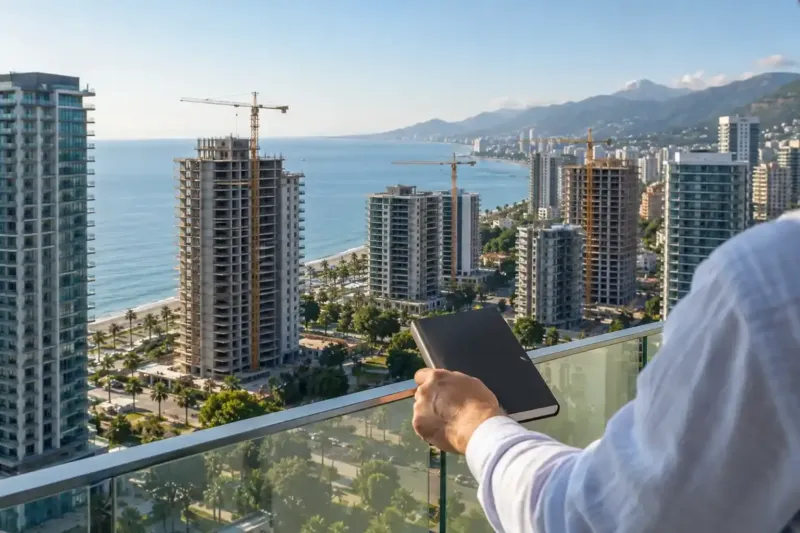
What you get from investing in Batumi property depends on the strategy: an apartment to rent out, a building under construction, commercial premises and land all bring different income and risks. There are no promised yields or percentages from sales presentations here. This page covers how to calculate down to the net figure, Batumi's seasonality, liquidity when you sell and the risks to weigh before you buy. We run the numbers for a specific property before you pay a deposit.
from 330 ₾The final price is confirmed once agreed.
How to calculate an apartment's yield in Batumi: the whole investment, income by season, costs before your account, taxes…
from 1 200 ₾
How to invest in Batumi property step by step: goal and term, the whole budget, strategy, district and building, checks, the deal…
from 390 ₾
How to choose a residential complex in Batumi for investment: the developer, plot and permit, management, letting rules and…
from 1 200 ₾
Batumi districts for investment: the New Boulevard, the Old Town, the centre, the Airport Highway, Makhinjauri and Gonio by…
from 1 200 ₾
Investing in an off-plan apartment in Batumi: the early price, payment plans, the time to first income, assignment, competition at…
from 1 200 ₾
Flipping apartments in Batumi: which property to buy, the renovation estimate and timeline, selling costs, tax on a sale within…
from 1 200 ₾
An income property in Batumi as an investment: buy a working one, build or convert, rooms or apartments, economics per room…
from 1 200 ₾
Investing in commercial premises in Batumi: what the investor buys, with a tenant or empty, how to calculate income, the lease…
from 1 200 ₾
Investing in a plot in and around Batumi: category and zone, how to add value to a plot, holding costs, where to look, exit and…
from 1 200 ₾
Batumi property investment risks: supply and prices, the developer, the season, liquidity, rules and taxes, currency, climate and…
from 1 200 ₾
Batumi property investment strategies: long-term and short-term letting, off-plan, flipping, an income property, commercial, land…
from 390 ₾
In advertising, Batumi property investment looks simple: buy an apartment by the sea, rent it out, collect your percentage. In practice the result depends on decisions made before the purchase: what kind of property, in which building, at what stage, who will manage it and how you will later exit the investment. This page is about making those decisions with numbers.
There are only a few ways to make money from property, and each has its own source of income and its own main risk. A rental house, meaning a house or guest house built to rent out, combines renting and construction, and with them the risks of both.
| Strategy | Source of income | Main risk |
|---|---|---|
| Long-term rental | The tenant's monthly rent | Empty periods between tenants, wear, a lower rate than summer short-term lets |
| Short-term or seasonal rental | Guest bookings, mainly between July and September | An empty winter, cleaning and management for every stay |
| Buying off-plan | A possible rise in price by completion | Delayed completion, the developer itself, many similar apartments for sale |
| Flipping | Renovation and resale | The renovation estimate and timing, tax on a sale within 2 years of ownership |
| Commercial property and land | A tenant or a rise in value | Finding a tenant, 20% tax on sale, a slow exit |
Yield is calculated from what is left for you, divided by everything you have put in. The order is:
The annual amount left after all deductions, divided by your total investment, is your yield. Compare it with what the money would earn with no effort at all, for example in a bank deposit, and remember that the price of the apartment itself may rise or fall over those years.
Batumi has the most tourists between July and September. An apartment let short-term earns most of its revenue in these months, and in winter the costs can eat up almost everything. That is why we calculate the same property under two scenarios: short-term only, and short-term in summer with monthly rental in winter.
Liquidity shows how quickly, and without a big discount, you will be able to sell the property. It is assessed when you buy: how many similar apartments there are in the building and nearby, who the buyer will be in a few years, whether the layout will date. The exit is also worked out in advance. There is no tax if the home has been yours for more than 2 years. If you sell earlier, you pay 5% of the price difference, and for non-residential property the rate is 20%.
Buying at an early stage is tempting because of the price and the interest-free payment plan that many developers offer. But income is still a long way off: completion, the handover, renovation, furniture. The usual payment plan has no escrow, and payments go straight to the developer. We check the contract to see whether the project has a dedicated bank account or a bank guarantee.
If you plan to sell the apartment before completion, we read the assignment terms before the first payment. Tax on an assignment may be calculated differently from tax on selling an apartment; we check it in advance with a tax adviser.
Buy an apartment in poor condition, renovate it and sell it: here the result depends on the estimate, the time the renovation takes and an accurate sale price. Partitions can be moved without a permit as long as load-bearing structures are not affected, and documented renovation costs reduce the tax on a sale within 2 years of ownership. But if you buy and sell regularly, the Revenue Service may treat it as a business, and the exemptions for housing will no longer apply.
Your own house or guest house for rental gives you control over the layout and the costs, but it adds construction: the plot, the design, the permit from Batumi City Hall, the building work and management afterwards. We build such houses as a contractor and work out the rental figures before the design stage, so that the layout works for the income.
Premises with a tenant bring in money straight away. Empty ones wait for a tenant, and that empty period goes into the calculation. Land brings no income: it is bought for future construction or a rise in price, and you will still have to pay land tax. Agricultural land is closed to foreigners, so the plot's category is the first thing we check.
We compare districts using the same measures as for apartments: how many minutes' walk to the sea and the boulevard, whether shops and cafes stay open in winter, how many new buildings are going up nearby (these are your future competitors for tenants and buyers) and how the street copes with downpours. For short-term rental the route to the sea matters more; for monthly rental, everyday life and quiet in winter.
In the complex itself we look at the management company, the service charge and the company's rules for short-term rental, the lifts, security and the number of similar studios. We judge the developer by its completed buildings: if the facades and windows of its earlier buildings coped badly with a couple of winters, the new one has the same odds.
We don't promise a yield and don't quote market-average percentages. We calculate the specific property using the steps above, and if you decide to buy, we can prepare it for rental and manage the letting.
The advertised figure usually comes from the summer rate and almost full occupancy, stretched over twelve months. It leaves out the low-demand winter, platform commissions, cleaning, utility bills, management and tax. The investment is understated too: only the price of the apartment is counted, without renovation, furniture and fees. Ask the seller for a month-by-month calculation with every cost item. If there isn't one, the figure is not worth trusting.
At least once a year, after the season, and every time the rules change. The season's results show the real occupancy and costs instead of expectations. In 2026 the residence permit conditions, the property tax exemption and the rules for calculating the tax on sales all changed, and each such change shifts the calculation. We compare the amount actually left with what was assumed at purchase and decide whether to change the rental format, refresh the renovation or prepare an exit.
If you are prepared to wait and have checked the developer, it can work. The advantages are the interest-free payment plans that many developers offer and a choice of layouts. The drawbacks: income only starts after completion, the handover and renovation; under the usual payment plan the money goes straight to the developer with no escrow; and a delay in completion freezes your money. We check the contract to see whether the project has a dedicated bank account or a bank guarantee. Before the first payment we look at the plot, the permit, the developer's completed buildings and the contract: the schedule, the penalty clause and the assignment terms, if you are thinking of selling before completion.
There is no property transfer tax on purchase; you pay the registry fee. While you rent out housing, tax on rental income applies: 5% of the gross amount if you are registered as a landlord, or 20% of the income after expenses, and for short-term rentals we choose the tax regime with a tax adviser. Property tax is paid by households with an annual income above 100,000 GEL, the municipality sets the rate of up to 1% of the value, and land is taxed regardless of income. When you sell a home after 2 years of ownership there is no tax; before that it is 5% of the price difference, and 20% for non-residential property.
Usually this is an assignment of your rights under the contract with the developer. We look for the terms in the contract itself: whether assignment is allowed, whether the developer's consent is needed, whether the apartment must be paid for in full first and whether there is a fee for the transfer. A buyer taking over the contract will check you the same way you checked the developer, so keep the contract, the schedule and proof of every payment. Consider the tax as well: an assignment may be taxed differently from the sale of a completed apartment, and we check this in advance with a tax adviser. We build an exit through assignment into the calculation before the purchase rather than hoping for it later.
We reply within an hour during business hours. Message us or leave a request: we’ll call you back, go over the details and suggest the next step.
Mon–Fri 10:00–19:00, Sat 11:00–16:00