
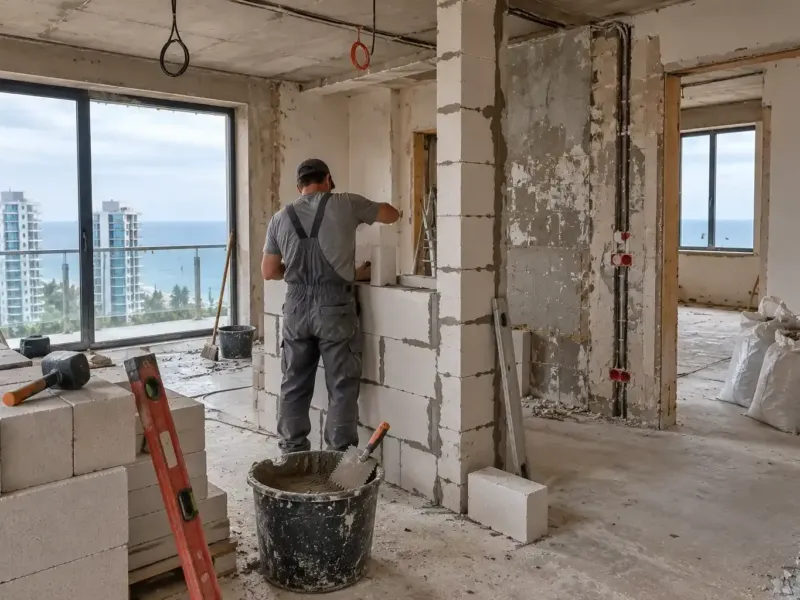
Preparation
Strip-out, waste removal, layout changes, plastering, screed and skim coating: the order to do them in and what each job leaves…
from 36 ₾/m²

Electrics, tiling, floors or air conditioners: you can order these renovation works in Batumi one at a time, without renovating the whole apartment. Before we start, we look at what the work will rest on: what screed the tiles will go onto, which circuit in the consumer unit (fuse box) feeds the new sockets. We photograph concealed work before it is closed up, and a separate job gets the same warranty as a full renovation, including 5 years on concealed services.
from 20 ₾/m²The final price is confirmed once agreed.
Strip-out, waste removal, layout changes, plastering, screed and skim coating: the order to do them in and what each job leaves…
from 36 ₾/m²
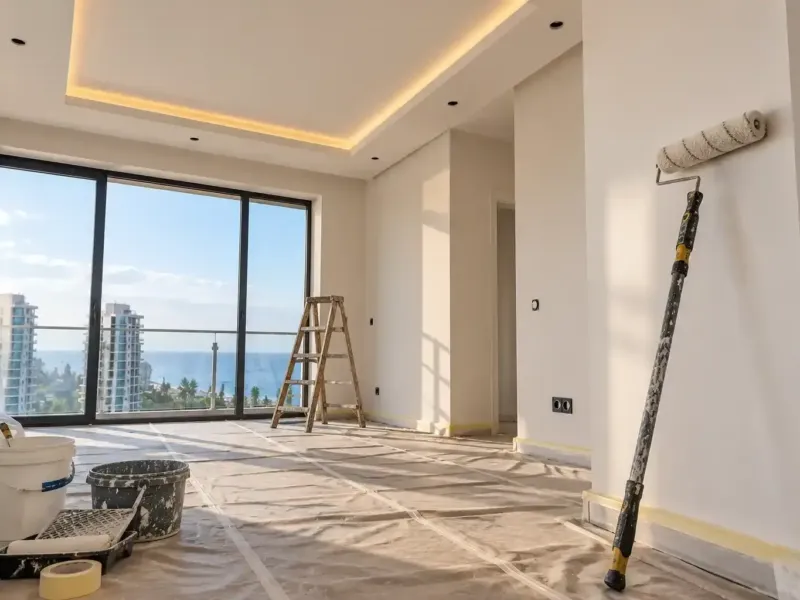
Painting, wallpaper, decorative finishes, panels and ceilings: what to choose for an apartment by the sea, and in what order to do…
from 23 ₾/m²

Which floor covering goes where, in what order the floor work is done, and how we check the subfloor, gaps and thresholds.
from 20 ₾/m²
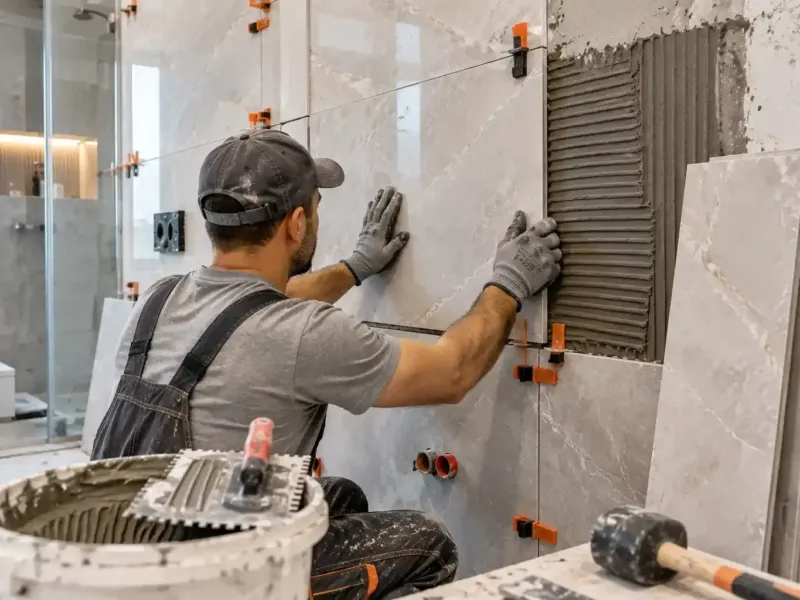
Ceramic tiles, porcelain, mosaic and stone: which job to order, in what order it is done and what to check at sign-off.
from 66 ₾/m²
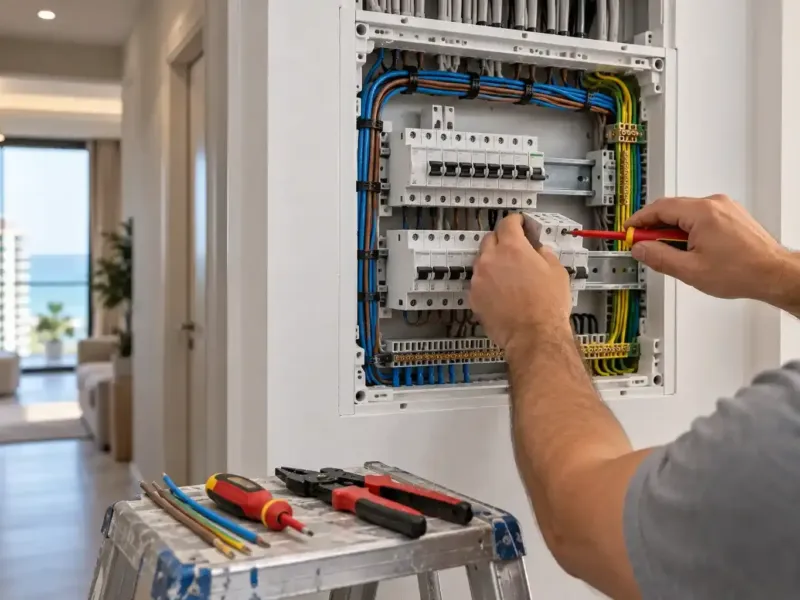
Installation from scratch, rewiring, the consumer unit, surge protection, lighting and smart home: what to choose, in what order…
from 42 ₾/point

Minor repairs, bathroom pipework and replacing old pipes: what a plumber does, in what order, and what a plumbing point costs.
from 96 ₾/point
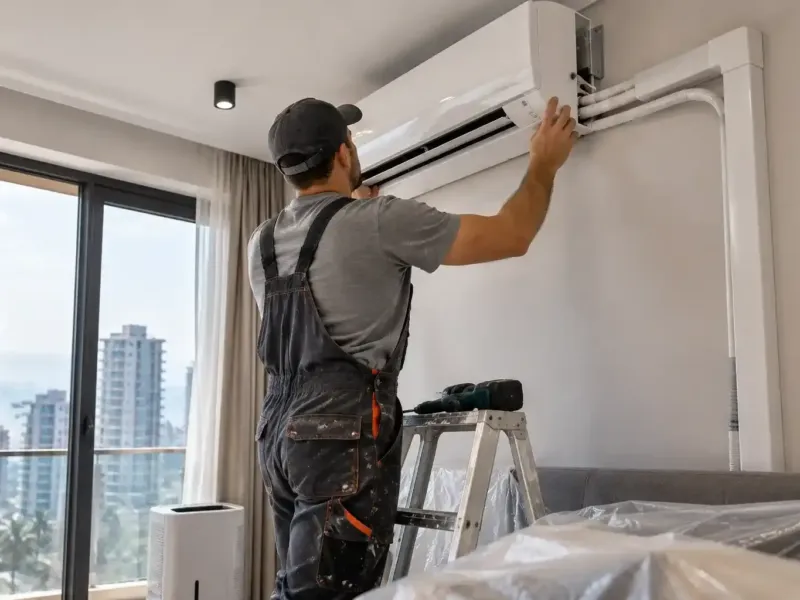
Air conditioners, multi-splits, extraction and air supply, dehumidifiers and heating: which of these an apartment by the sea…
from 330 ₾/pc
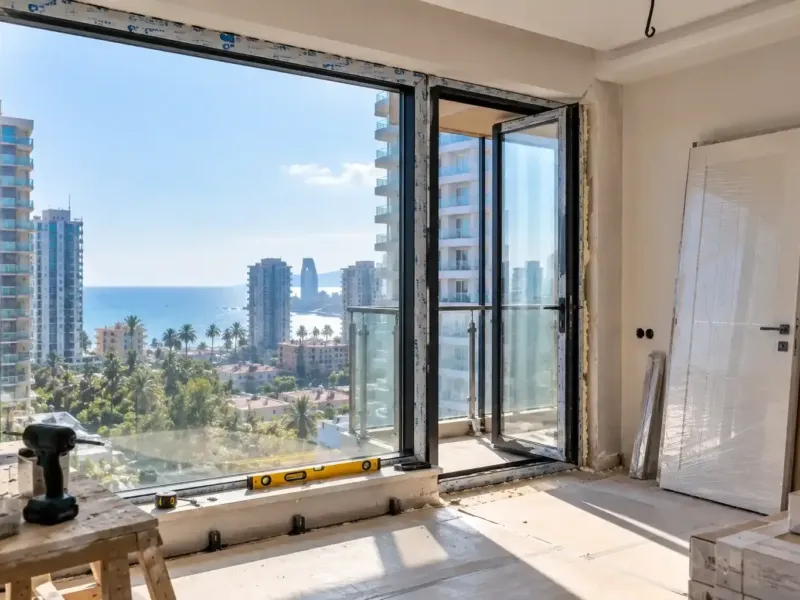
uPVC and aluminium windows, front, interior and concealed doors, partitions and screens: in what order to fit them and how to sign…
from 330 ₾/m²
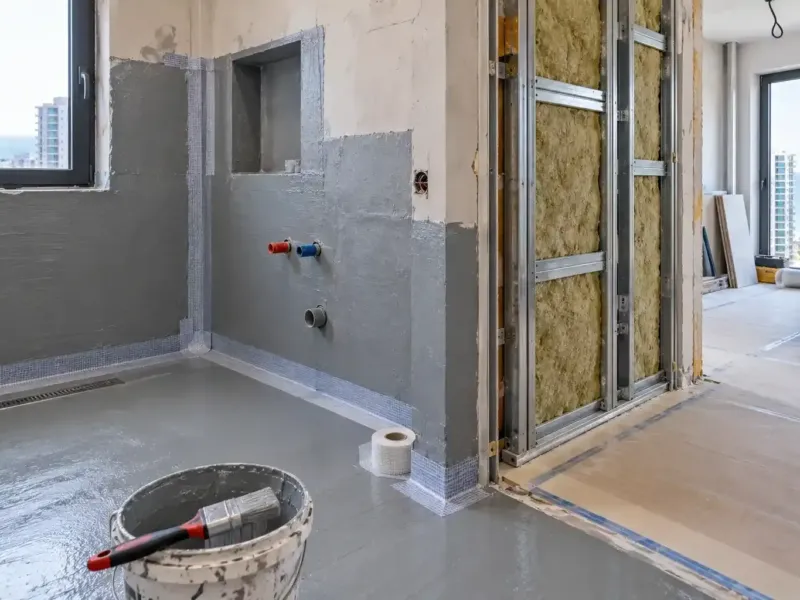
Waterproofing, soundproofing, thermal insulation and mould treatment: the order they go in and how to check the layers before they…
from 30 ₾/m²

Slats, wood, stone, fireplaces and staircases: what to choose for a room, what to plan at the rough stage and what it costs.
from 185 ₾/m²
Any renovation is made up of two groups of work. One group ends up hidden in walls and floors: preparation, electrics, plumbing, air conditioning lines, waterproofing and soundproofing. The other stays in sight: walls and ceilings, floors, tiling, windows and doors, decorative finishes. The first group is harder to redo, so we check the two groups differently. Concealed work is checked more strictly, and before it is closed up.
In an estimate, preparation work looks like a minor item. It covers strip-out, protecting the lift and shared corridors, waste removal, measurements and checking the surfaces we will work on. It decides how precisely everything else can be done and how many complaints the neighbours will have.
In a humid climate, plaster takes longer to dry than the schedule would like, and we paint a wall only once it is dry. Paint on damp plaster blisters over time. The ceiling often hides air conditioning and ventilation runs, so its type, stretch ceiling or plasterboard, is chosen before the rough work.
Flooring is chosen for each room and for how often people walk on it in wet shoes. We lay tiles to a layout agreed in advance, so that cut tiles end up in corners where they won't be noticed and the joints line up with the centre lines of the sanitary ware.
By the sea, microcement and decorative plaster need a protective coating, otherwise they soak up moisture and dirt. In a bathroom we put the same waterproofing under microcement as under tiles.
Electrical work starts with the consumer unit and a circuit diagram: separate circuits for the hob, oven, water heater and air conditioners, and RCD protection for wet areas. We run cables in straight lines, parallel to corners and the floor, so that their position can be traced from the diagram.
In plumbing, what matters most is the pipe layout and access. Where possible we don't leave joints buried inside walls, we put manifolds and valves behind access hatches, and we check the slope of the drain pipes with a level before closing them in.
In Batumi, climate control is more about humidity than heat. We lay air conditioning lines before the finishing and connect the condensate drain to the sewer through a trap, so that water doesn't run down the facade. We design the air supply and extraction so that the air is replaced even with the windows closed.
When replacing windows, we pay attention to the joint between the frame and the wall: on the outside a tape that keeps water out and lets vapour escape, on the inside a vapour barrier. Expanding foam left unprotected from sun and rain breaks down, and the reveals start to darken within a couple of seasons.
Interior doors go in after the floors and painting, so the door leaves aren't damaged. We replace a front door with the building's rules in mind, because in new builds all the doors on a floor sometimes follow one design.
Soundproofing for partitions and ceilings goes in at the rough stage, because it can't be added later without stripping things out. Internal insulation is done to a calculation and with a vapour barrier: the dew point will be behind the insulation, and vapour must not reach it.
It makes sense to order as separate jobs the things that wear out or date sooner than the rest: air conditioners, taps and toilets, bathroom tiles, floors, wall painting, interior doors. This work has little to do with the rest of the renovation, and each job can be signed off on its own.
It is harder with work that depends on other work. Tiles are not laid on screed that hasn't dried yet. There is no point putting a new kitchen socket on an old aluminium circuit, and SPC vinyl flooring on an uneven screed will show every ripple over time.
So before a separate job, we check what it sits on: the screed, the wall, the circuit in the consumer unit, the pipes up to the tap. If we didn't do that earlier work, we record its condition in photos and in a signed condition report before starting. That way it is clear which part we are responsible for.
You see concealed work before it is closed up. The site foreman photographs and films every part of it with a tape measure in the shot, showing distances from the corners, and sends you the pictures before it is covered. On request, the foreman shows you any part on a video call, right there on site.
| Work | What we photograph before it is closed up |
|---|---|
| Electrics | Cable runs with measurements from the floor and corners, junction boxes, the consumer unit with labelled circuits |
| Water supply and drains | Pipes and joints, the pressure test, slopes, inspection points |
| Waterproofing | The layer on the floor and up the walls, the water test |
| Air conditioning lines | Insulated copper pipes, the condensate drain and its slope |
| Soundproofing and insulation | The layers before boarding, the junctions with walls and ceiling |
The warranty period doesn't depend on the size of the job. Our work has a 2-year warranty, and concealed services have a longer one: 5 years on wiring, water pipes and drains in walls and floors. If we have replaced the pipework in a bathroom, the five-year period applies to that pipework. For taps, sockets and appliances the period is set by the manufacturer, and their documents are kept in the handover file.
Yes, that is a normal separate job. Electrical work starts with the consumer unit and the circuit diagram: how many circuits there are, what load they carry and whether there is an earth. Plumbing starts with where the valves are and what state the riser is in.
If the work affects the finishes, for example cable channels cut into painted walls, repairing them is included in the estimate from the start, unless you decide to do it yourself. We photograph the runs before they are closed up and give you the diagram, so the next tradesman knows where the cables and pipes go.
It is everything you can't see once the renovation is finished: wiring in the walls, pipes in the floor, waterproofing under tiles, soundproofing behind boarding. It can only be checked before it is closed up; after that, the finishes have to be opened.
We photograph and film each part with a tape measure and send it to you. You look, ask questions and, if you like, ask for a video call with the foreman. If you have your own technical supervision engineer, they can inspect this work on site. Any issues are settled before that part is closed up.
Wiring, water pipes and drains hidden in walls and floors come with a 5-year warranty. Visible items such as sockets, taps and toilets are covered by the manufacturer's warranty, and their installation by our 2-year warranty.
The period runs from the date on the acceptance certificate. If something leaks or cuts out because of our work, we fix it at our own expense. A failure in the building's shared riser or alterations by someone else are not warranty claims, but we will help find the cause.
Sometimes. The old tiles must be firmly fixed, with no hollow sound when tapped and no cracks, and the extra thickness must not get in the way of the door, the floor drain or the sanitary ware. A special primer and an adhesive for difficult surfaces are needed.
In bathrooms and on balconies we don't do this: under old tiles you can't see whether there is waterproofing or what state it is in. There we take the tiles off, check the base and redo the waterproofing. On a dry wall in a kitchen or hallway, tiling over tiles can be a sensible solution.
Yes, ideally at the rough stage. For walls and ceilings we build a framed lining with mineral wool on anti-vibration hangers, and for floors a floating screed on a sound-insulating layer. Each system takes a few centimetres off the room, which is worth allowing for in the layout.
Soundproofing doesn't give complete silence: impacts and vibration partly travel through the building's frame. Voices and the TV become much quieter, though footsteps from above are only reduced. We seal sockets on the shared wall and the joints with the floor slab, otherwise sound will get around the insulation.
We reply within an hour during business hours. Message us or leave a request: we’ll call you back, go over the details and suggest the next step.
Mon–Fri 10:00–19:00, Sat 11:00–16:00