
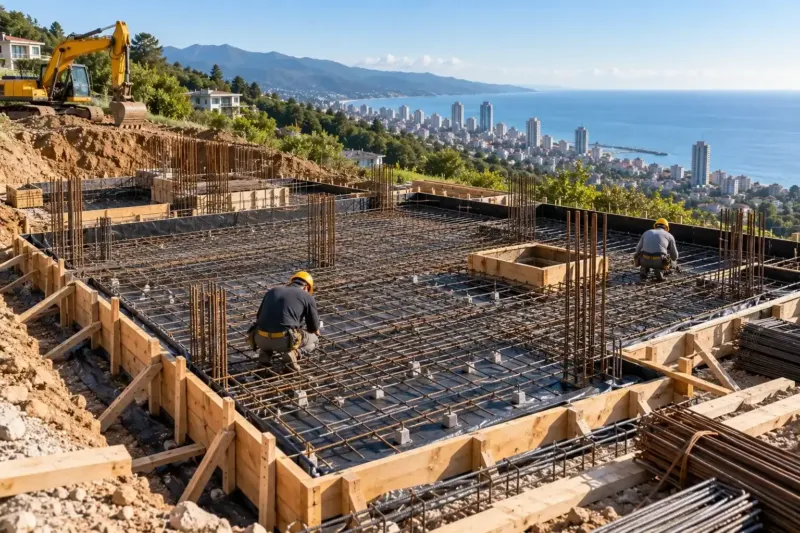
Bored piles in Batumi: drilling, cage, concrete
We make bored piles in Batumi without impacts or vibration, so they can go in next to neighbouring houses. A hole down to dense ground from the survey, lined with a casing tube in wet sand, a reinforcement cage over the full length and concrete placed from the bottom through a pipe. One reinforced pile costs from 540 ₾; ground beams and the survey are extra.
from 540 ₾/pcpile with drilling, cage and concrete; ground beams and soil removal extra. The final price is confirmed once agreed.
- Timeline: piles for a 120–150 m² house usually take 1–3 weeks of drilling, plus time for strength gain before the ground beams
- Warranty: Our work on the piles and pile heads has a 2-year warranty
Who it’s for
A house by the sea on wet sand, where the ground is too weak for a slab
An extension to an old house that cannot rest on the existing foundation
A retaining wall or terrace on a slope that needs support below the fill
The neighbour's house is a metre from the boundary, so piles cannot be driven
A pool on filled ground that cannot be left without support
What’s included
- setting out of drilling points by a surveyor
- drilling the holes, with casing in water
- making and placing cages with spacers
- concreting from the bottom through a pipe in one go
- pile log: depth, ground at the base, concrete volume
- trimming the pile heads and preparing starter bars for the ground beams
- photos of cages and pile heads in the report
Bored piles in Batumi: how one pile is made
A drilling rig bores a hole of the required diameter down to the dense ground from the survey report. A reinforcement cage on spacers is then lowered into the hole so it stays centred and does not touch the sides. Concrete is placed from the bottom through a pipe that is raised as the hole fills, pushing out water and slurry. Once the pile has gained strength its top is cut back to sound concrete and the starter bars are taken into the ground beams.
The work involves no impacts, so these piles can be made a metre from a neighbour's house or next to an old wall that must not be shaken. That is what sets them apart from driven piles, and from screw piles in that they carry both the heavy weight of a masonry house and the sideways load in an earthquake.
Wet ground and the casing tube
By the sea and in river valleys the hole often fills with water while it is still being drilled, and sandy sides collapse. Then the hole is lined with a casing tube: it goes down with the drilling and is pulled out once the concrete is in. Concreting such ground without a casing leaves necks and voids in the body of the pile, and that is almost impossible to check later.
So we place concrete continuously, without gaps between trucks, and each pile is concreted in one go. On wet plots we drill no more piles per shift than we can concrete the same day: a hole left open overnight has slumped by morning.
Diameter, length and reinforcement
The engineer sets the diameter, length and reinforcement of each pile from the load, the ground survey and seismic loads. In private houses these are usually small-diameter piles, but reinforced over their full length: in an earthquake a pile works not only under vertical load but also in bending near the top. We do not put a short cage only in the top part of a pile under a home.
If dense ground turns out deeper than in the report, we do not shorten the pile. The site foreman records the depth of every hole in a log, and the engineer decides whether to lengthen the piles or change the layout. This log, together with photos of the cages, goes into the handover file.
Where else bored piles are needed
Besides houses, we use these piles under retaining walls, heavy terraces on a slope, a pool on filled ground and an extension to an old house that cannot rest on the existing foundation. Strengthening an existing foundation can call for smaller drilled and grouted mini piles: they are drilled straight through the old strip, as described on the page about foundation underpinning.
What we check on every pile
- the position of the drilling point against the surveyor's setting out;
- the depth of the hole and the ground at its base compared with the survey;
- the cage: bar diameters, length, spacers;
- continuous concrete placement and the level of the pile top;
- the pile head after trimming: concrete without honeycombing, starter bars intact.
All of this goes into the pile log and is photographed. If you are running the build from abroad, on request the site foreman shows the drilling and concreting on a video call.
How much bored piles cost
One reinforced bored pile costs from 540 ₾: drilling, a casing tube if needed, the cage and concrete. Ground beams are priced separately, and a complete pile foundation with ground beams comes to from 300 ₾ per m² of house footprint. A drilled and grouted mini pile for underpinning costs from 810 ₾, soil removal from 39 ₾ per m³, the ground survey from 3,000 ₾. The final cost is set from the engineer's calculation, after a site visit and agreement on the estimate.
Stages and timelines
-
Setting out
1–2 days
The surveyor sets out the pile points from the house grid, and the pad for the rig is levelled.
-
Cages
3–5 days
We tie the cages to the drawings on site and check length and spacers.
-
Drilling
1–2 weeks
Holes down to dense ground, with casing in wet ground, and a depth log.
-
Concreting
on the day of drilling
Cage into the hole, concrete from the bottom through a pipe without breaks, casing pulled out.
-
Pile heads
2–4 days
Once the concrete has gained strength we cut the top back to sound concrete and straighten the starter bars.
Local specifics in Batumi
On reclaimed plots in Batumi and in the Chorokhi and Korolistskali valleys the top layer is often followed by sand and gravel with water. A hole slumps quickly here, and a pile cannot be made without a casing tube. So a pile by the sea usually costs more than on dense ground above the city, and that is already clear from the survey report.
The second local question is access. A large tracked rig will not fit along a narrow street in an old district or up the switchbacks in Makhinjauri, and then we bring a compact rig. It drills more slowly but does not require knocking down a fence or building a temporary track. On a slope we plan the drilling order from the top down, so the machine never stands above fresh piles on softened ground.
Materials and brands
Plant concrete with a batch certificate, fluid enough to fill the hole without voids when placed through a pipe. Its class and water resistance are set by the engineer. Cages of ribbed bar on round plastic spacers that hold the cover at the side of the hole. Casing tubes are reusable: they are pulled out, they do not stay in the ground and are not part of the pile price as material.
What makes up the cost
Timeline: piles for a 120–150 m² house usually take 1–3 weeks of drilling, plus time for strength gain before the ground beams
- removal of spoil from the holes
What raises the cost
- water and collapsing sand, casing tube
- long piles down to a deep dense layer
- a compact rig because of narrow access
- work right next to a neighbouring house
What lowers the cost
- dense dry ground at medium depth
- many identical piles on one plot
We prepare the exact estimate from measurements and photos. It’s free and comes with no obligation.
Get an estimateGuarantees
Our work on the piles and pile heads has a 2-year warranty. The pile log with depths and photos of the cages goes into the handover file. If another contractor made the piles for your house, we first take them over against a signed report.
Questions and answers
How much does one bored pile cost in Batumi?
From 540 ₾ per pile with reinforcement and concrete. The price depends on length, diameter and water in the ground: in wet sand a casing tube is needed, and the pile costs more. Ground beams, soil removal and the ground survey are priced separately. The final cost is set from the engineer's calculation, after a site visit and agreement on the estimate.
Can bored piles be made next to a neighbouring house?
Yes, that is why they are chosen in dense housing. Drilling causes no impacts or strong vibration, unlike driving. Before work we photograph the neighbour's walls along the boundary, and we agree drilling points near old foundations with the engineer so as not to weaken the ground under them.
What if the hole fills with water?
Line it with a casing tube and concrete from the bottom through a pipe, pushing the water out with concrete. Pumping the water out and pouring concrete from the top is wrong: the mix separates and voids appear in the pile. We do not leave a hole open overnight; it is concreted on the day it is drilled.
How can I check the quality of bored piles if I am abroad?
Through the pile log and the photos. The log records the depth, the ground at the base and the concrete volume for every pile, and the photos show the cage and the pile head. On request the site foreman shows the drilling and concreting on video. You can also send your own engineer to sign off; we will agree the timing with them.
What is the difference between a bored pile and a drilled and grouted mini pile?
A bored pile is larger in diameter and is built from scratch under a new house. A mini pile is thinner, drilled with a compact rig through an old foundation and filled with grout under pressure. It is used to strengthen an existing house where a large rig cannot be brought in.
Further reading
Send us the ground survey or photos of the plot: we will price the piles in 24 hours
We reply within an hour during business hours. Message us or leave a request: we’ll call you back, go over the details and suggest the next step.
Mon–Fri 10:00–19:00, Sat 11:00–16:00