
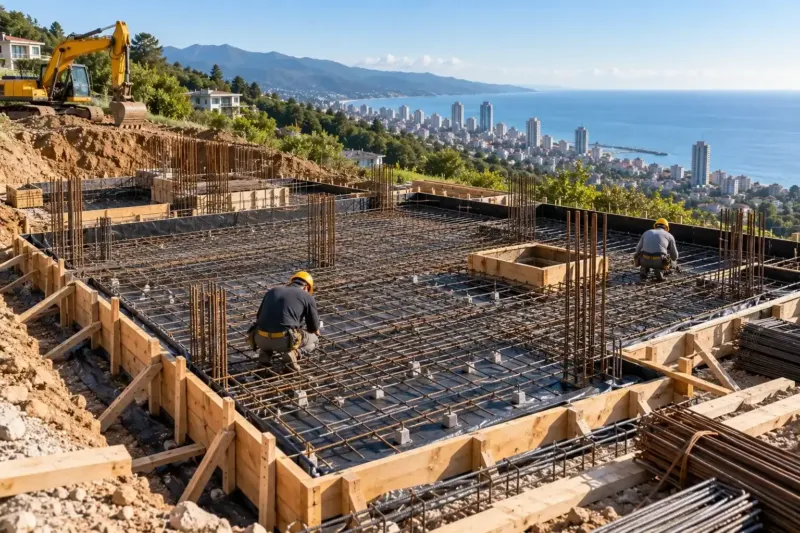
Screw piles in Batumi: for terraces, gazebos and light houses
We use screw piles in Batumi under terraces, gazebos, carports and light timber-frame buildings: no pit, no concrete and no heavy machinery, done in a day. By the sea we use thick-walled galvanised piles, fill the shaft with grout and build a frame on top. We do not put a masonry house on them. A pile with installation and head plate costs from 300 ₾.
from 300 ₾/pcpile with installation, grout in the shaft and head plate; frame extra. The final price is confirmed once agreed.
- Timeline: piles for a gazebo or carport usually go in within 1–2 days, for a terrace or light house within 2–5 days
- Warranty: Installation of the piles and frame has a 2-year warranty
Who it’s for
A timber terrace along the house where you would rather not pour concrete
A gazebo or pergola in the garden on soft ground
A carport on a sloping plot
A garden store or timber-frame sauna at a country house in Adjara
A temporary building that may be taken down later
What’s included
- site inspection and a trial pile on unfamiliar ground
- choice of piles by load, length and corrosion protection
- setting out the points from the building plan
- screwing in with control of verticality and depth
- cutting to one level with a surveyor's level
- filling the shaft with cement grout
- head plates and anti-corrosion paint on the cuts
- a frame of channel or timber to the design
What screw piles are suitable for
A screw pile is a steel tube with a helix at the end, screwed into the ground like a wood screw. It goes in within a day without concrete or heavy machinery, so it is handy where the load is light and you do not want to dig a pit: under a timber terrace, a gazebo or pergola, a carport, a garden store, a timber-frame sauna, a light timber-frame country house.
We do not put a masonry house by the sea on screw piles. A thin steel shaft rusts in wet salty ground, and the pile resists sideways movement poorly in an earthquake. For a house of blocks or cast-in-place concrete we use bored piles with ground beams.
Screw piles in Batumi: corrosion protection
By the sea the ground is damp all year and contains salt, so the life of a pile is set by how the steel is protected. We use piles with a thick shaft wall and a factory coating, preferably hot-dip galvanising. After installation the shaft is filled with cement grout: it pushes air and water out of the inside, and the tube can only rust from the outside. The cut above ground and the head plate are painted, and the section of pile at the boundary between ground and air, where corrosion is fastest, gets extra protection.
Cheap thin-walled piles with paint instead of zinc last noticeably less on the seafront than the building above them. So we write the make and wall thickness into the estimate and put the batch certificate into the project documents.
Ground and a trial pile
A screw pile needs ground the helix can grip: clay, loam, sand. In pebbles and rock the helix jams and tears, and in fill full of building rubble the pile goes in crooked. So on an unfamiliar plot we first screw in a trial pile and see at what depth the torque rises. For light buildings this is usually enough; for a timber-frame house the engineer asks for a ground survey.
If the trial pile hits rock at a shallow depth, it makes more sense to switch to a pier foundation or concrete footings.
Installation and the frame on top
We screw the piles in by hand with a lever or with a compact machine, keep them vertical with a level and make sure each one reaches the right ground. Then we cut the shafts to one level with a surveyor's level, fill them with grout and fit head plates. On top the piles are tied together by a frame of steel channel or glulam: without it the individual supports sway and the building settles unevenly.
Mistakes that make a building lean
- Piles screwed to the same depth regardless of the ground: some stand in the dense layer, some in fill, and the building settles unevenly.
- The shaft not filled with grout: condensation collects inside and the tube rusts from within.
- No frame, or one put together with self-tapping screws: the individual supports sway and the terrace deck skews over time.
- Head plates buried under soil or gravel: moisture stays against the steel all year round.
- Pile spacing taken by eye, without calculating the load from snow in the mountains or a heavy carport roof.
If there are already piles on the plot, we check their levels and the state of the cuts before building on top.
How much screw piles cost
A screw pile with installation and head plate costs from 300 ₾ each, and a frame of steel channel or timber from 110 ₾ per linear metre. For comparison, a reinforced concrete foundation pier is from 240 ₾ and a bored pile from 540 ₾. A 4×4 m gazebo usually needs 6–9 piles, a terrace along the house more; the number comes from a load calculation. The final cost is set after a trial pile on the plot and agreement on the estimate.
Stages and timelines
-
Inspection and trial pile
1 day
We look at the ground, screw in one pile and record the depth and torque.
-
Selection and order
2–5 days
We calculate the number of piles from the load and choose wall thickness and coating.
-
Setting out
1 day
We set out the points from the building plan and check the diagonals.
-
Installing the piles
1–2 days
Screwed in plumb, cut to one level, filled with grout.
-
Head plates and frame
1–3 days
We fit the head plates, paint the cuts and install the channel or timber frame.
Local specifics in Batumi
The weakest point of a screw pile in Batumi is the band at ground level, where the steel gets wet after a downpour and then dries out. The paint wears there first, especially if a lawn is watered nearby or water runs off a roof. We keep the frame clear of the ground, lead roof water off a gazebo away to one side and do not bury the head plates under soil or gravel.
In Gonio, Kvariati and Kobuleti many plots have pebbles and rock almost at the surface. A screw pile there often fails to reach the required depth, and that becomes clear with the very first trial pile. In the mountains of Adjara, by contrast, the ground can be dense and dry and piles hold well, but delivery and work on a steep slope are priced separately.
Materials and brands
Factory-made piles with a thick-walled steel tube shaft and a helix welded all the way round. By the sea we use hot-dip galvanising, not just paint. After installation the shaft is filled with cement grout. The frame is made of steel channel with anti-corrosion paint, or of treated glulam if the building is timber. The make of pile and the wall thickness are written into the estimate.
What makes up the cost
Timeline: piles for a gazebo or carport usually go in within 1–2 days, for a terrace or light house within 2–5 days
- a steel or timber frame
What raises the cost
- seafront: galvanising and a thick shaft wall
- long piles down to dense ground
- a heavy load and close pile spacing
- a slope and carrying piles to the spot by hand
What lowers the cost
- soft uniform ground without stones
- a light building with few supports
We prepare the exact estimate from measurements and photos. It’s free and comes with no obligation.
Get an estimateGuarantees
Installation of the piles and frame has a 2-year warranty. The piles themselves carry the manufacturer's warranty, and we hand you the batch certificate. Photos of depths and cuts stay in the project documents.
Questions and answers
How much does a screw pile with installation cost in Batumi?
From 300 ₾ per pile with installation and head plate. The price depends on length, wall thickness and coating: by the sea we use galvanised piles, which cost more than painted ones. The frame is priced separately, from 110 ₾ per linear metre. The final cost is set after a trial pile and agreement on the estimate.
How long do screw piles last by the sea?
It depends on the steel and its protection. A thick-walled galvanised pile with grout inside lasts a long time by the sea; a thin painted one noticeably less. Their life is shortened by constant moisture at the head and by cuts buried under soil. That is why we keep the frame clear of the ground and lead water away from the supports.
Can a house be built on screw piles in Batumi?
A light timber-frame country house can, to the engineer's calculation and after a ground survey. A masonry house by the sea cannot: a thin shaft rusts in salty ground and resists sideways movement worse in an earthquake. For such a house we use bored piles with ground beams or a slab.
What if a screw pile hits rock?
Do not force it further: the helix tears and the pile ends up skewed. If there is rock at a shallow depth across the whole plot, we switch to concrete piers or a pier foundation. If it is a single boulder, we move the point within what the frame allows, or put a concrete footing in that spot.
Do I need a permit for a gazebo on screw piles?
That depends on the class of the structure and the zoning rules, and it is decided from the registry extract for the plot. For a gazebo, carport or terrace we check the requirements with the architect and our partner lawyer before work starts. The piles themselves make no difference; what matters is what stands on them.
Further reading
Send us the building plan and photos of the plot: we will choose the piles in 24 hours
We reply within an hour during business hours. Message us or leave a request: we’ll call you back, go over the details and suggest the next step.
Mon–Fri 10:00–19:00, Sat 11:00–16:00