
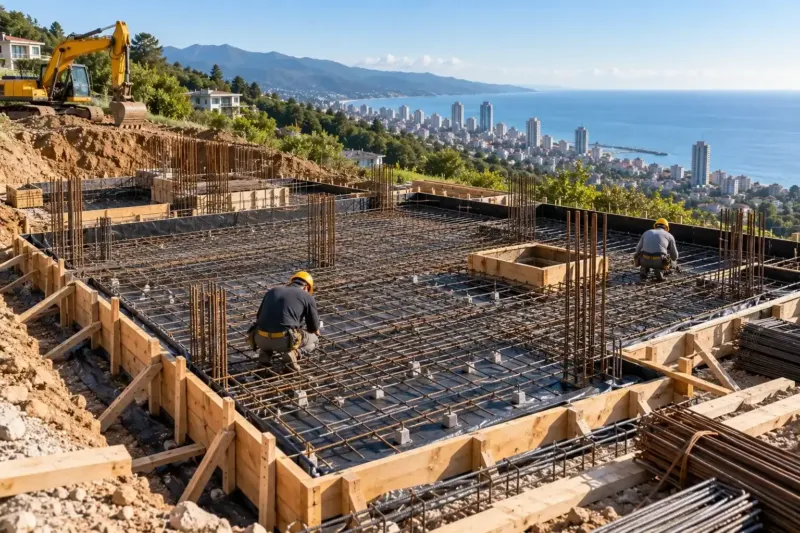
Insulated slab foundation in Adjara for a light house
An insulated slab foundation is a shallow cast-in-place slab on a continuous layer of insulation, with underfloor heating pipes and the sewer cast inside. In Adjara we offer it for a light timber-frame or block house on a level dry plot, and only after the engineer has checked it for seismic loads. The price is from 470 ₾ per m² of house footprint.
from 470 ₾/m²slab on insulation with underfloor heating and sewer pipes; drainage extra. The final price is confirmed once agreed.
- Timeline: an insulated slab for a 100–150 m² house usually takes 3–4 weeks from excavation to paved apron
- Warranty: 2 years on the work, 5 years on concealed pipes and wiring
Who it’s for
A timber-frame house on a level plot where you want underfloor heating without a separate screed
A SIP panel or light gauge steel house that does not need a heavy foundation
You are planning a heat pump and low-temperature heating
You have seen an insulated slab in another country and want to know if it suits seismic loads
You are comparing the estimate for an insulated slab and an ordinary slab with insulation on top
What’s included
- review of the survey and seismic design of the slab by the engineer
- shallow excavation and a bed in compacted layers
- sewer runs and sleeves for service entries
- insulation under the slab and edge elements
- reinforcement to the calculation
- underfloor heating pipes with a manifold and pressure test
- photos of the pipes under pressure and the reinforcement before the pour
- pouring the concrete and curing it
What an insulated slab foundation is
An insulated slab foundation, sometimes called a Swedish slab, is a shallow cast-in-place slab that rests on a continuous layer of rigid insulation. At the edges the insulation turns up in L-shaped elements, so the concrete is shielded from the ground on every side except the top. Underfloor heating pipes and the sewer runs are cast into the slab from the start, so after the pour you have a finished base with heating, on which the walls can go up straight away.
The system was developed for cold climates, where it matters not to lose heat into frozen ground. Winters in Batumi are mild and the heating saving is smaller, but the advantages remain: underfloor heating without a separate screed, a dry base and a short cycle on a level plot.
Insulated slab foundation in Adjara: where it fits
An insulated slab suits a light house of one or two storeys: timber-frame, SIP panel, light gauge steel or lightweight blocks. It needs a level plot with ground that carries the load without piles, and groundwater below the base. Then the slab on insulation lies shallow, and almost no excavation is needed.
Where we do not offer it:
- a slope, where the slab would need retaining walls and fill underneath;
- high groundwater by the sea, which would leave the insulation standing in water;
- a heavy masonry house in a cast-in-place concrete frame;
- ground where the survey calls for piles.
Seismic loads: why the engineer decides
The main question for an insulated slab in Georgia is earthquakes. The slab rests on insulation, not on the ground, and in an earthquake the horizontal force has to pass through that layer. For a light house an engineer can accept this by calculation; for a heavy one usually not. So we never take a standard Swedish system as it is: the engineer checks the slab against the seismic load for the plot under the Georgian code and, if needed, changes the insulation, the edge reinforcement or chooses an ordinary slab with insulation on top.
What we cast into the slab
Since the slab becomes the floor straight away, everything that goes into the floor is decided before the pour. Underfloor heating pipes are laid in circuits with a manifold, pressure tested and photographed under pressure. The sewer is run to the bathrooms and kitchen to the approved layout, and sleeves for water and cable go in at the entries. Moving a bathroom after an insulated slab is poured is almost impossible without opening the slab, so the room layout is approved before the insulation is laid.
The heat source for the underfloor heating is chosen in advance: a heat pump suits a low-temperature slab well. There is more on this on the page about energy-efficient houses.
Insulation and materials
We have hardly seen complete insulated slab systems with branded elements in Georgia, so we assemble the slab from available materials: extruded polystyrene of the right compressive strength under the whole slab, edge elements of the same material, cross-linked polyethylene pipes, reinforcement and concrete to the calculation. The insulation under the slab must carry the load for years without crushing, so we check its grade against the certificate, not the price.
How much an insulated slab foundation costs
An insulated slab foundation costs from 470 ₾ per m² of house footprint: bed, insulation, underfloor heating and sewer pipes, reinforcement and concrete. For comparison, an ordinary slab without insulation and pipes is from 390 ₾ per m². Plinth insulation from 75 ₾ per m², drainage from 87 ₾ per linear metre, the paved apron from 93 ₾ per m² and the ground survey from 3,000 ₾ are extra, as is the boiler or heat pump. The final cost is set after the engineer's calculation, a site visit and agreement on the estimate.
Stages and timelines
-
Design and layout
1–2 weeks
The engineer checks the slab for seismic loads, and we approve the bathroom layout and heating circuits.
-
Base
3–7 days
We strip the topsoil, lay and compact sand or crushed stone and lay the sewer.
-
Insulation
2–4 days
We lay the insulation boards and edge elements and check the levels.
-
Reinforcement and pipes
1 week
We tie the reinforcement, lay the circuits, pressure test the pipes and photograph everything.
-
Pour
1 day
Concrete in one shift with the pipes under pressure, the surface trowelled.
-
Paved apron and drainage
1 week
Edge protection, drainage round the house, a sloping paved apron.
Local specifics in Batumi
In Batumi cold is not the main problem; moisture is. The insulation under the slab must stay dry, so we do not use an insulated slab where groundwater rises to the surface after downpours. Drainage and a paved apron round the slab are essential, and the plot is graded so storm water flows away from the house.
The second local factor is heat. In summer underfloor heating is not needed, and a massive slab on insulation warms up slowly and stays cool, which is welcome in hot weather. If cooling through the floor from a heat pump is planned, the circuits and manifold are designed for both modes from the start, so condensation does not form on the floor on humid summer days.
Materials and brands
Under the slab, extruded polystyrene with the compressive strength the engineer specifies, and edge elements of the same material. Underfloor heating pipes of cross-linked polyethylene with an oxygen barrier and a manifold with flow meters. The sewer in pipes rated for buried use. Plant concrete with a batch certificate, ribbed reinforcement to the calculation. Between the insulation and the concrete we lay a sheet so cement laitance does not run into the board joints, and the insulation joints are taped.
What makes up the cost
Timeline: an insulated slab for a 100–150 m² house usually takes 3–4 weeks from excavation to paved apron
- heat source: boiler or heat pump
What raises the cost
- seismic loads: heavier edge reinforcement to the calculation
- circuits for both heating and cooling
- many bathrooms and sewer outlets
- drainage and paved apron on a damp plot
What lowers the cost
- a compact rectangular plan
- a level dry plot without fill
We prepare the exact estimate from measurements and photos. It’s free and comes with no obligation.
Get an estimateGuarantees
The slab and the underfloor heating installation have a 2-year warranty. Sewer and water pipes we lay in the slab have a 5-year warranty. The circuit layout and photos of the pipes under pressure go into the handover file.
Questions and answers
How much does an insulated slab foundation cost in Georgia per square metre?
From 470 ₾ per m² of house footprint with insulation, underfloor heating and sewer pipes, reinforcement and concrete. An ordinary slab without insulation and pipes is from 390 ₾ per m². Drainage, the paved apron, the ground survey and the heat source are extra. The final cost is set after the engineer's calculation and agreement on the estimate.
Can an insulated slab be used in a seismic area?
Only to the engineer's calculation for the specific house. The slab rests on insulation, and in an earthquake the horizontal force has to pass through that layer. For a light timber-frame house this is solved with reinforcement and the choice of insulation; for a heavy masonry house we usually choose another foundation.
Is an insulated slab worth it in Batumi if winters are warm?
The heating saving here is smaller than in the north, but the advantages remain: underfloor heating built into the slab, a dry base and a short build time. If the house is light and the plot level and dry, an insulated slab can be more convenient than a slab with a screed. If the plot is damp or on a slope, it does not suit.
Can an aerated concrete house go on an insulated slab?
A single-storey house of lightweight blocks sometimes can, if the engineer confirms it by calculation. A two-storey masonry house in a concrete frame is usually too heavy for a slab on insulation in a seismic area. Then we build an ordinary slab and put the insulation in the floor on top.
What if a bathroom needs moving in a house on an insulated slab?
The sewer and underfloor heating pipes are cast into the slab, so moving a bathroom means opening the slab or raising the floor. That is exactly why the plumbing layout and heating circuits are approved before the insulation is laid, and the layout with photos is kept in the handover file.
Further reading
Send us the house plan and photos of the plot: we will check whether an insulated slab suits
We reply within an hour during business hours. Message us or leave a request: we’ll call you back, go over the details and suggest the next step.
Mon–Fri 10:00–19:00, Sat 11:00–16:00