
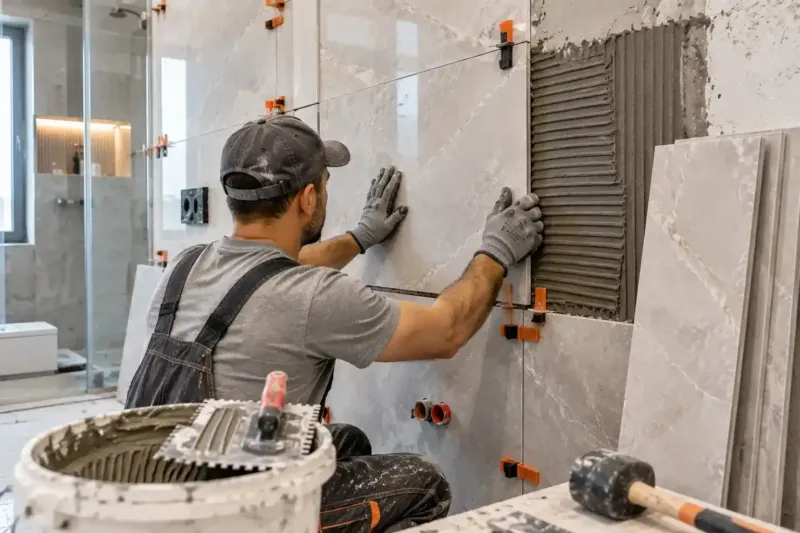
Tile installation in Batumi on walls and floors
Tile installation in Batumi: we lay ceramic tiles on bathroom walls and floors, kitchen splashbacks, and floors in hallways and storerooms. The work costs from 66 ₾ per m² on walls and from 72 ₾ on floors, and you buy the tiles and mixes yourself or we buy them from the materials list. Before laying we check the base with a straightedge and by tapping, choose the adhesive to suit the wall and the format, and lay every tile on a continuous bed of adhesive, with no voids under it.
from 66 ₾/m²laying ceramic wall tiles, labour only, tiles and mixes extra. The final price is confirmed once agreed.
- Timeline: 5–9 days for a 3–4 m² bathroom with tiles on the walls and floor over a ready base; a kitchen splashback in 1–2 days
- Warranty: Tile installation carries a 2-year warranty
Who it’s for
The bathroom tiles in your resale apartment sound hollow when tapped, and it is time to relay them on a new base
You need a kitchen splashback before the units arrive, and the kitchen fitter is waiting for a finished wall
Two tiles have cracked in an apartment you rent out, and they need replacing without relaying the whole wall
You have chosen metro tiles or herringbone and want to know in advance how many tiles will go into cuts
You have a white frame apartment with the developer's plaster, and it isn't clear whether tiles can go straight onto it
What’s included
- checking the walls and floor with a straightedge, by tapping and with a moisture meter
- priming, with a bonding primer on smooth concrete
- a support profile set to a laser level and marking out the rows
- laying on a continuous bed of adhesive, checking the back of the first tile
- straight and shaped cuts, holes for pipes and back boxes
- external corners with a trim profile or a 45° mitre
- grouting, silicone in corners and at junctions with the bath and shower tray
- removing old tiles and replacing single tiles from spares
The base: what tiles can be laid on
Tiles hold only as well as the layer under them, so before laying we tap the plaster and screed, check the walls with a straightedge and measure moisture. A hollow sound means the layer has come away from the wall, and the tiles would come off with it.
| Base | What we do before tiling |
|---|---|
| Cement plaster | We remove the dust and prime, and apply waterproofing in wet areas |
| The developer's gypsum plaster | In a dry room we prime it; in the shower and above the bath we strip it and replaster with a cement mix |
| Smooth cast-in-place concrete | We apply a bonding primer with quartz sand, otherwise the adhesive has nothing to grip |
| Moisture-resistant plasterboard | We prime it and tape the board joints with reinforcing tape |
| Old paint | We strip or score it and check that what remains is holding |
A wall for tiling has to be flat: no more than a 2–3 mm gap under a two-metre straightedge. A leaning wall can't be corrected with a thick bed of adhesive: as it shrinks, the adhesive pulls on the tile and leaves voids. If the deviation is greater, we first level the walls with plaster, and in a bathroom we apply waterproofing carried up the walls before tiling. In a resale apartment we take the old tiles off completely; how we handle the strip-out of old finishes in a residential building is described separately.
How we apply the adhesive and set the rows
We mix the adhesive with a paddle mixer, adding exactly the amount of water given in the data sheet. It goes onto the wall with a notched trowel, with the ridges combed in one direction, and each tile is set and slid across the ridges so that the adhesive forms a continuous bed. The bigger the tile, the bigger the trowel notch.
We lift the first tile on each wall straight away and look at its back. If the adhesive hasn't covered it completely, we change the trowel or add a thin layer to the tile itself. We never lay adhesive in dabs, even on a dry wall. Adhesive has an open time: once a skin has formed and your finger comes away dry, the tile will no longer bond, and that layer is scraped off.
We start each wall from the second row. We fix a support profile to a laser level line, work the rows upwards from it and add the bottom row last, at the height of the finished floor. That way the horizontal joints don't depend on an uneven floor or bath.
Layout and how much goes into cuts
| Layout | Cuts and waste | Where it fits |
|---|---|---|
| Straight, joint to joint | The least | Bathrooms, splashbacks, floors in any room |
| Offset, brick bond | Slightly more: tiles are cut at both ends of the row | Metro tiles and elongated tiles on walls |
| Diagonal | Every edge tile is cut, waste is noticeably higher | Hallway and lobby floors where the walls aren't parallel |
| Herringbone | Many angled cuts | A feature wall or a floor on display |
For any layout we first find the centre line: the middle of the wall, the centre of a window or a basin. The rows spread out from it to both sides, and the cuts at the corners come out equal. How the layout is coordinated with the plumbing outlets and where whole tiles are kept is covered in the overview of tiling work.
Cutting, holes and external corners
We cut ceramic tiles with a soft body on a manual tile cutter, and make an L-shaped cut-out for boxing or a pipe with a diamond blade. Holes for pipes are drilled with core bits 3–4 mm larger than the pipe: hot water makes a pipe expand, and a tile fitted tightly around it cracks. The gap is then covered by the tap's decorative cover plate.
A glazed ceramic tile has a light or reddish body, and on a 45° mitre it shows as a strip along the whole corner. So on ceramic tiles we more often finish external corners with a trim profile in the grout colour or with a metal finish. If you want a corner without a profile, we try a mitre on one tile before ordering: in some ranges the body is tinted and the corner looks neat, but there aren't many of them.
Laying faults that show at sign-off
- A tile sounds hollow when tapped. That is a void, and sooner or later the tile will crack from a knock or come away.
- You can feel a step between tiles with your palm, and a torch held against the wall casts a shadow at the edge. The tiles were set by eye.
- The joints drift off the horizontal towards a corner. The wall was started from the floor or the bath without marking a level line.
- A narrow strip of cut tile has been left by the door or on a visible wall. No layout was drawn, and the rows were started from the corner.
- A crack runs through several tiles in one line. Underneath there is an unreinforced joint or a crack in the screed.
- The grout has pinholes and patches of different shades. It was mixed by eye or washed off with a sponge that was too wet.
If we are called in to redo someone else's work, we first show you, in photos and by tapping, which tiles are holding and which will have to come off.
How much tile installation costs in Batumi
Laying ceramic wall tiles costs from 66 to 96 ₾ per m², and floor tiles from 72 to 110 ₾. That is the labour price: you buy the tiles, adhesive and grout yourself or leave the purchase to us. The tiles themselves cost from 69 to 110 ₾ per m². Grouting is a separate line, from 24 to 36 ₾ per m², and mitre cutting tiles at 45° costs from 100 to 130 ₾ per linear metre.
In a resale apartment the estimate also includes tile removal, from 24 to 30 ₾ per m², and two-coat bathroom waterproofing, from 30 to 42 ₾. Small formats, offset metro tiles, diagonal layouts and walls with boxing and outlets push the price up. A straight layout on flat walls that need no correction comes out lower.
We give the final cost after the site measurement and once the estimate is agreed, when the walls have been seen and the tiles chosen. The price of each stage is written into the contract, and it doesn't change unless the scope does.
Stages and timelines
-
Inspection and tapping
1 day
We check the walls and floor, tap the old plaster, measure the moisture of the screed and decide what needs correcting.
-
Levelling and primer
1–3 days
We correct leaning walls, apply a bonding primer to smooth concrete and reinforce the board joints on plasterboard.
-
Marking out and support profile
1 day
We transfer the layout onto the walls, mark a level line with a laser and fix a profile for the second row.
-
Tiling the walls and floor
3–6 days
We tile the walls upwards from the profile, then the floor and the bottom row, cutting and drilling on site.
-
Grouting and cleaning
1–2 days
We grout the joints once the adhesive has gained strength, apply silicone in the corners and wash off the haze.
Local specifics in Batumi
In white frame apartments the bathroom walls are often finished in gypsum plaster, and the partitions are built from aerated concrete blocks or plasterboard. Dry, porous block draws water out of the adhesive, which then fails to gain strength, so we prime the block until it is saturated, sometimes in two passes. Where block meets cast concrete, we reinforce the joint with mesh: the building is still settling, and within a year a crack along such a joint runs through all the tiling.
In winter, new-build apartments often stand unheated, the air in them is damp, and grout hardens slowly. If you wash it off with a wet sponge, pale patches and haze come up on the joints. We wash it off with an almost dry sponge, and between shifts we air the apartment or leave a dehumidifier running.
Kitchen splashbacks are often tiled when the kitchen units have already been ordered and are on their way. The kitchen fitter needs the height of the bottom row for the worktop, so we agree it with them before tiling.
Materials and brands
For ceramic tiles on a wall in a dry room, C1T adhesive is enough; in the bathroom, in the kitchen and on floors we use C2T from the Ceresit or Weber ranges, both available at Citadeli. We take the primer from the same brand as the adhesive: the manufacturer states in the data sheet which primer the adhesive bonds to.
We check the tiles box by box: the grade, calibre and shade must match on all of them, otherwise the rows will be a millimetre out and the wall will look patchy. It is best to choose a range you can buy more of by product code: Turkish Ege Seramik, Polish Cerrad and Spanish Azuvi and Realonda are available at Domino.
What makes up the cost
Timeline: 5–9 days for a 3–4 m² bathroom with tiles on the walls and floor over a ready base; a kitchen splashback in 1–2 days
- floor and wall tiling are separate lines in the estimate
What raises the cost
- small formats and metro tiles: more tiles and joints in every metre
- diagonal or herringbone instead of a straight layout
- removing old tiles and levelling the walls in a resale apartment
- external corners mitred instead of finished with a profile
- boxing, niches and many outlets on one wall
What lowers the cost
- flat developer's walls that take tiles without correction
- a straight joint-to-joint layout in a standard format
We prepare the exact estimate from measurements and photos. It’s free and comes with no obligation.
Get an estimateGuarantees
Tile installation carries a 2-year warranty. It runs from the date on the completion certificate. Tiles that come away or sound hollow because of the way we laid them, we take off and relay at our own expense. If the base was prepared by someone else, we record its condition in photos and in a certificate before we start, so that it is clear what we are responsible for.
Questions and answers
How much does tile installation cost per m² in Batumi?
Laying wall tiles costs from 66 to 96 ₾ per m², and floor tiles from 72 to 110 ₾. That is the labour price without materials: you buy the tiles, adhesive and grout yourself or leave the purchase to us. Grouting and waterproofing are priced as separate lines.
Small formats, metro tiles, diagonal layouts and bathrooms with boxing come out closer to the upper end. The final cost is set after the site measurement and once the estimate is agreed, and we send a preliminary estimate from photos and a plan within 24 hours on business days.
Can tiles be laid on plasterboard?
Yes, if the board is moisture-resistant and the frame is rigid. For tiling we place the studs closer together than usual, so that the board doesn't flex under the weight of the tiles, and fix it with screws at short spacings. Before laying we prime it, tape the board joints with reinforcing tape and, in a shower, apply a liquid waterproofing membrane over the whole surface.
If pipes run behind the board, we pressure-test them before boarding and leave an access hatch to the valves. Water on the back of the board soaks the gypsum unnoticed, and the tiles come away before any stain appears.
Why do tiles come away from the wall?
Most often the tiles were laid on dabs of adhesive and held on just a few points. Other causes: the wall wasn't primed, and the adhesive went onto dust; the tile was pressed into adhesive that had already skinned over; underneath there is gypsum plaster that water has reached, or old paint that came away together with the tiling.
A single loose tile can be refixed once the old adhesive has been removed. If the tiles around it sound hollow too, we tap the whole wall: the cause is usually the same, and the area has to be relaid back to a sound base.
Can one cracked tile be replaced?
Yes, if there is a tile from the same batch. We cut out the grout around it with a grout rake, break the tile from the centre towards the edges so as not to damage its neighbours, and scrape the old adhesive back to the base. The new tile is set flush with the ones around it, and with a rapid-setting adhesive we grout it the same day.
If there are no spares, we look for the range by the product code in the handover file. When it is no longer made, we move a tile from an inconspicuous spot, for example from behind the washing machine or under the bath, and put a similar one there.
Can tiles be laid on a painted wall?
Not on water-based emulsion paint: the adhesive holds onto the paint, but the paint holds onto the wall much more weakly, and the tiling will come away with it. We wash this kind of paint off or sand it away. Dense oil or acrylic paint that is firmly bonded is scored with a mesh, dusted off and primed with a bonding primer.
Checking whether paint is holding is easy: cut a cross into it with a knife, stick masking tape over the cut and pull it off sharply. If paint comes away on the tape, all of it is removed. In a bathroom in a resale apartment, we always strip the paint under tiles back to the plaster.
Further reading
Photograph your bathroom or splashback, and we'll send a tiling estimate within 24 hours on business days
We reply within an hour during business hours. Message us or leave a request: we’ll call you back, go over the details and suggest the next step.
Mon–Fri 10:00–19:00, Sat 11:00–16:00