
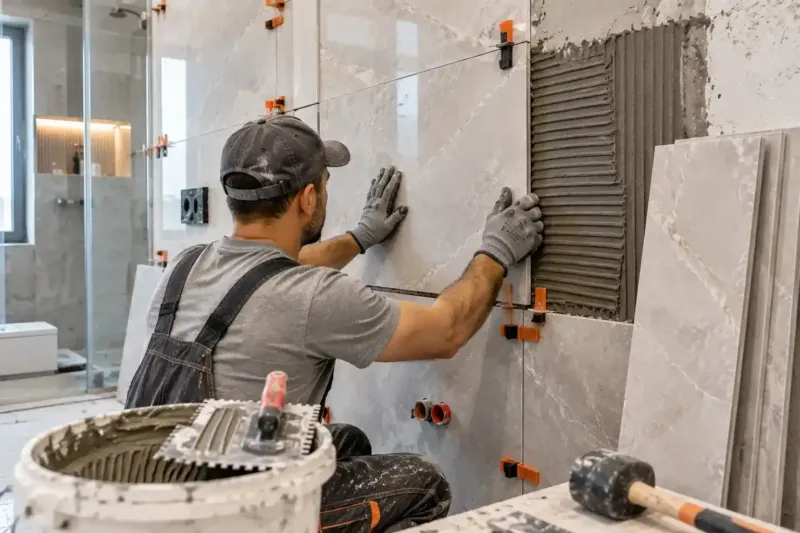
Mosaic tile installation in Batumi: showers, niches, splashbacks
Mosaic tile installation in Batumi covers shower floors and walls, niches, benches, kitchen splashbacks and curved walls, where tiles can only go with a great many cuts. We lay glass, ceramic and stone mosaic on mesh and on paper, and in wet areas we grout with epoxy. Laying costs from 140 ₾ per m² without materials, and grouting is a separate line: a square metre of mosaic has dozens of times more joints than a square metre of tiles.
from 140 ₾/m²laying only: grouting, mosaic and adhesive are priced separately. The final price is confirmed once agreed.
- Timeline: 2–4 days of laying and 1–2 days of grouting for a shower with about 10 m² of tiling, once the waterproofing is done
- Warranty: A 2-year warranty on mosaic laying and joint grouting
Who it’s for
A shower without a tray with a point drain, where you want a floor without diagonal tile cuts
A niche, bench or curved wall in the shower that tiles can't cover neatly
A kitchen splashback in glass mosaic, where the joints mustn't darken from grease
Old mosaic in the shower has darkened at the joints and is coming away from the wall in places
A hammam or steam room in a house or hotel, where the tiling hardly ever dries out
What’s included
- checking the walls and floor for flatness, finishing the base for small chips
- waterproofing the wet area with tape in the corners
- a layout from the centre lines of the mixer, niche and drain
- laying the sheets on white or epoxy adhesive
- cutting along the joints and nipping chips at corners, the drain and outlets
- removing the paper and adjusting chips in the fresh adhesive
- tiling niches, benches and curved surfaces
- epoxy or cement grout, depending on the area
- cleaning grout haze off the face
Types of mosaic and what depends on them
Mosaic is sold in sheets of about 30×30 cm made up of chips from 1×1 to 5×5 cm. The sheet is held together either by mesh on the back or by paper on the face, which is soaked and peeled off after laying while the adhesive still lets you adjust a chip.
The chip material decides the adhesive and the tools:
- glass is translucent and the colour of the adhesive shows through it, so the adhesive has to be white, and glass is cut with nippers that have carbide wheels;
- ceramic mosaic is opaque and behaves like small tiles;
- stone mosaic is porous, so we seal it before grouting, otherwise the grout pigment soaks into the stone.
The base: mosaic shows every irregularity
A mosaic sheet follows the base like fabric. A bump nobody would notice under a 60×60 tile shows up on glass mosaic as a glint under the shower light. Mosaic adhesive goes on in a thin bed, and it won't hide pits and lumps in the wall.
That is why walls for mosaic are plastered to guide beads and brought to a smooth surface, and in the shower only with a cement mix. Over it, in the wet area, goes waterproofing with tape in the corners, and we use a mosaic adhesive that the manufacturer approves for that waterproofing.
Adhesive: white, a thin bed, a small notch
We lay glass mosaic only on white adhesive. Grey cement shows through glass, and light mosaic looks dirty, or patchy where the adhesive bed is uneven.
We spread the adhesive with a small-notch trowel, 3–4 mm, and under clear glass we smooth out the ridges so that they don't show through the chips. Adhesive squeezed into the joints is cleaned out at once while it is still soft: on mosaic, a joint with set adhesive in it stays shallow, the grout goes in thin, and that joint comes out lighter than the ones next to it.
Tiling that hardly ever dries out, for example in a steam room, goes on epoxy adhesive, which can take constant water.
Mosaic tile installation in Batumi: sheets, joints and cutting
We set out the mosaic from the main centre line: the mixer, the centre of a niche or the edge of a bench, so that the cut pieces end up in the corners and under the ceiling. If a strip half a chip wide is left at a corner, we shift the layout.
We keep the joint between sheets the same as the joint within a sheet, otherwise the wall gets marked out in 30×30 squares. We check the rows with a string line as we go and correct any sheet that has shifted while the adhesive is fresh.
A sheet on mesh is cut with a knife between the rows, and individual chips are cut with nippers. Murals and colour blends in several shades arrive with numbered sheets: before laying, we set them out on the floor following the manufacturer's plan and photograph them, so that no sheet goes in upside down.
Epoxy grout in the shower and on the splashback
In the shower, on the bathroom floor and on the splashback by the hob, we grout mosaic with epoxy grout. On mosaic the choice of grout matters more than on tiles: a square metre of 2×2 cm mosaic has about 90 linear metres of joint, while a square metre of 60×60 tiles has just over three. In a wet area, cement grout soaks up water and soap through that whole grid, and the wall darkens in a check pattern. There is a general table of grouts in the section on tiling.
We work the epoxy in with a rubber float diagonally to the rows, so as not to drag it out of the joints, in sections of about a metre at a time, and wash the residue off the face straight away. With clear glass, the joint colour shows through the edge of each chip, so we choose the grout on a sample from the same sheet: a dark joint turns light glass grey. How the splashback meets the worktop and the sockets is covered on the page about kitchen renovation.
Mosaic on the shower floor, in a niche and on a bench
For a point drain, the floor is formed with four falls, and large tiles have to be cut diagonally along the fall lines. Mosaic doesn't need this: a 2×2 cm chip on a fall of about 2% gives a step of less than half a millimetre, and the sheet sits on the falls without any cuts. On the floor we use matt mosaic, as glossy glass is slippery under water. The fall and the choice of drain are described on the page about the shower without a tray.
We tile niches, benches and curved walls without metal trims: the sheet bends to the radius, and the smaller the chip, the tighter the curve it follows without gaps. We build external corners from whole chips, and give the bench seat a fall outwards so that water doesn't stand on it.
How to sign off mosaic
We sign off mosaic before the water in the shower is turned on:
- step back three or four metres: from there you can see whether the joint between sheets differs from the joint within a sheet;
- shine a torch along the wall: on glass, waves in the base come through as glints;
- the joints are filled to the same depth, with no dips and no adhesive showing in them;
- the glass has no cloudy haze or grout smears;
- the chips don't move under a finger at corners, along the edges of niches and by the drain.
How much mosaic tile installation costs in Batumi
Laying mosaic costs from 140 to 190 ₾ per m². That is labour only: the mosaic, adhesive and grout mix are not included, and mosaic grouting as a job is a separate line, from 48 to 66 ₾ per m². It costs more than grouting tiles because of the number of joints.
Mosaic as a material costs from 215 to 360 ₾ per m², and glass, ceramic and stone vary widely in price. If the wall has to be replastered for mosaic, sand and cement plaster adds from 51 to 66 ₾ per m², and two-coat shower waterproofing from 30 to 42 ₾ per m².
Niches, benches and curved walls, murals to a plan and small glass chips cost more, while a flat wall of ceramic mosaic with large chips costs less. The final cost is set after the site measurement and once the estimate is agreed.
Stages and timelines
-
Site measurement and choosing the mosaic
1 day
We look at the walls and floor, decide where mosaic goes and where tiles do, and which adhesive the chosen material needs.
-
Plastering and waterproofing
3–5 days
We plaster or correct the walls with a cement mix to a smooth plane, waterproof the wet area and test it.
-
Layout
1 day
We set the sheets out on the floor, murals by their numbers, mark the centre lines on the walls and send you a photo of the plan.
-
Laying the sheets
2–4 days
We lay the sheets on a thin bed of adhesive, even out the joints between sheets, remove the paper and adjust the chips.
-
Grouting and cleaning
1–2 days
We grout section by section and wash off the residue at once; the next day we remove the film with a cleaner.
-
Sign-off
1 day
We look at the wall from a few metres away and in raking light, run a finger along the corners and the edges of niches, and sign the certificate.
Local specifics in Batumi
Epoxy grout is sensitive to temperature. In July and August, in an apartment on the sunny side, it thickens within minutes, so we grout in the morning in smaller sections and shade the windows from direct sun. In an unheated apartment in winter, on the other hand, it becomes stiff and takes a long time to harden, so we warm the room with the air conditioner before we start.
Many seafront apartments are let out for short stays, and the shower gets cleaned with whatever is to hand, often an acidic product. Cement joints in mosaic wash out and darken from this faster than on large tiles, while epoxy joints hold up. For these apartments we recommend ceramic or glass mosaic, and leave stone mosaic for places where the owner looks after it personally.
In hotels and aparthotels, mosaic is used to line hammams and steam rooms. The tiling there hardly ever dries out, so it needs waterproofing and a vapour barrier for the whole chamber and an adhesive designed for constant moisture. We therefore price these rooms from a design.
Materials and brands
White adhesive for glass mosaic comes from Ceresit or Mapei, and for tiling that hardly ever dries out we use Mapei or Litokol epoxy adhesive. Epoxy grout comes from the same two brands, and we buy the cleaner for it from the same brand at the same time as the grout.
We choose the mosaic itself from a sample of a whole sheet: a photo shows neither the gap between the chips nor how the mesh is glued on. We also check that the shade is the same in sheets from different boxes. You choose the brand of mosaic, and we'll tell you whether it suits the place where it is going.
What makes up the cost
Timeline: 2–4 days of laying and 1–2 days of grouting for a shower with about 10 m² of tiling, once the waterproofing is done
- grouting is priced separately and grows with the number of joints
What raises the cost
- small glass chips on white adhesive
- niches, benches, columns and curved walls
- murals and colour blends to the manufacturer's plan
- epoxy adhesive for tiling that hardly ever dries out
- removing old mosaic and replastering underneath
What lowers the cost
- a flat wall of ceramic mosaic with large chips
- mosaic only in a niche or as a band, with tiles everywhere else
We prepare the exact estimate from measurements and photos. It’s free and comes with no obligation.
Get an estimateGuarantees
A 2-year warranty on mosaic laying and joint grouting. If chips come away or joints crack because of our work, we redo that area at our own expense. Scratches on glass from abrasive cleaners and damage from impacts are not warranty cases. The mosaic, adhesive and grout come with the manufacturer's warranty.
Questions and answers
How much does mosaic tile installation in Batumi cost per m²?
Laying mosaic costs from 140 to 190 ₾ per m², and that is labour only. Grouting is priced separately, from 48 to 66 ₾ per m². You buy the mosaic, adhesive and grout as materials yourself, or ask us to buy them as a separate line in the estimate.
Niches, benches, curved walls, small glass chips and murals to a plan push the price towards the upper end. Send photos and measurements of the wall or shower, and you'll get a preliminary estimate within 24 hours on business days. The final cost is set after the site measurement and once the estimate is agreed.
Which mosaic is better for a shower: on mesh or on paper?
Both work on walls outside the splash zone. For the floor and walls of a shower, paper-faced mosaic is more reliable: the back of every chip is free and beds fully into the adhesive. With mesh-backed mosaic, we look at how the mesh is attached to the chips. If it is glued on in dots, the sheet holds well, but if the whole back is coated in glue, the bonding area is smaller, and we don't put that kind of sheet in an area that is constantly wet.
Paper-faced mosaic takes longer to lay: the paper is soaked and peeled off, and the chips are adjusted in the fresh adhesive. On the other hand, you see the face straight away, and a shifted row is noticed before grouting.
How do you clean epoxy grout off mosaic?
While the grout is fresh, it is washed off with water and a sponge made for epoxy products, changing the water often: cloudy water leaves a new film on the glass. The next day a thin haze appears on glossy surfaces, and only a cleaner for epoxy grout removes it. It is applied according to the instructions, left for the specified time, wiped with a white non-abrasive pad and rinsed off with clean water.
Acidic products don't touch epoxy, and a rough sponge or scouring powder scratches the glass. A film that has been left to harden for weeks takes several passes of the cleaner. That is why we go over the whole surface with it before sign-off, while the haze is still thin.
Why can you see the squares of the sheets in a mosaic?
The joint between sheets differs from the joint within a sheet. The sheets were butted up or laid with too wide a gap, the rows weren't checked with a string line, and a 30×30 grid shows across the whole wall. There is another possible cause: sheets from different boxes differ slightly in shade, and they weren't mixed before laying.
While the adhesive is fresh, a sheet can be moved into place in a minute. After grouting, the only fix is relaying the area. Close up the squares are easy to miss, so look at the wall from a few metres away in ordinary light, before grouting and again at sign-off.
Is mosaic slippery in a shower?
Usually less so than large tiles with the same surface. Mosaic has a lot of joints, and a wet foot grips on them, which is why mosaic is laid on shower floors and poolside walkways. A lot depends on the chip: glossy glass is slippery under water, so for floors we use matt ceramic, stone or glass mosaic with an anti-slip surface.
The second condition is that water mustn't stand, so we check the fall to the drain with a bucket of water before laying. Epoxy joints are easy to clean of the soap scum that makes a floor slippery.
Further reading
Send photos of your shower or splashback, and we'll price the mosaic laying within 24 hours
We reply within an hour during business hours. Message us or leave a request: we’ll call you back, go over the details and suggest the next step.
Mon–Fri 10:00–19:00, Sat 11:00–16:00