
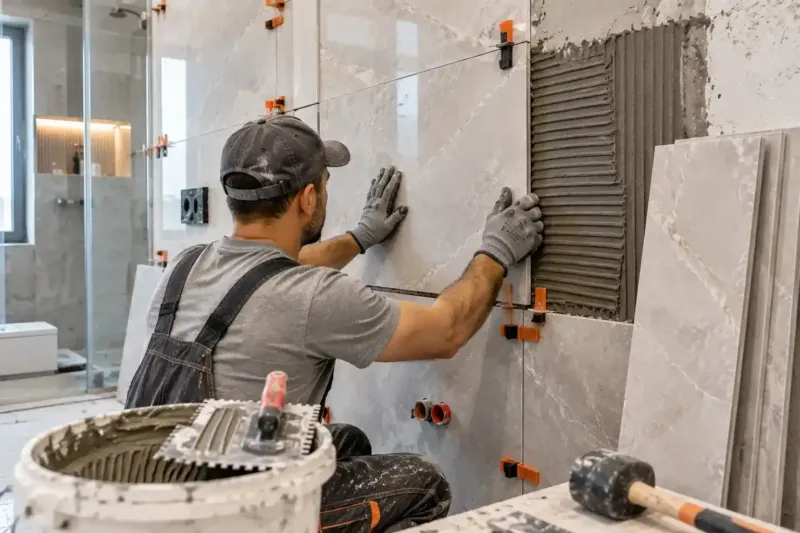
Natural stone installation in Batumi: marble and travertine interiors
Natural stone installation in Batumi: marble, travertine and granite for floors, bathroom walls and stairs. We choose the stone with you from the slabs of a specific batch, lay it on white adhesive, and after laying grind the joints flush and seal the surface against stains. Labour costs from 93 ₾ per m², and the stone, adhesive and polishing are priced separately. At the site measurement we'll tell you where the stone you have chosen will last and where it makes more sense to replace it with porcelain tiles.
from 93 ₾/m²laying only: stone, adhesive, grinding and polishing are priced separately. The final price is confirmed once agreed.
- Timeline: 1–1.5 weeks for a 15 m² floor in marble tiles: laying, a pause while the adhesive gains strength, grinding and sealing
- Warranty: A 2-year warranty on stone laying and the joints
Who it’s for
You want marble walls in the bathroom and worry that light stone will turn yellow or darken at the joints
You've bought travertine for the living room floor and are deciding whether to have the pores filled or keep the texture
A marble floor in a resale apartment has lost its shine, with dull patches and lips between the tiles
A stone staircase in a house: you need steps with a neat edge and without slippery polish
You live abroad and want to choose the stone slabs from a warehouse video before laying
What’s included
- choosing slabs from the batch at the warehouse or by video
- a dry lay with numbered slabs and the pattern agreed with you
- waterproofing under the stone in the bathroom and shower
- laying on white rapid-setting or reactive adhesive
- wet-saw cuts, mitres on the corners of niches and reveals
- grouting to match the stone after a first coat of sealer
- grinding the joints, polishing or a matt finish
- sealing after grinding, and a care guide
- protecting the surface until the end of the renovation
Which stone goes where
Marble, travertine and limestone are soft and consist mainly of calcium carbonate: sand scratches them, and acid dissolves the surface. Granite and quartzite are harder, and household acids barely affect them. Onyx is brittle and translucent, and it is used on backlit walls.
| Stone | Where it works well | Where to be careful |
|---|---|---|
| Marble | Bathroom walls, floors in rooms, stairs in a house | A hallway floor that gets sand on it, a polished shower floor |
| Travertine | Walls, floors in rooms, a shower if the pores are filled | An open balcony by the sea, where salt settles in the pores |
| Granite and quartzite | Hallway and stair floors, window sills, a balcony | A polished floor in wet areas |
| Onyx | Backlit walls and counters | Floors and places where the stone may get knocked |
Choosing slabs from the batch and a dry lay
A showroom sample shows the type of stone, but every slab has its own pattern and shade. That is why we choose stone from a specific batch: we look at the slabs at the warehouse together with you, or send a video of each slab if you are abroad.
Before laying, we set the slabs out on the floor without adhesive and move them around until the veins sit calmly, then number the backs. We order more spare stone than we would for porcelain tiles: a year later the same batch is usually impossible to find. On a bathroom wall, slabs are sometimes book-matched, so that neighbouring slabs mirror each other's pattern. For this they are cut in sequence from one block, and a batch like that is ordered in advance.
Base and adhesive: why white
Light marble is translucent to a depth of several millimetres, and grey cement shows through it as a shadow. That is why we lay marble and light travertine on white adhesive.
Stone also absorbs water from the adhesive. If the adhesive takes a long time to dry, the water carries salts and iron compounds to the face, and yellow and rust stains appear on white marble. For these types we use a white rapid-setting adhesive. Stone that warps when wet, such as some green marbles, goes on a two-component reactive adhesive that contains no water.
We apply adhesive to both the base and the back of the slab, because marble over a void cracks on impact. We prepare the base the same way as for large-format porcelain: a heavy slab can't be levelled over an uneven base with adhesive. In a bathroom we always put waterproofing carried up onto the walls under the stone, because stone and its joints let water through.
Natural stone installation in Batumi: joints and cuts
We lay polished marble with a narrow joint, 1–2 mm, and a grout that matches the stone. A wide joint chops the pattern up into squares.
We cut with a wet saw and a diamond blade: on a dry cut the edge of soft stone crumbles, and the pores of travertine break out. We try not to leave a narrow strip at a cut running along a vein, as a strip like that often snaps along the vein. We order steps with a ready-made rounded edge to our measurements, and mitre the corners of niches and reveals.
Grinding, polishing and sealing after laying
Stone tiles are less precisely calibrated than porcelain, and lips of a fraction of a millimetre remain between neighbouring tiles. On a floor, grinding removes them: once the adhesive has gained strength, the floor is gone over with a machine fitted with diamond pads, from coarse grit to fine, and the joints disappear.
Then we polish the surface to a shine or leave it matt. In an apartment by the sea we more often recommend matt: scratches from sand and acid marks show less on it, and when wet it is less slippery than polished stone.
An impregnating sealer soaks into the pores and doesn't form a film on the surface. We seal travertine and light marble before grouting, so that the grout pigment doesn't get into the pores, and seal them again after grinding.
What damages stone in an apartment
In the bathroom, the main acids come in bottles: limescale removers, toilet cleaners and products for glass shower screens. In the kitchen it is lemon, wine and vinegar, and on the hallway floor, sand. A sealer protects against stains but not against acid: a dull mark is left even on sealed marble. If a cleaner looks after the apartment, the stone needs a note on how to clean it and a pH-neutral product kept nearby, which is what we do for cleaning between guests as well.
For a short-term rental apartment, we recommend stone for walls only. For the floor and the worktop, marble-look porcelain is the better choice: guests don't read notes, and a glass of wine on polished marble leaves a mark within an evening.
How to sign off stonework
We sign off stone in daylight and with a torch:
- light stone has no grey shadows from the adhesive and no rust stains;
- after grinding, the floor is smooth at the joints, and the shine or matt finish is even across the whole area;
- the joints are narrow and straight, the grout matches the stone, and there is no cloudy haze in the pores of travertine;
- tapping reveals no hollow areas, especially at the corners and on steps;
- a drop of water on the sealed surface beads up and doesn't darken the stone.
How much natural stone installation costs in Batumi
Laying marble and travertine costs from 93 to 145 ₾ per m². That is labour only: the stone, adhesive and polishing are not included. Stone grinding, polishing and sealing after laying is a separate line, from 51 to 72 ₾ per m².
Material prices vary widely: travertine costs from 81 to 110 ₾ per m², and marble from 310 to 420 ₾ per m². The laying price goes up with walls and steps, large slabs, book-matching and work with reactive adhesive. A floor in a rectangular room in calibrated tiles with a bevelled edge, which don't need grinding, comes out cheaper. The final cost is set after the site measurement and once the estimate is agreed.
Stages and timelines
-
Site measurement and choosing the stone
1–3 days
We look at the base and the room, choose the type of stone and the slabs from the batch together, and decide whether the surface will be polished or matt.
-
Dry lay
1 day
We lay the slabs out without adhesive, match the pattern, number the backs and agree the plan with you from photos.
-
Base and waterproofing
2–4 days
We level the floor and walls, apply two coats of waterproofing in the wet area and test it.
-
Laying and grouting
3–5 days
We lay the slabs in numbered order on white adhesive, seal porous stone and grout the joints to match.
-
Grinding and sealing
2–3 days
Once the adhesive has gained strength, we grind the joints, polish the surface or give it a matt finish, and seal it.
-
Sign-off
1 day
We check the stone with a drop of water, raking light and tapping, and hand over the care guide.
Local specifics in Batumi
By the sea, salt settles on everything outdoors. In porous travertine and limestone on an open balcony it crystallises in the pores, and over time the surface starts to flake. That is why for an open balcony or terrace on the beachfront we recommend granite or porcelain tiles, and if the owner wants travertine, we seal it and advise rinsing it with fresh water once a season.
In winter, in a damp apartment, the adhesive under stone takes longer to dry, and the risk of stains on light marble rises. At that time of year we work only with white rapid-setting adhesive, and after laying we air the room or run a dehumidifier.
Georgia lies in a seismically active zone. Heavy slabs on a wall above head height and fireplace surrounds are secured with stainless steel mechanical fixings as well as adhesive. A marble slab 2 cm thick weighs more than 50 kg per square metre, and in a tremor it must not fall.
Materials and brands
White adhesive for marble comes from the Ceresit and Mapei ranges. Types that warp when wet need a two-component reactive adhesive: we check the specific product and whether it is available in Georgia for the chosen stone before the stone is ordered. We choose the sealer for the type of stone and test it on an offcut from the same batch: some products darken the stone slightly or give it a wet look, and it is better to see that before the whole floor has been sealed.
Stone itself has no brand. It is chosen by type, quarry and batch, and we record the supplier and batch number in the handover file, so that in a few years there is somewhere to start when looking for a replacement slab. For care, we leave a pH-neutral product in the apartment.
What makes up the cost
Timeline: 1–1.5 weeks for a 15 m² floor in marble tiles: laying, a pause while the adhesive gains strength, grinding and sealing
- finish: polishing to a shine takes more passes than a matt finish
What raises the cost
- walls, steps and window sills instead of floors
- large slabs and book-matched patterns
- reactive adhesive for types that warp when wet
- mitres on steps, niches and reveals
- mechanical fixing for heavy slabs on walls
What lowers the cost
- calibrated tiles with a bevelled edge that don't need grinding
- a rectangular room without niches or steps
We prepare the exact estimate from measurements and photos. It’s free and comes with no obligation.
Get an estimateGuarantees
A 2-year warranty on stone laying and the joints. If a slab comes away, cracks over a void or a joint opens up because of our work, we relay it at our own expense. Natural veins, pores and differences in shade between slabs are not defects, and neither are dull marks from acids or scratches from sand. The stone, adhesive and sealer come with the supplier's and manufacturer's warranty.
Questions and answers
How much does marble installation in Batumi cost per m²?
Laying marble and travertine costs from 93 to 145 ₾ per m², and that is labour only. Grinding, polishing and sealing after laying is a separate line, from 51 to 72 ₾ per m², and the stone and adhesive are priced separately too.
Walls and steps, large slabs and pattern matching push the price towards the upper end. Send photos of the room, the measurements and the type of stone if you have already chosen it, and you'll get a preliminary estimate within 24 hours on business days. The final cost is set after the site measurement and once the estimate is agreed.
Can a shower be finished in marble?
Yes, if you are prepared to follow the care rules. On shower walls we lay marble over waterproofing, and for the floor we use matt or textured tiles, because polished ones are slippery under water. We seal the stone before and after grouting, and fill the joints with a product the manufacturer approves for natural stone in wet areas.
After that, everything comes down to cleaning. Drops left after a shower are best removed with a squeegee, and limescale with a pH-neutral product: an acidic limescale remover leaves dull patches on marble after a single clean. In a shower the sealer has to be renewed more often than in the rooms.
How often should marble and travertine be sealed?
The sealer manufacturer gives an interval, but a drop test is more reliable. Put a drop of water on the stone where it gets the most use: by the basin, in the shower, in a walkway. If the stone under the drop has darkened after a couple of minutes, water is getting into the pores, and it is time to renew the sealer.
In the shower and by the basin this can be needed after just a year, while on walls in the rooms the sealer lasts noticeably longer. Before renewing it, the stone is washed with a neutral product and left to dry, otherwise the sealer locks dirt into the pores. Polished marble absorbs less than travertine, so the sealer lasts longer on it.
How do you remove a dull mark from marble?
A dull mark on polished marble is almost always left by acid: lemon, wine, vinegar, a limescale remover. It isn't dirt: the surface has dissolved in that spot, and it can't be washed off. The mark is removed by spot polishing, with a craftsman working the area with polishing pads or powder until the shine matches the stone around it.
A dark stain from oil or cosmetics is treated differently, with a poultice, a paste that draws the contamination out of the pores, sometimes over several applications. If there are a lot of marks, it is simpler to polish the whole slab or the whole floor. We do this as a separate job, and it isn't covered by the warranty, because it is damage from use.
Filled or unfilled travertine: which should you choose?
For floors, bathrooms and kitchens we use filled travertine. The pores are filled at the factory with resin or a cement-based compound in a matching colour, and then the slab is ground, giving a smooth surface: sand and soap don't get trapped in it, and it is easier to clean and seal.
Unfilled travertine with open pores looks beautiful on a wall where nobody walks on it or gets it wet. If tiles like these are laid on a floor, we fill the pores on site with matching grout, and that takes extra time. In a shower, open pores quickly collect soap scum and darken, so we don't recommend it there.
Further reading
Send photos of the room and the stone, and we'll tell you where it will last and price the laying
We reply within an hour during business hours. Message us or leave a request: we’ll call you back, go over the details and suggest the next step.
Mon–Fri 10:00–19:00, Sat 11:00–16:00