
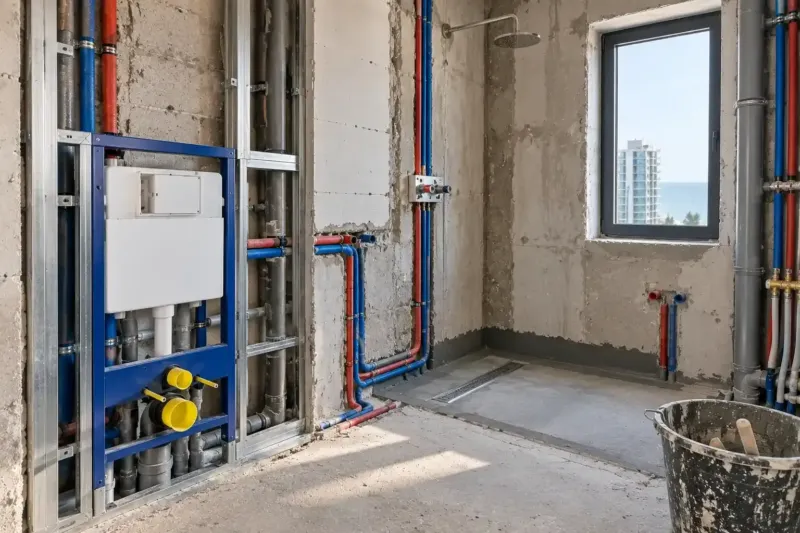
Pipe replacement in Batumi apartments: water supply and drains
Pipe replacement in Batumi apartments is needed when the old water supply is rusting, leaking at the joints or lies under tiles you are about to replace. We replace the pipework from the apartment's main valve to every fixture and the drains up to the riser, pressure-test the new pipes and photograph them before they are closed up. Labour for a bathroom, including removal of the old pipes, costs from 1,320 ₾, with pipes and fittings extra. New pipes in walls and floors carry a 5-year warranty.
from 1 320 ₾/roomlabour only for a bathroom, including removal of old pipes; pipes and fittings extra. The final price is confirmed once agreed.
- Timeline: 3–5 days for the bathroom pipes, including removal of the old ones; restoring the tiles adds 1–2 weeks
- Warranty: 2 years on the work, 5 years on concealed pipes and wiring
Who it’s for
A resale apartment where rusty water runs from the tap after a supply cut, and the steel pipes drip at the threads
Multilayer pipe on compression fittings has started to weep in the boxing behind the toilet
You are about to retile the bathroom and don't want new tiles going over old pipes
The neighbours below have a stain on their ceiling, the leak is somewhere in the wall, and you'd rather not open everything up
The bathroom already has new pipes, but the kitchen is still on old steel, and it is time it caught up
What’s included
- inspecting the pipe runs and materials, and checking the valve on the branch
- one or two trial openings, with your consent
- removing old pipes and boxing
- chases in brick and block, or boxing if the tiles are being kept
- new water pipework from the apartment's main valve to every fixture
- replacing the drains, with a fall and an inspection opening
- thermal insulation on the hot and cold water pipes
- a pressure test, flushing the lines and photos of the runs before closing up
- filling the chases and restoring the waterproofing in the bathroom
- a diagram of new and disconnected pipes in the handover file
When it is time to replace the pipes in an apartment
Pipe replacement in Batumi apartments almost always starts with one of these signs. After a water supply cut, rusty water runs from the tap for a long time. The hot water pressure is weaker than the cold, even though the mixer is new. There are orange streaks or white deposits at the joints, and the boxing behind the toilet smells damp. In Soviet-era buildings the pipes are usually steel and date from when the building went up, so we replace them without waiting for a leak.
The second reason is a bathroom renovation. If you are changing the tiles, it is better to replace the pipes under them at the same time, even if they are holding up for now. Otherwise, the first leak will have to be tracked down by taking off the new tiling.
What we check at the inspection before the estimate
We follow the pipe run from the apartment's main valve to the fixtures. We check the valve on the branch first: if it doesn't shut off, we agree the work day with the management company, because the water will have to be shut off at the riser. The riser is not included in the price of replacing the bathroom pipes. If it is rusty or cast iron, its section in the apartment is replaced as a separate item, which is in the price table, and what else to check in an old building is covered on the page about renovating an older resale apartment.
Next we find out where the old pipes run: in a chase, in the screed, in boxing or exposed. With your consent, we make one or two trial openings, usually at the tee under the basin and behind the bath's inspection panel. They show the material, the condition of the joints and how much of the finish will have to come off. We check the drains separately: cast iron in an old building, sagging plastic pipes with no fall, sockets sealed with sealant instead of a rubber seal.
Replace everything or only a section
| Situation | What we replace | What to allow for |
|---|---|---|
| A leak at one joint, the rest of the pipes are new | The joint or a length of pipe | After the repair we pressure-test the whole system |
| Old steel or multilayer pipe throughout the apartment | All the pipework from the apartment's main valve | It is better to do the kitchen and bathroom in one go, so as not to shut off the water and open up the walls twice |
| A bathroom renovation, with the kitchen left as it is | The bathroom pipes, with a new manifold | The joint with the old kitchen pipe goes behind a hatch |
| Drains that sag or are cast iron | The pipes from the fixtures to the riser socket | A fall towards the riser and an inspection opening at the bend |
Partial replacement is cheaper, but it has a weak point: the joint between new and old. We always put it somewhere it can be reached without opening up the tiles, and mark it on the diagram.
Which pipes we fit in place of the old ones
| Material | Where we use it | What we watch for |
|---|---|---|
| Polypropylene | Water supply in walls and boxing | Heat-fused joints. An overheated joint narrows the pipe on the inside, so we keep to the heating times in the manufacturer's table |
| PEX (cross-linked polyethylene) | Long runs in the floor, lines from the manifold | Flexible and goes round corners without fittings; fittings from the same system only |
| Multilayer (metal-plastic) pipe | Only exposed or behind a hatch | Compression fittings loosen over time, so we don't bury them in walls |
| Plastic drain pipe | From the fixtures to the riser | Sockets with rubber seals, a fall, an inspection opening |
We choose the material to suit the run. In a wall with short lengths, polypropylene is more convenient, while under the screed a long line to a distant fixture is simpler in one piece of PEX. We put thermal insulation on both lines, the cold one too.
How we lay the new runs
In brick and block walls, the pipes go into a chase. We don't chase cast-in-place concrete walls and columns in new builds: they are load-bearing structures, and the reinforcement lies close to the surface. There we take the run along partitions, in the floor or in boxing. In the floor, the pipes lie in unbroken lengths in corrugated sleeving, and the joints are made at the manifold behind a hatch.
If the layout of the fixtures changes along with the pipes, that means a new outlet layout, and the job proceeds as turnkey bathroom pipework. If the fixtures stay where they are, we put the new outlets at the old positions, so that the mixers and toilet go back without alterations.
Finishes after the replacement
After the pressure test we fill the chases: with a cement mix in wet areas and a gypsum one in dry rooms. In the bathroom, over the filled chase, we restore the waterproofing, with tape over the joint with the old layer, otherwise water will find that seam first.
Tiles can almost never be removed intact, so before work starts we decide what will cover the opened-up areas. If the product code is in the handover file or on a box, we look for the same tile. If not, we retile a band or a whole wall, and then laying the tiles is priced as a separate line in the estimate.
Pipe replacement in Batumi: prices per bathroom and per linear metre
Replacing the pipes in a bathroom, including removal of the old ones, costs from 1,320 to 1,920 ₾ for labour. This covers removing the old pipes, new water pipework, drains and a pressure test, while restoring the tiles is a separate line. Pipes and fittings are not included in the price, and for a bathroom they come to 810–1,200 ₾.
If the replacement doesn't cover the whole bathroom, we price it by the metre: running a water supply pipe costs 12–18 ₾ per linear metre, and chasing 24–36 ₾ per metre. It costs more when the pipes are in concrete walls, when tiles have to be restored, and when the drains are replaced together with the water supply. It is cheaper when the pipes are in boxing or the replacement coincides with a bathroom renovation, where the finishes are coming off anyway. The final cost is set after the inspection and the trial openings, once the estimate is agreed.
Stages and timelines
-
Inspecting the run
1 day
We follow the run from the apartment's main valve to the fixtures, check the valve on the branch and, if you agree, open up one or two spots.
-
Estimate and shut-off day
1–3 days
We price the items. If the riser has to be shut off, we agree the time with the management company and warn the neighbours.
-
Strip-out
1–2 days
We remove the boxing and tiles along the runs, take out the old pipes or cut them off from the system, and bag up the waste.
-
New pipework
2–3 days
We cut the chases, lay the insulated water supply and the drains, and assemble the manifold behind a hatch.
-
Pressure test and photos
1 day
We hold the water supply under pressure, run water through the drains and photograph the runs with a tape measure from the floor and corners.
-
Filling and finishing
1–2 weeks
We fill the chases and restore the waterproofing and tiles on the opened-up areas.
-
Connection and handover
1 day
We flush the lines, refit the mixers and toilet, test every point with water and hand over the work with a completion certificate and the diagram.
Local specifics in Batumi
In an old building, the trickiest spot is the valve on the branch from the riser. The thread on the steel there is often held together by rust, and if the pipe is rocked, the valve can snap off together with the end of the pipe. So we cut this assembly out rather than unscrew it, and agree a back-up riser shut-off with the management company in advance. We join cast-iron drains to plastic with an adaptor coupling made for that material.
Chasing concrete can be heard several floors away, so we schedule it for daytime hours. The law allows noisy work from 08:00 to 23:00, but if the building's rules are stricter, we follow them.
In an apartment let short-term, pipe replacement is best scheduled for the off-season, together with the bathroom renovation. The main flow of guests in Batumi comes in July–September, and by then the plaster in the chases should be dry and the tiles laid.
Materials and brands
In place of steel we fit polypropylene or PEX, and in place of cast iron plastic drains with seals in the sockets. The transition from old steel to plastic is made with a fitting with a brass thread, and before that we clean the thread on the steel back to bare metal.
We fill chases in wet areas with Ceresit cement mix, and in dry rooms with Knauf gypsum. On the opened-up areas of the bathroom, we restore the waterproofing with Ceresit or Mapei compound, with tape over the joint with the old layer. If the brand of the previous waterproofing is in the handover file, we use the same one.
What makes up the cost
Timeline: 3–5 days for the bathroom pipes, including removal of the old ones; restoring the tiles adds 1–2 weeks
- the length of the runs and the number of points affect the estimate more than the floor area of the apartment
What raises the cost
- the pipes are buried in cast-in-place concrete walls, and the run has to be laid anew
- removing and restoring tiles on the opened-up areas
- the drains are replaced together with the water supply
- the valve on the branch doesn't hold, and the work is done with the riser shut off through the management company
What lowers the cost
- the pipes are in boxing or exposed, and can be reached
- the replacement coincides with a bathroom renovation, and the finishes are coming off anyway
We prepare the exact estimate from measurements and photos. It’s free and comes with no obligation.
Get an estimateGuarantees
A 5-year warranty on new pipes in walls and floors.
Old sections that are left in place, such as the kitchen pipes when only the bathroom is replaced, are not covered, and we record this in the certificate with photos. We put the joint between new and old behind a hatch, so that it can be inspected without opening anything up. Fixtures that were removed and refitted carry a 2-year warranty on installation.
Questions and answers
How much does it cost to replace the pipes in an apartment in Batumi?
Labour for a bathroom, including removal of the old pipes, costs from 1,320 to 1,920 ₾, and the pipes and fittings themselves add 810–1,200 ₾. If the kitchen or a single section is being replaced, we price it by items: points, linear metres of pipe and chases.
What affects the total most is where the old pipes run. If they are in boxing, there is hardly anything to open up. If they are buried in concrete under tiles, removing and restoring the finishes is added to the work. We give the final cost after the inspection and a trial opening, once the estimate is agreed.
Can pipes be replaced without removing the tiles?
Often, yes. We run the new pipes in boxing along the wall, in a false wall behind the toilet or exposed under the basin, and disconnect the old ones and leave them in the wall. Boxing made of moisture-resistant plasterboard takes up a few centimetres; it is tiled over, with an access hatch left to the manifold.
It rarely works with no opening up at all: the spots at the mixers and the outlet in the kitchen usually have to be opened. If there are no spare old tiles, we look for the same tile by product code in advance, or agree to tile the boxing in a different tile, as a separate feature of the bathroom.
Do multilayer (metal-plastic) pipes need replacing?
Not always. The pipe itself lasts a long time, and its weak point is the compression fittings: over the years, temperature changes loosen the nut, and the joint starts to weep. If the fittings are behind a hatch or under the basin, they can be tightened or replaced one by one.
We decide on site. Exposed pipework in good condition stays, but compression joints buried in a wall or screed are replaced together with the pipes during a bathroom renovation. Once the new tiles are down, there is no way to reach them, and a leak from such a fitting is usually noticed as a stain at the neighbours'.
Do the old pipes have to be taken out of the wall?
No. If an old pipe doesn't get in the way of the new run, it is cut off from the system at both ends, capped and left in the wall. Breaking steel out of concrete just for the sake of removing it means extra noise, dust and restoring the wall for no benefit.
We take a pipe out when the new one will run in the same place, or when the old one leaks and is soaking the wall from inside. We mark pipes left in place on the diagram as disconnected. Otherwise, years later, a tradesman will find the pipe with a detector and assume it carries water.
Why is the pipe boxing wet when nothing is leaking?
Most likely it is condensation. In summer, warm humid air condenses on the cold water pipe, as it does on a glass taken out of the fridge, and in closed boxing the droplets run down onto the plasterboard and the floor. It is easy to tell from a leak: with the taps closed the meter doesn't move, only the cold pipe is wet, and in winter the boxing is dry.
Thermal insulation on the cold water pipes helps. When replacing pipes, we fit it on both the cold and the hot lines, and build the boxing from moisture-resistant board with a hatch. If the boxing has already gone black inside, it is taken apart, treated and reassembled.
Further reading
Photograph the pipes under the basin and in the boxing, and we'll tell you what to replace
We reply within an hour during business hours. Message us or leave a request: we’ll call you back, go over the details and suggest the next step.
Mon–Fri 10:00–19:00, Sat 11:00–16:00