
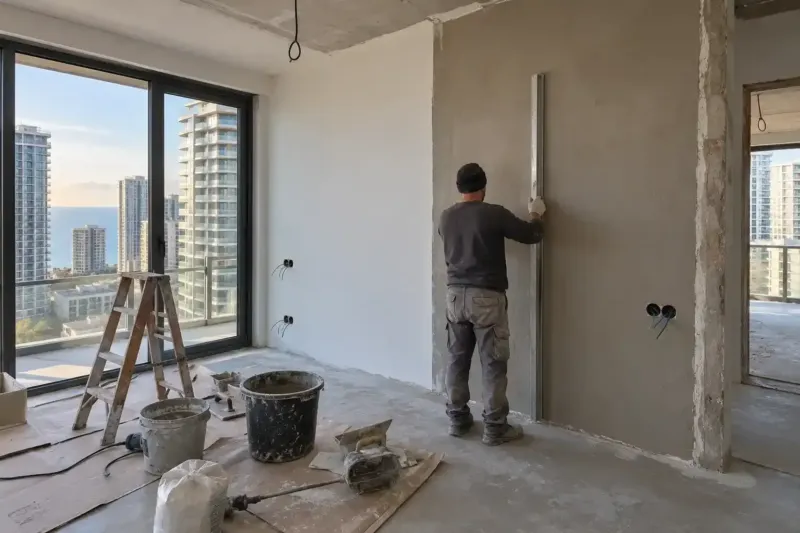
Old apartment renovation in Batumi: Soviet-era blocks and 2010s buildings
Old apartment renovation in Batumi starts with one question: what kind of building is the apartment in? In Soviet-era and older buildings we replace the pipes, wiring and screed, and check the floor structures and the services of the whole building. In 2010s new builds the services are usually younger, but pre-sale renovations, damp on the window reveals and bathrooms without waterproofing are more common. A full renovation with strip-out and new services costs from 570 ₾ per m².
from 570 ₾/m²full renovation with strip-out, new pipes and wiring: labour and rough-work materials. The final price is confirmed once agreed.
- Timeline: 3–4 months for an apartment of about 50 m² in a Soviet-era block with all services replaced; usually faster in a 2010s building
- Warranty: 2 years' warranty on work
Who it’s for
You bought an apartment in a Soviet-era block by the sea, with pipes and wiring as old as the building
A 2010s apartment after its first owners: swollen laminate, mould behind the wardrobe, a weak consumer unit
An apartment in the Old Town has come to you, and it isn't clear what in it can be kept
You plan to let a resale apartment all year round and don't want emergencies while tenants are living there
You are choosing between two apartments and want to know the renovation estimate before you pay a deposit
What’s included
- Inspection of the apartment and the building: consumer unit, risers, wall moisture, stairwell and basement
- Checking the measured floor area against the Public Registry extract
- Strip-out of old finishes, tiles and boxing, and waste removal
- New wiring and a consumer unit with RCDs on the wet areas
- New water pipes and drains, and a section of the riser by agreement with the neighbours
- Plastering to guide beads, and screed or a dry floor depending on the floor structure
- Waterproofing of the bathroom and balcony
- Finishing in the grade of materials you choose
- A handover file with routing diagrams of the new services
Renovating a resale apartment in Batumi depends more on the age of the building than on its size. An apartment in a block from the middle of the last century and one in a 2012 new build appear in the same section of the listings, but they have to be renovated differently, and their estimates are made up of different lines.
Soviet-era blocks: what we almost always replace
In Soviet-era blocks, and in the even older buildings of the Old Town, the pipes, wiring and screed are usually as old as the building itself. Steel pipes clog up inside and rust at the threads, cast-iron drains crack at the sockets, and aluminium cable with no earth was never meant for an air conditioner in every room, a water heater and a hob. We replace these systems completely, from where they enter the apartment to every point, and put together a new consumer unit (fuse box) with RCDs on the wet areas.
We look at the building separately. Its risers, water supply and electrical network are shared, and their condition decides what can be done in a single apartment. A rusty riser that the neighbours aren't ready to replace is better found before the estimate than after the tiling. If the supply to the building can't carry air conditioners in every room, we raise the capacity question at the inspection: an increase is usually arranged through the electricity company, and that application has its own timeline.
An apartment in a 2010s building: what the last renovation hides
Buildings put up in Batumi in the 2010s usually still have fairly young services: copper cable, plastic pipes, a reinforced concrete frame. Their weak spot is the finishing, which was done quickly, for a sale or for the first season. What we find most often:
- a bathroom with no waterproofing, tiles on gypsum plaster and dark joints around the shower tray;
- laminate that has swollen by the balcony door and at the entrance;
- mould on the reveals of windows that stream with condensation in winter, and behind wardrobes against the external wall;
- a bathroom fan without a non-return valve, which lets in the neighbours' smells;
- a consumer unit without RCDs, with all the kitchen sockets on one circuit;
- an air conditioner drain run straight out onto the facade.
In apartments like these, the screed and partitions can often stay if they are level and don't sound hollow. The job is then closer to a full renovation of part of the apartment: we redo the wet areas, the electrics and the floors, and bring the walls up to a paintable finish. If both the services and the base are sound, a cosmetic refresh will be enough.
Inspecting the apartment and the building before the estimate
A resale estimate can't be worked out from the photos in a listing, so the first step is a visit from the foreman. In an old building the foreman looks beyond the apartment: where the water and gas supplies come in, what state the risers in the basement are in, and whether there are cracks in the load-bearing walls of the stairwell. Owners usually pay for repairs to the shared parts of an old building together, and you will have a share in that too.
We check the measured floor area against the Public Registry extract. Soviet apartments often have glazed-in loggias added on that don't appear in the extract, and it is better to know this before any layout change. If you are still choosing, the inspection can be done before you pay a deposit, and then you can decide between an apartment with or without a renovation with the figures in front of you.
Strip-out: what we keep and what goes
Stripping out old finishes costs from 36 to 54 ₾ per m², and removing tiles from 24 to 30 ₾ per m², so in a resale estimate this is a noticeable line. That is why we only remove what gets in the way. We can often keep the brick partitions of Soviet buildings, solid parquet if the boards aren't rotting underneath, and a level, sound screed in a 2010s building.
Some things go without discussion: old wiring, steel pipes in the walls, a second layer of tiles laid over the first, and plasterboard boxing with mould inside. In the old centre, waste removal is harder: the streets are narrow, there is nowhere to put a skip, and the bags are carried to the van by hand.
Walls and floors in an old building
Walls in Soviet buildings are rarely straight, and in the bathroom we always level them for tiling. Plastering to guide beads costs from 39 to 60 ₾ per m²: cement plaster in wet areas, gypsum plaster in the rooms. For painting, a skim coat over the old plaster is sometimes enough, if it holds and doesn't sound hollow when tapped.
Floors in the Old Town need more care. In buildings from the late 19th and early 20th centuries the floor structures are sometimes timber, and a heavy wet screed overloads them. There we lay a dry floor or a floor on joists, and build the bathroom on a lightweight base with waterproofing. The order of work in a wet area is described on the page about bathroom renovation.
How much old apartment renovation in Batumi costs
A full renovation of a resale apartment, with strip-out and new services, costs from 570 to 780 ₾ per m². This price covers the labour and the materials for the rough work: cable and the consumer unit, pipes, plaster, screed where it is needed, waterproofing. Tiles, flooring, sanitary ware and lighting are priced separately, according to the grade you choose.
The points move the estimate most. An electrical point costs from 42 to 66 ₾ and a plumbing point from 96 to 145 ₾, and in an old apartment almost all of them are made from scratch. A 2010s building with sound screed and partitions works out cheaper, while an old building with timber floors and a riser replacement costs more. The final cost is set after the site measurement and once the estimate is agreed.
Stages and timelines
-
Inspection and test openings
1–2 days
The foreman checks the consumer unit, pipes, screed and wall moisture, and in an old building the risers and stairwell as well. With your consent, we open up disputed spots in a few places.
-
Estimate and contract
3–5 days
We work out the estimate item by item and sign a contract with the price and timing of each stage. You choose the language of the contract.
-
Strip-out and waste removal
5–10 days
We take the old finishes back to the base, remove the waste and photograph the exposed walls and floors.
-
New services
2–3 weeks
We run the wiring from the new consumer unit, replace the pipes and, if agreed, a section of the riser. Everything is photographed before it is closed up.
-
Walls, floors and waterproofing
2–3 weeks
Plastering to guide beads, screed, or a dry floor on a timber floor structure, and waterproofing of the bathroom and balcony.
-
Finishing
4–6 weeks
Tiles, flooring, painting, doors, sanitary ware and lighting. You accept the stages on site or by video.
-
Cleaning and handover
2–3 days
We clean the apartment, sign the completion certificate and give you the handover file with diagrams of the new services.
Local specifics in Batumi
Resale apartments by the sea age faster: salt and damp work on them for decades. In Soviet-era blocks, the first thing we look at is the underside of the balcony slab. Rust streaks and spalled concrete mean the reinforcement is already corroding, and we settle this with an engineer before any tiles go down on the balcony.
On the ground floors of the old centre, walls often draw up moisture from below. There we start the finishing by drying the walls out and use a plaster that lets vapour escape rather than trapping it under paint.
Some apartments in 2010s buildings stood empty between seasons for years. Without airing, damp gets into the wardrobes, the plasterboard boxing and under the laminate, even though the apartment looks fresh in the photos. That is why we bring a moisture meter to every inspection and move furniture away from the external walls.
In old buildings the neighbours live there all year round, so we put loud strip-out work in the middle of the day, within the legal hours of 08:00–23:00. In five-storey blocks without a lift, materials are carried up by hand, and that is a separate line in the estimate.
Materials and brands
In a resale apartment, the brand matters most for whatever goes into the wall for decades. We use copper cable, for example Ünal Kablo NYM, and ABB, Schneider Electric or Legrand circuit breakers and RCDs in the consumer unit. Water pipes are replaced with polypropylene or PEX, and drains with plastic pipes.
Uneven old walls in a bathroom need cement plaster and a C2 tile adhesive, for example Ceresit or Mapei, while in the rooms we level with Knauf gypsum compounds. On timber floor structures, instead of a wet screed we lay a dry floor of gypsum fibreboard.
What makes up the cost
Timeline: 3–4 months for an apartment of about 50 m² in a Soviet-era block with all services replaced; usually faster in a 2010s building
- moving partitions without touching load-bearing walls
What raises the cost
- replacing a riser and agreeing it with the neighbours
- timber floor structures: a dry floor instead of screed and a lightweight bathroom
- a building without a lift or on a narrow street: materials carried up and waste carried out by hand
- increasing the electrical capacity for air conditioners
What lowers the cost
- a concrete-frame building with sound screed and straight partitions
- keeping brick partitions and parquet that can be sanded
We prepare the exact estimate from measurements and photos. It’s free and comes with no obligation.
Get an estimateGuarantees
2 years' warranty on work, 5 years on new pipes and wiring in walls.
Our warranty doesn't cover old sections that you decide to keep, such as the riser in the neighbours' apartment, and we record this in the certificate with photos. The new services, with diagrams and photos taken before closing up, go into the handover file.
Questions and answers
How much does it cost to renovate a resale apartment in Batumi per square metre?
A full renovation of a resale apartment, with strip-out and new services, costs from 570 ₾ per m², which covers the labour and the materials for the rough work. Finishing materials, sanitary ware and lighting are added according to the grade you choose.
The spread between apartments is wide: in a 2010s building the screed and partitions can often stay, while in an old building almost everything is replaced, including the electrical and plumbing points. We send a preliminary estimate from photos and a floor plan within 24 hours on business days. The final cost is set after the site measurement and once the estimate is agreed.
What can be done if an old building has no earthing?
In Soviet-era blocks the wiring is often two-core, with no protective conductor. Inside the apartment we still run three-core cable to every socket and put together a consumer unit with an earth bar. How it is connected to earth is decided by the electrician, depending on how the supply into the building is arranged, and we show you this before the estimate.
Until there is an earth, people are protected by RCDs: they cut off the circuit if current starts to leak, for example through a person in the shower. We never connect the earth to water pipes or radiators: an “earth” like that is dangerous both for you and for your neighbours.
Can the wiring in an old building handle an air conditioner in every room?
Inside the apartment, new wiring takes care of it: separate circuits for the air conditioners, the water heater and the hob, and a consumer unit with breakers sized by calculation. What comes into the apartment is the harder part. The supply to an old building was designed for a fridge and light bulbs, and with all the air conditioners on, the main breaker may trip.
We check the supply capacity at the inspection. If it isn't enough, an increase is usually arranged through the electricity company as a separate application, and the company sets the timeline. Until that is sorted out, the load can be reduced with inverter air conditioners and a water heater that heats water at night on a timer.
Can I remove the wall between the kitchen and a room in a Soviet apartment?
If it is a partition, under the 2026 rules it can be taken down without a permit. A load-bearing wall is only altered with design documentation and a permit, and in Soviet buildings interior walls often turn out to be load-bearing too. So before demolition, our structural engineer looks at the building's documents and at the wall itself.
If the kitchen has a gas cooker, we advise switching to induction when you open it up to a room: gas gives off combustion products and extra moisture into the shared space. We don't touch the gas pipe ourselves: disconnection and removal are usually done by the gas service on request.
Can old parquet be kept when an apartment is renovated?
Often it can, if the blocks are firmly fixed and not rotting. At the inspection we take off the skirting and lift one or two blocks by the external wall and by the balcony door, because that is where parquet takes on moisture first. Dark, soft wood on the underside, a smell of damp or a base that gives underfoot mean the floor will have to come up.
If the base is sound, the parquet is sanded, missing blocks are replaced and it is finished with lacquer or oil. While the other work goes on, we cover the floor with thick cardboard and apply the lacquer last, when there is no more dust in the apartment. The floor fitter can tell how much wood is left for sanding from the edge of a lifted block.
Terms used on this page
- Public Registry extract
- A document from Georgia's state registry: the owner, cadastral code, area, legal use and encumbrances of a property on the date of issue.
Further reading
Send photos and a plan, and we'll tell you what to replace and what to keep
We reply within an hour during business hours. Message us or leave a request: we’ll call you back, go over the details and suggest the next step.
Mon–Fri 10:00–19:00, Sat 11:00–16:00