
Renovated
A developer's finish, the previous owner's renovation or a fresh coat of paint for sale: what to check and how to value the…
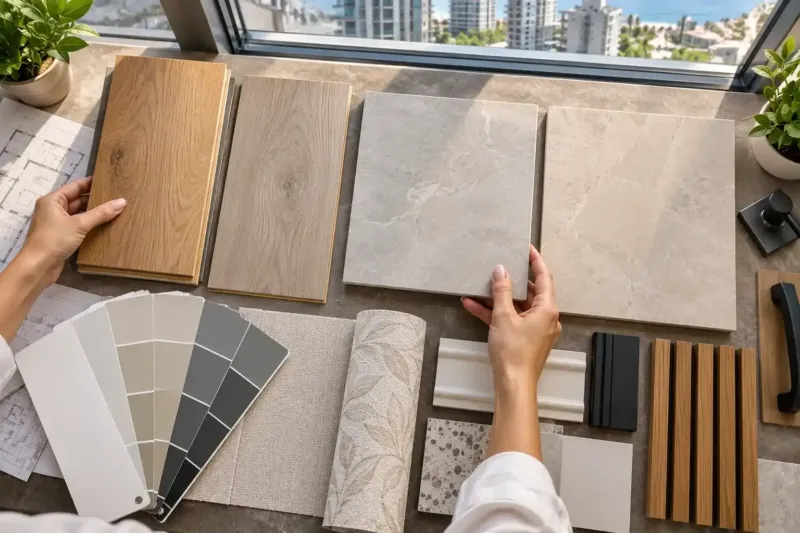
A renovated apartment is a better buy than an unrenovated one when you need to live in it or rent it out this season and a pre-purchase inspection has found no serious problems. Buy without renovation, in black or white frame or as an older resale apartment, if you have a few months and want to control what goes inside the walls yourself. For a rental apartment in Batumi the second route is usually safer: in the very first winter, humidity finds the mistakes in someone else's waterproofing and ventilation.
Updated 17 October 2026
| Criterion | Renovated | Unrenovated |
|---|---|---|
| Time until you move in or rent out | Almost straight after the purchase | After the renovation, several months later |
| Concealed work | Not visible, can only be partly checked | Under your control, photographed before closing up |
| Materials for humidity | Whatever the developer or seller chose | You choose them for the climate and renting |
| Resale market | The seller's renovation, often without documents | An older apartment in the right place, renovated your way |
| Money | Included in the price, upfront or on a payment plan | Cheaper apartment, renovation paid stage by stage |
| Risk of redoing work | Yes, if the renovation doesn't suit you | Lower: you make the decisions |
| Tax on a sale within 2 years | The renovation is already in the purchase price | Counted if the costs are documented |
| If you live abroad | You need a video inspection before the purchase | You need a contractor who reports weekly |
A "renovated apartment" in a listing can mean very different things. In a new build it is the developer's finish, and what it includes is set by the contract: the word "renovation", like the terms white frame and green frame, has no legal definition. In a resale apartment the renovation was done by the previous owner, and there is usually no specification for it.
In resale apartments, a renovation is either lived-in or done for the sale. A lived-in one was done by the owners for themselves and has been used, so its weak spots show in the wear. A pre-sale renovation is done for good photos, and anything can be hiding under the fresh paint.
For a buyer these are different jobs. A developer's finish is checked against the list in the contract and accepted by signing the developer's handover certificate. A renovation in a resale apartment is checked before you pay the deposit, because whatever turns up after the purchase is, as a rule, fixed at your own expense.
A finished renovation saves time. You can move in or list the apartment for bookings almost straight after the deal, while your own renovation of a 1+1 (one-bedroom) apartment from white frame, with furniture, takes several months. For short-term rental that can mean a whole season: most tourists come to Batumi between July and September.
Money is more complicated. You pay for a finished renovation as part of the apartment price, upfront or on a payment plan, even if you later redo part of it. An unrenovated apartment costs less, your own renovation is paid for stage by stage, and the money for it is needed over several months rather than on the day of the deal.
In a resale apartment, the seller puts a value on the renovation, and it does not always match its condition. If after you buy it turns out that the bathroom has no waterproofing and the consumer unit (fuse box) has old circuit breakers, you pay for the renovation twice: once in the apartment price and again in a new estimate. An inspection report with photos and a preliminary estimate for the fixes helps you negotiate the price before signing.
The finish hides what matters most: pipes, wiring, waterproofing and the state of the walls under the paint. Some of this can be assessed without opening anything up, and this is what we do at an inspection:
We ask the seller for documents: photos of concealed work, routing diagrams, receipts for materials. If there are none, that is no reason to turn the apartment down, but then the inspection is the only source of information about what is inside. If you have a choice, view the apartment after a few days of rain, when damp corners and streaks on the window reveals are easier to see.
Your own renovation gives you control over what you will not be able to see later. You choose the waterproofing, the ventilation, materials for a humid climate and sockets placed for your furniture, and concealed work is photographed before it is closed up and goes into the handover file. For a short-term rental, it also means materials that will stand up to a steady flow of guests.
We are a renovation company, so we will be direct: if a renovated apartment has passed the inspection and the layout suits you, there is no need to redo it just for the sake of a new renovation. Often a few targeted jobs are enough, such as replacing the silicone and grout in the shower, reworking the consumer unit or changing the window seals.
If you might have to sell the apartment within the first 2 years, the two options also differ on tax. Under the rules for 2026, such a sale of residential property is taxed at 5% of the increase in price, and documented renovation costs, according to a 2026 clarification from Georgia's Ministry of Finance, are added to the purchase price in this calculation. After 2 years of ownership there is no tax on selling residential property.
If you bought a renovated apartment, the cost of the renovation is already included in the price in the sale and purchase agreement. Your own renovation counts in the calculation if the costs are backed by documents. Keep the renovation contract, the signed acceptance certificates and the receipts together with the papers for the apartment, even if you have no plans to sell yet.
Buy a renovated apartment when time matters more than doing everything your own way, and the inspection has found no serious problems. The more recent the renovation and the fuller its paperwork, the safer the purchase.
Buy an unrenovated apartment if you are ready to wait and want to control what goes inside the walls yourself. The renovation is then done for your needs, not to the seller's taste.
Look for mismatches. Fresh paint on the ceiling with old windows and radiators, new sockets with old breakers in the consumer unit, new tiles in the bathroom with old pipes under the sink. A strong smell of paint and furniture pushed tight against the external walls should also make you cautious.
Ask the seller when the renovation was done, who did it and what was replaced inside the walls. If the answers are vague and there are no receipts or photos, assume the concealed work is still the original, and budget for replacing it.
First find the cause, or the mould will come back under any finish. We measure the moisture in the walls, check the draught in the ventilation and look for a leak from the neighbours or a cold corner behind the furniture. The results show whether drying out and an antifungal treatment will be enough, or whether the finish has to be opened up.
Until the cause is fixed, move the furniture away from the external walls, air the apartment and do not cover the stain with fresh paint. If the apartment stands empty in winter, install a dehumidifier that drains into the waste pipe, so nobody has to empty it by hand.
Anything that shows the hidden part: photos of the wiring, pipes and waterproofing before the finish went on, routing diagrams, and the contract and signed acceptance certificates if a company did the work. Warranty cards and manuals for the appliances, air conditioners and water heater are useful too, because they make it easier to order repairs or spare parts.
For your own tax on a resale, you do not need the seller's receipts: the cost of their renovation is already part of the purchase price. Their value is elsewhere. They show when the renovation was done and what it was made from.
Yes. Before the purchase we inspect the apartment and show you the inspection on video, and after the purchase we take the keys against a signed handover form. In a new build, our site foreman accepts the apartment from the developer under your power of attorney and records any defects in the handover certificate. The renovation runs under a contract with a price and a deadline for each stage.
A photo and video report comes every week, and you sign off stages by video. You pay by stage: an advance for materials and the first stage, then payment after you accept each stage. The result stays with you in the handover file: routing diagrams, photos of concealed work, a materials list and the warranty terms.
A developer's finish, the previous owner's renovation or a fresh coat of paint for sale: what to check and how to value the…
An apartment in a black, white or green shell: what the developer really leaves, what to check before buying, how much to add to…
We reply within an hour during business hours. Message us or leave a request: we’ll call you back, go over the details and suggest the next step.
Mon–Fri 10:00–19:00, Sat 11:00–16:00