
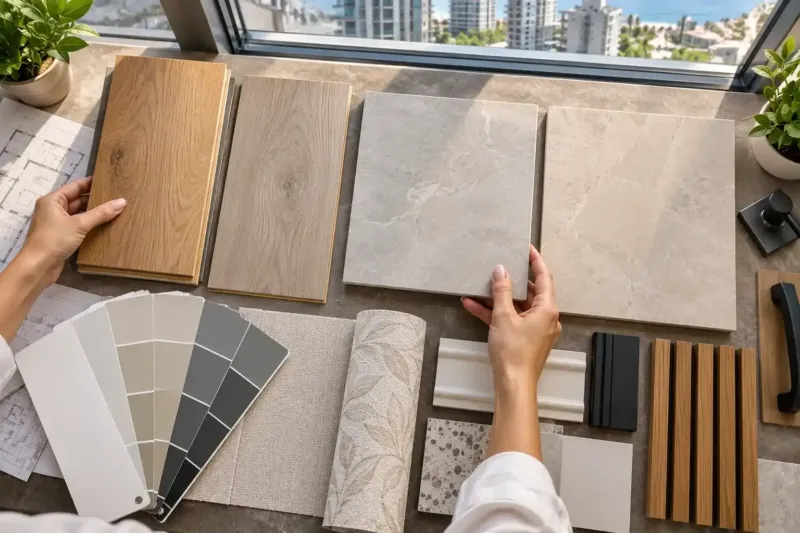
Solid wood vs engineered wood flooring: what to choose in Batumi
Between solid wood and engineered wood flooring, engineered boards are the safer choice for Batumi: their multi-layer base reacts less to damp, and the air here is humid almost all year round. Solid wood block parquet makes sense if someone lives in the apartment all the time, keeps the humidity under control and wants a floor that can be sanded many times. For short-term rental we don't recommend either.
Updated 17 October 2026
Comparison by criteria
| Criterion | Solid wood parquet | Engineered wood |
|---|---|---|
| Construction | Solid wood through the full thickness | Hardwood top layer on multi-layer plywood |
| Humid air | Moves a lot: cupping, gaps | Moves noticeably less |
| Dehumidifying | Essential all year round | Needed, but the risk is lower |
| Underfloor heating | We don't recommend it | If the manufacturer allows it |
| Installation | Glued, then sanded and lacquered or oiled on site | Glued, often with a factory finish |
| Time to finish | Longer: drying after every stage | Shorter, no sanding on site |
| Future sanding | Many times | Depends on the thickness of the top layer |
| Cost of the work | Higher | Lower |
Solid wood vs engineered wood flooring: how they differ
Block parquet and solid wood boards are made of one piece of wood through their full thickness. Engineered wood has a top layer of hardwood, such as oak or walnut, on a multi-layer plywood base in which the veneers run alternately along and across the board. The layers hold each other in place, so the board changes size less when the air gets drier or more humid.
Engineered wood is often confused with three-layer parquet board. That board is also multi-layered, with a softwood core, and is more often laid as a floating floor with click joints. Engineered wood is usually glued to the subfloor like parquet, so in sound and feel underfoot it is closer to solid wood.
Wood and Batumi's humidity
Wood exchanges moisture with the air: in damp air it takes moisture in and swells, in dry air it gives it back and shrinks. Instructions for wood floors usually ask you to keep the humidity in the room no higher than 60–65%. Outdoor humidity here is usually 70–80%, higher in winter, and without dehumidifying it is hard to keep a room at 60–65%.
Solid wood reacts to this more strongly. In the wet season the boards cup, rising at the edges, and when the air conditioning dries the air too much, gaps open between them. Engineered wood moves too, but noticeably less, because the plywood holds its shape.
That is why we only lay a wood floor together with climate control. You need an air conditioner with a dry mode or a dehumidifier, and a hygrometer in the room. In an apartment that stands empty in winter, you also need someone who switches them on and airs the rooms. Without that, even engineered wood will show its joints over time.
Wood has the hardest time by the balcony door and floor-to-ceiling windows: wind-driven rain, condensation on the glass in winter, sun in summer. There we leave the expansion gap the instructions call for, cover it with a threshold strip or skirting board, and adjust the door so that no draught gets under it.
Installation and timing
Either type of flooring is first left in the apartment to acclimatise, and the moisture in the screed is checked with a meter. From there the process differs. Parquet is glued onto plywood or a prepared screed, left to settle, sanded, and only then finished with lacquer or oil. That means several stages with dust and smell, and each one has to wait for the previous one to dry.
Engineered wood is more often sold with a factory lacquer or oil finish. It is glued to the subfloor, and once the adhesive has dried the floor is ready, with no sanding on site. For an owner running the renovation remotely, that saves several stage sign-offs by video.
For wood floors, the adhesive used here is water-free, polyurethane for example: a water-based adhesive would add moisture where there is already plenty of it.
Sanding and care
Solid wood can be sanded many times, as long as there is wood left above the tongue. With engineered wood, the margin depends on the thickness of the top layer: a thin one leaves almost no room for sanding, while a thick one will take several. We check this thickness in the specifications before buying, because it decides how many times the floor can be refinished.
The finish affects care as well. Lacquer resists water and stains better, but you cannot touch up a scratch in it on the spot, so the area has to be sanded. Oil is easy to refresh in one place, but it needs renewing regularly, and spilled water has to be wiped up at once.
Underfloor heating, sun and renting out
Of the two, engineered wood is the one that works with underfloor heating, and even then only if the manufacturer of the range allows it and the surface temperature stays within its limits. Solid wood laid over underfloor heating dries out and moves more, so we do not recommend that combination.
Near large windows the sun changes the shade of the wood over time, and a rug that stays in one place for years leaves a patch of a different tone. This is a property of wood and is not treated as a defect in the finish.
For short-term rental we do not recommend wood: suitcases, sand, wet feet after the beach and cleaning after every guest will age it quickly. For a long-term rental, engineered wood with a hard-wearing lacquer will do, as long as the apartment has a dehumidifier and the tenants use it.
Which to choose
When to choose: Solid wood parquet
Solid wood block parquet is worth it when the floor is meant to last and you are ready to keep a stable climate in the apartment. In Batumi, that means an apartment or house you live in permanently and do not plan to rent out.
- Living in the apartment all year round and controlling humidity
- A laying pattern, such as herringbone, made from solid blocks
- A floor that can be sanded many times
- No underfloor heating under the wood
When to choose: Engineered wood
Engineered wood suits you if you want real wood underfoot. It copes with damp better and is quicker to lay, although it also needs dehumidified air.
- An apartment for yourself or for long-term rental
- Underfloor heating in the apartment, if the board manufacturer allows it
- A renovation run without you on site, where fewer wet stages make it easier to manage
- Wide, long boards, which are risky to lay in solid wood in a humid climate
Questions and answers
What is the difference between engineered wood and three-layer parquet board?
Both are multi-layered, but they are built differently. Engineered wood has a hardwood top layer on multi-layer plywood and is usually glued to the subfloor. Three-layer parquet board has a top layer, a softwood core laid crosswise and a veneer underneath, and it is more often laid floating, with click joints. A floating floor is quicker to lay and easier to take up, but it sounds hollower underfoot and has a slight spring. For both, the sanding margin depends on the thickness of the top layer.
Can you lay solid wood parquet in an apartment by the sea?
Yes, if you are ready to keep humidity within the limits given in the floor's instructions. That is usually no higher than 60–65%, while outdoor humidity in Batumi is 70–80% and rises in winter, so without dehumidifying it is hard to keep a room within those limits. You will need a dehumidifier or an air conditioner with a dry mode, a hygrometer and regular airing, and an empty apartment needs someone to look after it in winter. If that routine is not realistic, engineered wood or SPC vinyl flooring with a wood look is the more sensible choice.
How many times can engineered wood be sanded?
As many times as the hardwood top layer allows. The manufacturer gives its thickness in the specifications, and it is the main figure to look at when choosing. A thin layer leaves almost no margin, while a thick one will take several sandings. Bear in mind the bevel along the edges of the boards: after deep sanding it gets shallower or disappears. Oiled boards are often refreshed with no sanding at all, just by cleaning off the dirt and applying fresh oil.
Solid parquet or engineered wood: which is better for a rental apartment?
For short-term rental we do not recommend either. Suitcases, pebbles from the beach, water after the shower and cleaning after every guest age wood quickly, and sanding means several days without guests. In that kind of apartment, SPC vinyl flooring with a wood look or porcelain tiles work better. For long-term rental, engineered wood with a hard-wearing lacquer is suitable, as long as the apartment has a dehumidifier and the tenants know what it is for.
Send your plan and we'll pick flooring that suits damp air and renting
We reply within an hour during business hours. Message us or leave a request: we’ll call you back, go over the details and suggest the next step.
Mon–Fri 10:00–19:00, Sat 11:00–16:00