
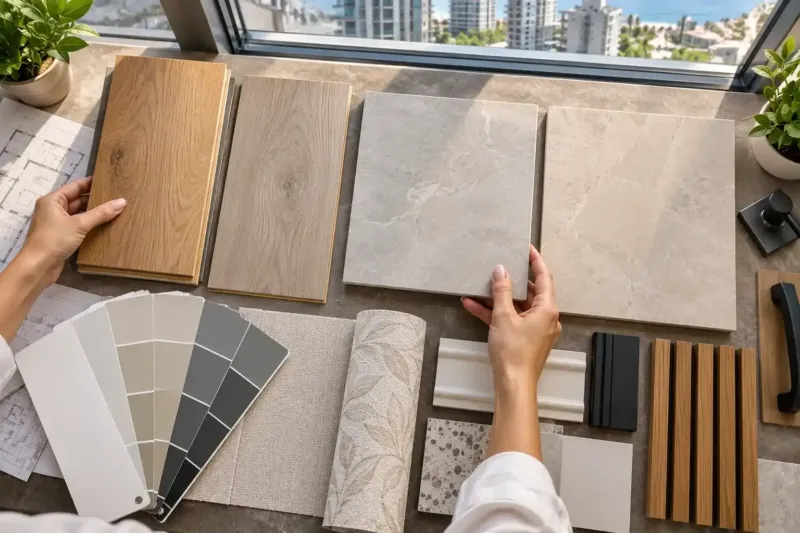
Laminate vs SPC vinyl: what to choose for a Batumi apartment
For an apartment by the sea that is rented out or left empty for the winter, SPC vinyl is the safer choice: water and damp air don't damage it. Laminate works in dry living rooms and bedrooms if it is moisture-resistant and the apartment is aired and dehumidified in winter. In the hallway, the kitchen and by the balcony door laminate loses out, so there we lay SPC vinyl or porcelain tiles, even if the bedrooms have laminate.
Updated 17 October 2026
Comparison by criteria
| Criterion | Laminate | SPC vinyl |
|---|---|---|
| Core | Wood fibre board, absorbs water | PVC with mineral filler, doesn't swell |
| Damp air in winter | Board edges can lift | Not affected |
| Kitchen and hallway | Not advisable, moisture-resistant only | Suitable |
| Bathroom | We don't lay it | Fine without a shower, porcelain tiles in the shower area |
| Subfloor | Tolerates small level differences | Needs a flat, dry screed |
| Footstep noise | Louder, needs a good underlay | Quieter |
| Underfloor heating | If the range allows it, with underlay | If the range allows it |
| Local repair | Taken up from the wall to the damaged plank | Glue-down tiles replaced one by one |
| Material price | Usually lower | Higher, plus preparing the base |
Laminate vs SPC vinyl: what makes them different
Laminate is built on a board of compressed wood fibre, with a decorative layer and a protective layer on top. SPC vinyl (stone plastic composite, also sold as quartz vinyl) is made of polyvinyl chloride with a mineral filler, quartz sand or limestone. The wood fibre board absorbs water and swells, and the filled vinyl doesn't. Almost all the differences come from this.
In Batumi, the laminate vs SPC choice comes down to water. A spilled glass won't harm laminate if you wipe it up quickly. What does harm it is water that runs into the joints when the floor is mopped, and damp air that hangs for months in a closed apartment. Moisture-resistant laminate with sealed click joints lasts longer, but its core is the same wood fibre.
Quartz vinyl comes as glue-down tiles (often sold as LVT) and as click planks with a rigid core (SPC). The glue-down kind is thinner, is stuck to a levelled screed and doesn't flex underfoot. The click kind is thicker and is laid as a floating floor, like laminate, but it also needs a flat base. For a rental apartment the glue-down kind is more practical: a damaged tile can be replaced without taking the floor apart.
The two floors also sound different. On a thin underlay, laminate is loud underfoot: you hear every heel and every dropped spoon, and so do the neighbours below. Vinyl, especially the glue-down kind, is quieter. If laminate still goes into the bedrooms, it is laid on a dense underlay.
Humidity and an empty apartment in winter
Outdoor humidity in Batumi is usually 70–80%, higher in winter. If the apartment stands empty with the windows shut, the wood fibre core of laminate takes on moisture and the edges of the boards lift, first by the balcony door and in the hallway. Damp air makes no difference to SPC vinyl.
Laminate can stay in dry rooms if a dehumidifier, or an air conditioner in dry mode, runs in the apartment in winter and the rooms are aired. For an apartment the owner only visits in summer, we don't take that risk and lay SPC vinyl.
Kitchen, hallway and bathroom
Kitchen and hallway floors get mopped more often, and people bring in water, street grit and small pebbles from the beach on their shoes. Laminate is the first to give way here, so we cover these areas with SPC vinyl or porcelain tiles, even when the rooms have laminate. We put the transition between the two floors under a door or along the edge of the kitchen area.
In a bathroom with a shower, porcelain tiles over waterproofing are the safer option. SPC planks themselves don't absorb water, but it gets under the floor through the joints and along the walls and reaches the screed. In a separate toilet without a shower SPC vinyl can be laid, but we don't use it in the shower area.
Short-term rental: grit, suitcases, cleaning
In a short-term rental the floor is mopped after every guest, suitcases are wheeled across it and grit comes in on shoes. Frequent wet cleaning gradually lifts the joints of laminate. Grit scratches both floors, so we choose a higher wear class, as for an office, and put a mat at the entrance.
Repairs work differently. A damaged glue-down vinyl tile can be cut out and replaced without touching the ones next to it. Click floors, laminate and SPC alike, have to be taken apart from the wall up to the damaged plank. Keep one or two packs from the same batch in a storeroom: in a couple of years that range may no longer be on sale.
Subfloor, underfloor heating and price
Vinyl is thin and follows every bump in the screed, the glue-down kind especially. The base under it is levelled more carefully, often with a self-levelling compound, and the screed is checked for moisture, because adhesive doesn't hold well on a damp one. Laminate on underlay is more tolerant of small level differences. Underfloor heating is possible under both, if the chosen range allows it.
On material cost, laminate is usually cheaper than SPC vinyl of the same class, and preparing the base for glue-down vinyl adds work. But in the hallway and kitchen, SPC vinyl isn't bothered by the water that makes laminate swell along the joints over time.
Which to choose
When to choose: Laminate
Laminate makes sense where it is dry and the floor isn't mopped often. In Batumi that means bedrooms and the living room in an apartment that is lived in all year round or has a dehumidifier running in winter.
- The apartment is for yourself, and it is heated and aired in winter.
- Laminate goes only in the dry rooms, while the kitchen, hallway and bathroom get a different floor.
- The screed has small level differences, and there is no point in levelling it perfectly.
- You want a wood-look floor for less money.
When to choose: SPC vinyl
We recommend SPC vinyl for apartments in Batumi, especially those that are rented out or left empty for the winter. Water and damp air don't harm it, and it copes well with cleaning after every guest.
- The apartment is let short-term or long-term, with frequent wet cleaning.
- The apartment stands empty in winter, with nobody to switch on a dehumidifier.
- You want one floor without thresholds through the kitchen, hallway and rooms.
- The base is flat or can be levelled with a self-levelling compound.
Questions and answers
Can you lay SPC vinyl in a bathroom?
Yes, with conditions. The planks themselves don't absorb water, but water gets under the floor through the joints and along the walls, onto the screed. In a toilet or a bathroom without a shower area, SPC vinyl on a flat, dry screed lasts well, and we seal the joints along the walls. Where water stands on the floor after every shower, we lay porcelain tiles over waterproofing, sloped towards the floor drain.
Will laminate swell if the apartment stands empty all winter?
There is a risk, and it is higher where the windows stay shut in winter and neither the heating nor the air conditioning is running. In winter the outdoor air in Batumi is damper than the usual 70–80%. In a closed apartment without heating that damp stays, and the board under the decorative layer slowly takes on moisture. If the floor is already down, a dehumidifier with a hose into a drain helps, or someone who airs the apartment once a week and turns on dry mode. For an apartment you only visit in summer, it is simpler to choose SPC vinyl from the start.
Which is better for a short-term rental, laminate or SPC vinyl?
For short-term rental we choose SPC vinyl, and porcelain tiles also work in the hallway and by the kitchen. The cleaner mops the floor after every guest, and in practice nobody will do it with an almost dry cloth, as laminate requires. SPC vinyl copes with ordinary wet cleaning. To keep scratches down, felt pads go under the furniture legs and a mat goes at the entrance: grit and small pebbles scratch any floor.
Can laminate or SPC vinyl go over underfloor heating?
Yes, if the instructions for that specific range explicitly allow it, and the conditions for water and electric heating can differ. The manufacturer limits the floor surface temperature, and the thermostat is set to that figure. SPC vinyl is thinner and warms up faster, while laminate needs an underlay that is compatible with underfloor heating. Before laying, the system is run and the screed is dried as the instructions say, otherwise the leftover moisture will go into the floor.
Send the floor plan and we'll suggest flooring for each room
We reply within an hour during business hours. Message us or leave a request: we’ll call you back, go over the details and suggest the next step.
Mon–Fri 10:00–19:00, Sat 11:00–16:00