
Private houses
A private house from plot to keys: the decisions needed from you at each stage, what to hand over to us in full and what in parts…
from 1 680 ₾/m²
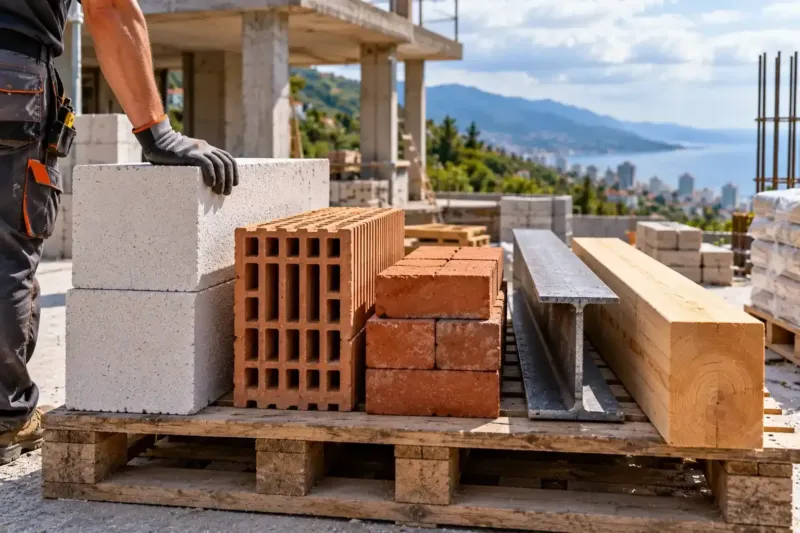
Buying an existing house makes sense if you need it soon and the one you have found has the right plot, layout and paperwork: you pay for what you can see and check separately what you can't. Building is the better option when you want your own layout, a view or rooms to rent out, and you have time for the design, the permit and the construction. Which works out cheaper depends on the specific house and plot. There is no general answer.
Updated 17 October 2026
| Criterion | Build a house | Buy an existing house |
|---|---|---|
| Time until you move in | Design, permit and construction, noticeably longer | After the transaction, registration and any renovation needed |
| Layout | Designed for your family or for renting | As it is, changes cost money and time |
| Concealed work | Rebar, pipes and waterproofing photographed before closing up | Hidden, needs checking by an engineer |
| Land | We check the plot's designated use before the deposit | We check both the land and the house in the registry extract |
| Cost | Set by the estimate, depends on plot and design choices | Known upfront, plus the inspection and improvements |
| Risks | Timing and budget, kept in check by a staged contract | Hidden defects and mismatches with the registry |
| From abroad | Weekly report, payment after each stage is accepted | Under a foreign power of attorney, notary only |
| Climate and earthquakes | Built into the design from the start | As the previous builder did it, the inspection shows how |
The first thing we look at is timing. If you need the house for the coming season, there is no time for a build with a design and a permit, and buying is the only option. If you do have time, whether to build or buy a house depends on two things: how much of an existing house you would have to change to suit you, and what in it cannot be seen with the naked eye.
Both routes start with an extract from the Public Registry. Under the rules in force in 2026, a foreigner cannot buy agricultural land. The exceptions are narrow, inheritance for example, although such land can be leased. That is why we check what the land is designated for, both for a building plot and for an existing house with land.
For an existing house, the extract must list both the plot and the house itself, and the floor area of the house must match what you see on site. An extension, an extra floor or an attic room that is not in the registry becomes your problem after the purchase. We also check who the owners are and whether there are any mortgages or seizures on the property.
The transaction is signed at a Public Service Hall or with a notary, and under a power of attorney issued abroad it can only be done in notarial form. You become the owner once your title is registered in the Public Registry. Building on a plot you have bought starts with a design and a permit: private houses are usually Class II structures, and in Batumi the permit for them is issued by City Hall.
You can judge the finishes, the layout and the view from the windows for yourself at a viewing. The reinforcement in the columns, the waterproofing of the foundations, the pipes in the walls and the cables under the plaster are out of sight, and only documents and indirect signs tell you how the house was built. That is why an engineer and a lawyer look at the house before you pay a deposit.
The engineer looks for cracks in the load-bearing structure and at joints, and for traces of water on ceilings and in the plinth. The roof, the gutters, the paving around the walls, the consumer unit (fuse box) and the drains are checked too. If we can, we come after heavy rain, when leaks and damp are easier to spot. We ask the seller separately for the design documentation and the building permit for the house.
When you build, it is different. You see the concealed work in photos while it is still open, and at the end, along with the keys, you get the handover file: the routing diagrams, those photos and the materials list. We build seismic resistance and moisture protection into the design from the start, while in an existing house they are whatever the previous builder made them.
If you plan to rent the house out, the layout matters. A house built for one family rarely divides well into guest rooms: there are not enough bathrooms, and shared staircases and thin partitions let sound through. It can be converted, but if the work touches load-bearing walls, floor slabs or columns, you need a design and a permit.
A house built for renting gets a bathroom in every room, soundproofing and separate entrances from the start. On the other hand, an existing house starts earning sooner: after the transaction and some light renovation, you can let it out this very season. In both cases we calculate income down to the net figure, and we do not promise any yield.
Compare the full cost. For an existing house, that is the purchase price, the inspection, the renovation or reconstruction needed to bring it to the state you want, and the time all of this takes. For a build, add up the plot, the ground and topographic surveys, the design and permit, the shell, the building services, the finishing and the landscaping.
The price of an existing house is clear from the start, while the final cost of a build depends on the plot and on the decisions you make at the design stage. In our contract the cost of the build is set out stage by stage, and a stage's price stays the same unless you change the scope of work. Send us photos of the plot or of the house you are considering, and we will send a preliminary estimate within 24 hours on business days.
You can choose an existing house without flying in for every viewing. We film the inspection and send you the engineer's report and the registry extract, and for the transaction either you come in person or your representative acts under a power of attorney. If the house needs renovation after the purchase, we take the keys against a signed handover form.
A build managed from abroad runs on reports. Photos and video arrive once a week, every stage is closed with a signed acceptance certificate, and you pay only after that. The site foreman will show you the build on a video call whenever you ask. You can message the project manager on WhatsApp at any time, and you get a reply during working hours.
Choose to build if there is no existing house that fits your plans and you have time. We start by checking the plot before you pay a deposit.
Buying makes sense when you need a house soon and have found one that almost fits. An engineer and a lawyer look at it before the deposit.
Under the rules in force in 2026, yes, as long as the land under the house is not agricultural. Agricultural land is closed to foreign buyers except in narrow cases such as inheritance, but it can be leased. The designated use is shown in the Public Registry extract, and we check it before the deposit.
You become the owner when your title is registered in the registry. The contract can be signed at a Public Service Hall or with a notary, but if you act under a power of attorney issued abroad, the transaction is registered only in notarial form.
The documents and the structure. In the registry extract we look at the owner, any mortgages, the land's designated use and whether the house itself is registered with the same floor area as on site. We ask the seller for the design documentation and the building permit.
On site, the engineer checks for cracks in load-bearing walls and at joints, damp in the plinth, the roof, the gutters, the wiring, and the drains or septic tank. Ideally, view the house after heavy rain, when leaks show up straight away.
Yes. Repainting, replacing the finishes and moving partitions are usually straightforward. If load-bearing walls, floor slabs or columns are changed, you need a design and a permit, and the structural engineer first checks how the house was built and whether it can take the changes, allowing for seismic loads.
Adding a floor or a large extension is in effect new construction on old foundations. Sometimes the survey shows that it would be cheaper to demolish the house and build a new one, and it is better to know this before the transaction.
Yes. To buy, you need a power of attorney. If it is issued abroad, a rule in force since 20 October 2023 applies: such a transaction is registered only in notarial form, which means you will need a notary in Georgia and a translation of the power of attorney. Whether you also need an apostille or legalisation is something a lawyer checks for your country, and we agree the wording of the power of attorney with you before you go to the notary.
For a build, we also submit the permit documents under a power of attorney. If you are buying a plot to build on, it is convenient to have both powers of attorney drawn up in one visit to the notary.
A private house from plot to keys: the decisions needed from you at each stage, what to hand over to us in full and what in parts…
from 1 680 ₾/m²
A private house in Batumi and its suburbs: an extract with house and plot, boundaries, unpermitted structures, seismic safety and…
We reply within an hour during business hours. Message us or leave a request: we’ll call you back, go over the details and suggest the next step.
Mon–Fri 10:00–19:00, Sat 11:00–16:00