
Aerated concrete
Aerated concrete blocks in a concrete frame: how we reinforce the blockwork, what goes on the facade, what to hang appliances on…
from 750 ₾/m²
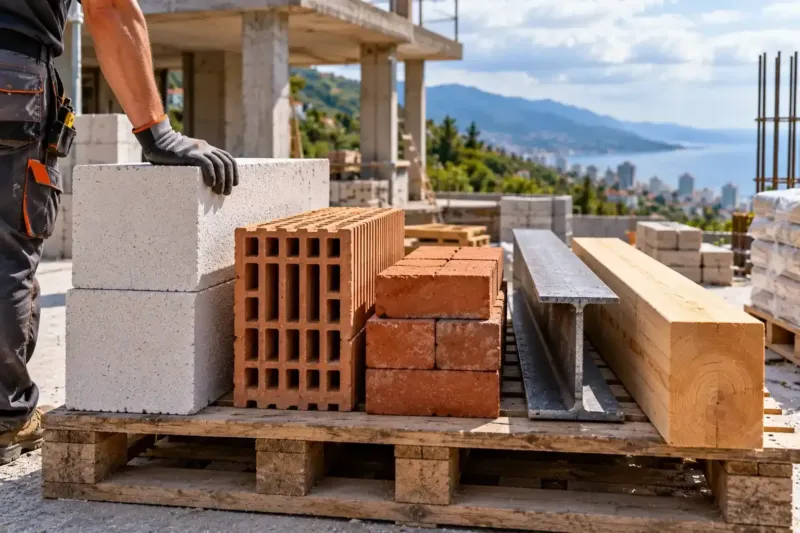
For a home or a guest house in Batumi, factory-made autoclaved aerated concrete (AAC) is more reliable than foam concrete blocks: the blocks are accurately sized and every batch comes with documents. Foam concrete is cheaper, but its quality depends heavily on the workshop that made it, and because it shrinks, it cracks under plaster more often. It makes sense for outbuildings, boundary walls and partitions in utility areas, where a crack will not be a problem.
Updated 17 October 2026
| Criterion | Aerated concrete | Foam concrete |
|---|---|---|
| How it is made | Autoclave, steam and pressure | Hardens in air, quality depends on the workshop |
| Shrinkage and cracks | Small, finishing starts sooner | Greater, cracks along joints and above windows |
| Accuracy and joints | Accurate blocks, thin adhesive joints | Sizes vary, thick mortar joints |
| Water | Absorbs more readily, needs a facade at once | Closed pores, but backyard blocks get wet |
| Strength | One grade across the batch | Varies even within one delivery |
| Checking a batch | Factory certificate with grade and density | Test reports and a photo of a fresh break |
| Where it fits | External walls and partitions of a house | Outbuildings, boundary walls, utility walls |
| Price | Block costs more, finishing and repairs cost less | Block costs less, extra spending on joints and cracks |
At the builders' yard, aerated concrete and foam concrete blocks (also called foamed concrete) look alike: light, porous blocks that are easy to saw. The difference is in how they are made. Factory aerated concrete hardens in an autoclave under steam and pressure, while foam concrete gains strength in the open air. This decides the shrinkage, how accurate the sizes are and how much the strength varies. So for a house in Batumi, aerated concrete vs foam concrete comes down to how many cracks and repairs a block will cause a year later. The price per cubic metre comes second.
After production, foam concrete keeps drying and shrinking, noticeably more than aerated concrete. In the wall this does not show at once. A few months later hairline cracks run along the joints and above the openings, and the plaster cracks along the same lines. An autoclaved block shrinks little, so finishing can start sooner.
A humid climate adds movement. A block that soaks up water over the winter and gives it up in summer changes size slightly again, and a weak foam block reacts more strongly. Reinforcement in the courses and mesh in the plaster help, but they will not fix a weak block.
Factory aerated concrete is cut with wires, so the blocks are almost identical in size. They are laid on adhesive with thin joints. Foam blocks cast in moulds often vary in size, so they are laid on mortar with thick joints, and every thick joint becomes a cold bridge.
In Batumi you see this in winter. Moisture from the room air settles on the cold joints, and a dark grid shows through on the wall, especially in a house that is heated in winter and where laundry is dried indoors. External insulation removes the problem, but then the main argument for a cheap block disappears too.
The low price of foam blocks at the yard melts away on the way to a finished wall. Thick joints eat up mortar, uneven faces need an extra coat of plaster, and cracks have to be opened up and filled after the first winter. Add the reinforcement and mesh that foam blocks need more than aerated concrete does, and the difference in the estimate becomes small.
Both blocks are porous, and by the sea neither should be left without a facade. The pores in foam concrete are mostly closed, so it takes up water from the surface more slowly, and it is often praised for this. The advantage is lost if the block is made in a backyard workshop: uneven foam, voids and shrinkage cracks let water in just as well as open pores do.
Aerated concrete absorbs water more readily, so a vapour-permeable facade and a damp-proof course under the first row are part of the plan for it. That is standard practice wherever it is damp, and in Batumi these items simply go into the estimate from the start.
In a seismic area we do not use either block for the load-bearing walls of a house with several storeys. A cast-in-place concrete frame carries the load, and the blocks fill it in. For infill, consistent strength and weight matter. Factory aerated concrete has one strength grade across the whole batch, while the strength of foam blocks can vary even within one delivery.
A weak block is dangerous wherever something is fixed to it, such as a tie to a column or the anchor of a window frame. In a tremor, or simply under load, it is the first thing to crumble. So for foam blocks we require the batch test reports, and if there are none, we suggest aerated concrete.
Blocks can be checked from documents and photos. We ask the supplier for the batch certificate with the strength grade and density, and on site we measure blocks from different pallets with a tape measure. For foam blocks we add a photo of a fresh break: the pores should be small and even, with no large voids.
These photos go into the weekly report, and the documents for the materials later go into the handover file. A batch that fails the check goes back to the supplier before laying starts, because rebuilding a wall costs more than waiting for another delivery.
Autoclaved aerated concrete is the sensible choice for almost any home on the coast, especially if you follow the build from far away.
Foam blocks are fine where a crack or an extra centimetre of joint will not spoil anything and the look of the wall matters less.
They are often confused by eye, especially as the names get used loosely for any lightweight block. Autoclaved aerated concrete is usually light-coloured, almost white, with straight edges and small pores all the way through. Foam concrete is greyer, its edges are often uneven, and a broken face shows separate round bubbles.
Documents are more reliable. The delivery note and the batch certificate state what the material is, its strength grade and its density. We do not accept blocks on site without documents.
A small outbuilding, yes, but we would not build a home from them. In a humid climate, seasonal wetting and drying add to the shrinkage of foam concrete, so cracks in the finish appear more often. A backyard-made block also takes in water through its voids.
If foam blocks are chosen anyway, you need batch test reports, reinforcement in the courses, mesh in the plaster and a vapour-permeable facade. With these measures the house will last, but the saving on the blocks gets noticeably smaller.
Usually shrinkage is to blame. Non-autoclaved foam concrete finishes drying in the wall, the blocks get slightly smaller, and plaster applied too early tears along with them.
Thick mortar joints, which dry differently from the blocks, add to this, and so do blocks of different strength in the same wall. What helps is reinforcement in the courses, mesh in the plaster and a pause before finishing until the masonry stops drying. A factory-made autoclaved block removes most of the problem from the start.
Aerated concrete blocks in a concrete frame: how we reinforce the blockwork, what goes on the facade, what to hang appliances on…
from 750 ₾/m²
For a garage, utility shed or country house: which foam blocks to choose, why the production date matters and what to do about…
from 720 ₾/m²
We reply within an hour during business hours. Message us or leave a request: we’ll call you back, go over the details and suggest the next step.
Mon–Fri 10:00–19:00, Sat 11:00–16:00