
Glulam
A factory kit of dry lamellas that hardly settles: what to decide before ordering, how to accept the timber on site and when to…
from 1 980 ₾/m²
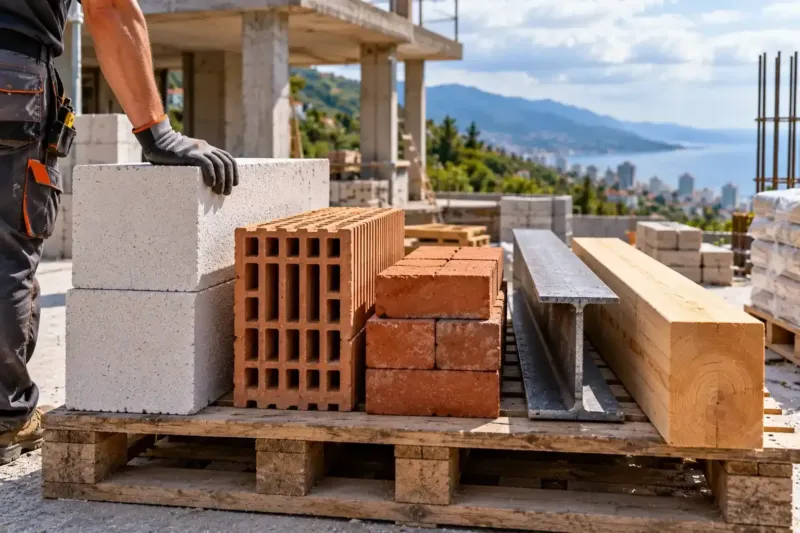
If your house in Batumi is going to be built of timber, glulam is usually a more sensible choice than solid profiled timber. It is glued together from kiln-dried layers, settles little and cracks less, so finishing can start sooner, which matters when you follow the build from far away. Kiln-dried solid timber is cheaper and suits a sauna or a guest cottage. We do not recommend undried timber in a humid climate: it takes a long time to settle and cracks badly.
Updated 17 October 2026
| Criterion | Glulam | Solid profiled timber |
|---|---|---|
| What it is made from | Dry layers glued at the factory | A solid log, undried or kiln-dried |
| Settling | Minimal, but openings still need gaps | Noticeable, openings need an allowance |
| Cracks | Rare and shallow | Deep, water runs into them on the facade |
| Humid climate | The glue line is the risk, exterior glue needed | Undried timber dries slowly |
| Spans and openings | Long beams, large windows | Limited by the size of the trunk |
| Build time | Factory lead time confirmed before the contract, quick assembly | Simpler assembly, then a pause for settling |
| Upkeep | Fewer adjustments after the first winter | Tightening and caulking in the first years |
| Price | Higher for the material | Lower, especially undried timber |
From the outside, glulam and solid profiled timber walls look alike: both are planed to size and assembled with an interlocking profile. The difference is in what each log is made from. Glulam (glued laminated timber) is glued together from several dried layers, while solid profiled timber is cut from a single trunk and comes either undried or kiln-dried. In Adjara the glulam vs solid timber choice comes down to exactly this, because it decides how much the house will settle and crack.
Wood gives off or takes up water until its moisture content balances with the air. In Batumi the air is damp for most of the year, so undried timber dries more slowly here than in a dry climate, and the settling drags on. This kind of timber is a poor fit for the coast: the wall takes a long time to settle, and the finishing and the windows have to wait.
Glulam arrives from the factory dry and hardly settles, but in Batumi's humid air it takes up a little water and swells, so it also needs gaps around windows and doors. Kiln-dried solid timber settles noticeably less than undried timber but more than glulam, so its openings are given a larger settling allowance.
Solid timber cracks as it dries, because the stress inside the trunk is released as splits along the grain. In solid profiled timber these can be deep and wide, and on the facade wind-driven rain runs into them. Glulam is made from layers with the growth rings running in different directions, so it holds its shape and cracks rarely, and not deeply.
On a wall by the sea, cracks are more dangerous than they look. Each one gives water a path to the core of the log, so it has to be filled and painted over.
Both types of timber make a light house, and the seismic load on it is small. The courses are tied together vertically with dowels and the house is anchored to the foundation as the calculation requires. The structural engineer checks the corners and the wall sections between large windows separately.
Glulam comes in longer lengths and larger sections, and it is used for beams over wide spans and for walls with panoramic windows. Solid timber is limited by the size of the trunk, so long walls are assembled with joints, and every joint on the facade is one more place where water and wind get in.
The weak point of glulam is the glue line. If the wrong glue is used or the gluing process is not followed, the line can open up in a damp climate, and the layers on the facade come apart. We ask the manufacturer which glue was used, which standard the timber was glued to and whether it is approved for external walls, and we look at the log ends in the batch.
Solid timber needs no glue, so it cannot delaminate. Its weak points are different: cracks, blue stain and rot if the timber arrives wet and is stacked in the rain without spacers.
A glulam kit is made at the factory to the design, and the walls go up quickly. We confirm the production time with the factory before the contract is signed, because it decides whether the house can be closed in before autumn. Long, heavy beams are lifted by crane, and we check the access for it in advance.
Solid timber can be put up by a small crew, but after assembly it needs a break for settling. Both kinds of wall must get a protective finish before autumn: in Batumi more than half of the year's rain falls between September and January, and bare timber in the rain turns grey and cracks faster.
For a house managed from far away, predictability matters. Glulam moves less, and after the first winter the doors and windows need adjusting less often. With solid timber the joints have to be tightened and caulked in the first years, and you need someone on the spot to do it.
If you are not in Batumi, ask for these in the reports: moisture meter readings on the timber when the batch is accepted, and photos of the insulation between the logs and of the damp-proof course on the plinth under the bottom row of logs. These places are hidden later, and they decide how soon the house will need repairs.
Glulam is the more sensible choice for a home or a rental house when the build is managed from far away and the house should not need fine-tuning after the first winter.
Kiln-dried solid timber suits small buildings and owners who are ready to fine-tune the house in its first years.
It takes longer to make. The boards are kiln-dried, sorted and cut to remove defects, then glued under a press, and only then planed to the profile. That is where the stable moisture content and the accurate shape come from, and that is what you pay for.
For the whole house the difference is smaller than per cubic metre of timber: the walls are only part of the estimate, and the foundation, roof, windows and services cost the same. Glulam also saves time on settling and fine-tuning, so you can live in the house or rent it out sooner.
It does, but rarely and not deeply. The layers are dried before gluing and arranged so that the stresses in them cancel each other out, so there are usually no large cracks like those in solid timber. Small surface cracks appear on the facade under sun and rain if the protective finish is not renewed in time.
Delamination along a glue line is more dangerous than cracks. It points to poor glue or faulty gluing, and we do not use such timber for external walls by the sea.
You can, but we advise against it. In Batumi's humid air undried timber dries slowly, the settling takes a long time, and the cracks come out deep and soak up water on the facade. While the walls are settling, finishes and windows have to be fitted with allowances, and in those years the house needs regular fine-tuning.
If glulam does not fit the budget, choose kiln-dried solid timber and build a pause for settling into the schedule. Undried timber is better left for outbuildings.
A factory kit of dry lamellas that hardly settles: what to decide before ordering, how to accept the timber on site and when to…
from 1 980 ₾/m²
Kiln-dried timber, a sealed “warm joint” and screw jacks for settling: how to build a timber house that comes through a damp…
from 1 200 ₾/m²
We reply within an hour during business hours. Message us or leave a request: we’ll call you back, go over the details and suggest the next step.
Mon–Fri 10:00–19:00, Sat 11:00–16:00