
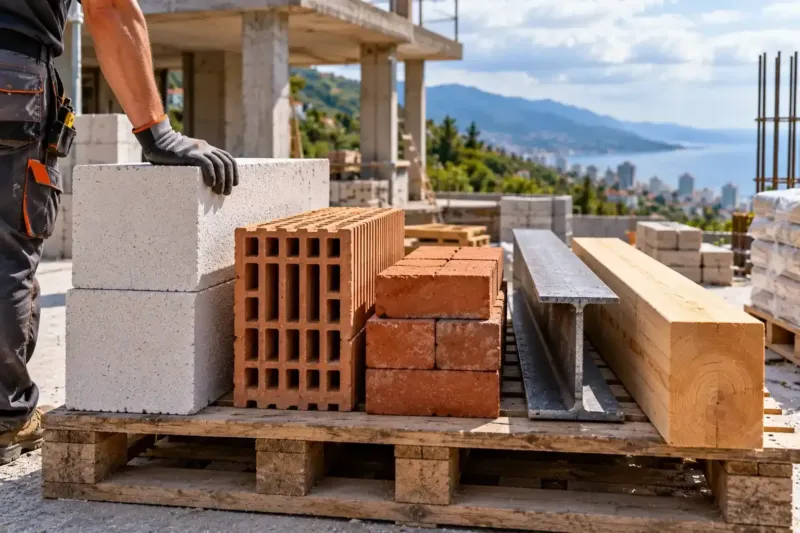
Modular home vs traditional home: what to build in Batumi
If you are going to live in the house or rent it out for many years, building a traditional home makes more sense in Batumi. It copes better with downpours and salt, while seismic safety in both cases depends on the structural calculations. A modular home is the choice when speed matters more: a guest cottage in time for the season, or somewhere to live on the plot while the main house is being built. Either way, you need a foundation, a design and the paperwork.
Updated 17 October 2026
Comparison by criteria
| Criterion | Modular home | Traditional home |
|---|---|---|
| Speed | Built in a factory while the foundation is laid | Stages follow one another, rain delays the schedule |
| Damp and downpours | Joints are the weak point, sealed and checked | Concrete and blocks behind a facade cope with humidity |
| Salt by the sea | A steel frame needs corrosion protection | Rebar inside concrete, stainless fixings outside |
| Seismic load | Modules and their foundation connections need calculations | Frame and reinforcement designed to the Georgian code |
| Access to the plot | Needs access for a heavy truck and room for a crane | Materials come in batches, tight access is no obstacle |
| Layout | Rooms limited by the size of the module | Flexible, with long spans and large windows |
| Soundproofing | Light walls, more sound between rooms | Heavy walls and floors absorb noise |
| Cost of the work | Similar, once delivery, crane and foundation are counted | Similar, with more work on site and a longer build |
A module is assembled in a factory complete with finishes, wiring and plumbing, brought in on a heavy truck and lifted by crane onto a ready foundation. A traditional home goes up on site from concrete, blocks or brick, floor by floor. That is why the modular home vs traditional home question is easier to answer on a real plot than from a catalogue. By the sea, what decides it is access, the ground and how you plan to live in the house.
Modular home vs traditional home by the sea: damp and salt
In our climate, the main weak point of a modular home is the joints. Between the modules there are seams in the walls, floor and roof, and wind-driven rain from the sea finds any gap in them. The seams are sealed during assembly, but after that they need checking, ideally every spring.
Next, we look at the frame. A steel frame rusts faster by the sea, so we ask the manufacturer how it is protected and what fixings are used. For a timber frame, the bigger danger is moisture inside the wall: if the vapour barrier was installed incorrectly, the insulation gets damp over a wet winter and mould starts to grow.
A traditional home faces the same conditions with fewer weak spots. The reinforcement is covered by concrete, a block wall is protected by its facade, and if the render or cladding gets wet, it can be repaired without touching the structure.
Seismic design and permits
Houses in Georgia are designed to the Georgian seismic building code, and a modular home is no exception. The manufacturer has to show calculations for the modules under seismic load, and we design the foundation and the connections that fix the modules to it and to each other. We don't place a module designed for another country's conditions on a plot without that check.
With permits, there is less difference than people expect. The procedure depends on the class of the structure: a private house is usually Class II, which needs a building permit from Batumi City Hall. So we order the modules only once the permit has been granted. A finished house that cannot be installed would have to be stored somewhere.
Delivery and timing
The main advantage of a module is time. While the foundation is being built and utilities are brought to the plot, the house is put together in a factory, where rain does not get in the way. What is left on site is installation, connection to the utilities and finishing the joints.
But the module has to get there. It travels in one piece and is lifted into place by crane, so before ordering we check the width of the street, the bends, overhead wires and where the crane will stand. On a slope with a narrow access road, this sometimes settles the question before any other factor.
A traditional home takes longer to build: the foundation, frame, walls, floors and roof go up one after another, and rainy weeks push the schedule back. On the other hand, materials arrive in batches on ordinary trucks, so tight access is less of a problem for this kind of build.
A house to live in and a house to rent out
For a house you live in all year, we look at sound and heat. The light walls of a module let more sound through between rooms, and in summer such a house heats up faster in the sun. The heavy walls and floors of a traditional home keep it quiet and even out the daytime heat, so the air conditioner has an easier job.
For rentals, the choice depends on the format. Several identical modules on a large plot can be set up in time for the season, with more added as demand grows, but each new module goes through the same permit procedure as the first. A small hotel with rooms on several floors is better suited to traditional construction: soundproofing between rooms and shared risers are easier to get right.
If you live abroad, think about maintenance. The joints, sealant and frame protection of a modular home need regular checks, and someone on site has to do them. A traditional home is more forgiving if an inspection is missed.
How to compare the cost
Compare the full cost of the house standing on your plot. Check whether the module price includes the foundation, delivery, the crane, utility connections and finishing the joints: suppliers count these differently in their offers. A traditional home involves more work on site and takes longer, but there is no cost for transporting finished modules.
Send photos of the plot and a plan, and you'll get a preliminary estimate within 24 hours on business days. In the contract, the price is set out stage by stage. If you already have an offer from a module manufacturer, send that too, and we'll work out what will be left to do on the plot.
Which to choose
When to choose: Modular home
A module makes sense when you need the house quickly and a heavy truck and a crane can reach the plot. We still prepare the design and the permit documents before ordering.
- A guest cottage or a few cottages ready for the coming season
- Somewhere to live on the plot while the main house is being built
- Testing rental demand before a bigger build
- A level plot with wide access
When to choose: Traditional home
Choose a traditional home if you will live in it or keep it for many years. In the Batumi climate it has fewer places that need watching.
- A house for living in all year round, winters included
- A small hotel with rooms on several floors
- A plot right by the sea, where salt quickly reaches any metal
- A narrow or steep access road that a heavy truck cannot use
- An unusual layout, large windows and long spans
Questions and answers
Do you need a building permit for a modular home in Georgia?
As a rule, yes. The procedure depends on the class of the structure, and private houses, modular ones included, usually fall into Class II, which requires a building permit. For a plot within Batumi city limits the permit is issued by Batumi City Hall. Chakvi, Kobuleti and Sarpi belong to other municipalities, so there we check the procedure for the specific address.
We order the modules only after the permit has been granted. Otherwise a finished house could sit in a warehouse while the design is still going through review.
Can you put a modular home on a sloping plot?
Yes, if a crane can reach the plot and there is a level area nearby to set it up on. The house sits on piles or posts tied together with a ground beam. We choose their height to suit the terrain and design the foundation and fixings for seismic loads.
On a slope, delivery is usually the hardest part. Before ordering, we drive the route, note the bends, gradients and overhead wires, and only then confirm that the module can be delivered in one piece.
How long does a modular home last by the sea?
It depends on the frame, the corrosion protection and how well the joints and facade are looked after. A steel frame with a good coating and a timber frame with a correctly installed vapour barrier last a long time, while a cheap module without protection starts to deteriorate sooner by the sea.
Ask the manufacturer about the warranty on the frame and the conditions for keeping it valid. Keep the documents, calculations and care instructions together with the handover file: you will need them for repairs and when you sell the house.
Can you put up a modular home first and build a traditional home later?
Yes. This works well if you want to live on the plot or rent out a guest cottage while the main build is under way. In that case we plan the whole plot from the start: where the house will go, where the module will stand, and the routes for utilities and site vehicles.
We size the water and electricity connections for both buildings so they don't need redoing later. Once the main house is finished, the module stays on as a guest house, a workshop or accommodation for the property manager.
Send photos of your access road and we'll check if a module can get in
We reply within an hour during business hours. Message us or leave a request: we’ll call you back, go over the details and suggest the next step.
Mon–Fri 10:00–19:00, Sat 11:00–16:00