
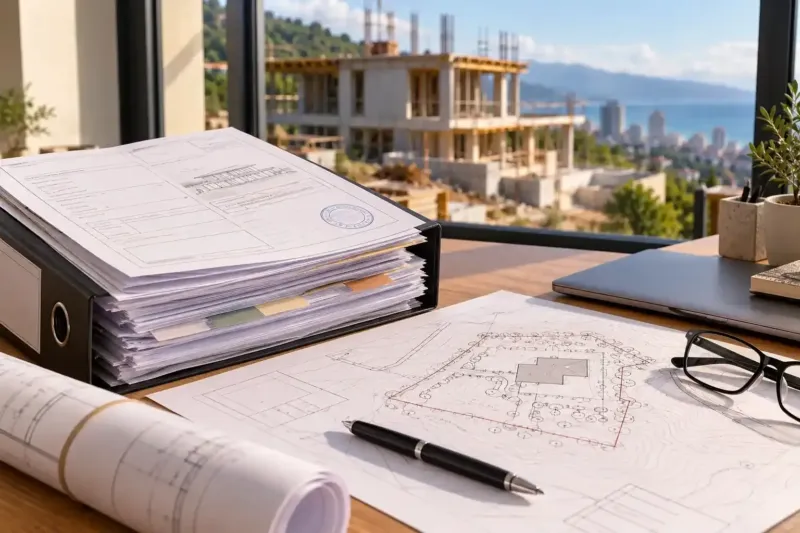
Construction permits and paperwork in Batumi: permits, approvals, commissioning
We handle construction permits and paperwork in Batumi from the extract to registration of the finished house: the plot's development conditions, design approval, the permit, utility technical conditions and commissioning. We legalise buildings put up without a permit and change land designation. If you are abroad, everything goes through a power of attorney, with copies of every decision sent to you. A building permit for a house from 2 280 ₾.
from 2 280 ₾gathering documents and obtaining a building permit for a house. The final price is confirmed once agreed.
- Timeline: paperwork for a private house from extract to permit usually takes 1–3 months, commissioning another 3–6 weeks
- Warranty: We stand behind the documents we prepare and submit
Who it’s for
You have bought a plot and want to build legally from day one
The house is built, but the extract still shows only the plot
There is a storey or an extension without a permit
The plot is registered as agricultural land
You live abroad and cannot go from office to office
What’s included
- checking the extract and land designation
- the plot's development conditions
- approval of the architectural design
- the building permit
- technical conditions for water, electricity and gas
- approvals from City Hall and agencies
- commissioning and registration of the house
- legalising buildings
Construction permits and paperwork in Batumi: what is needed and when
Construction permits and paperwork in Batumi start long before the first excavator bucket and end after the house is registered in the Public Registry. In between come the building permit, approvals from agencies, technical conditions for water, electricity and gas, and commissioning of the house. Skip a step and you get a house with no documents: it is hard to sell, mortgage or legally connect to utilities. We run these procedures for our own projects and separately for owners building with other contractors.
Building classes
In Georgia buildings are divided into classes by level of risk. The class determines whether a permit is needed and how many documents have to be gathered.
| Class | What it usually is | Permit |
|---|---|---|
| I | Small outbuildings, fences | Usually not needed |
| II | A private house, a small guesthouse | Needed, simpler procedure |
| III | An apartment building, a mid-size building | Needed, full procedure |
| IV | Large and tall buildings | Needed, with design review |
A private house almost always falls into class II. How a permit for it is obtained is described on the building permit page.
The order of documents for a new house
- a fresh Public Registry extract and a check of the land designation;
- a topographic survey, and a soil report for difficult plots;
- the plot's development conditions;
- the architectural design and its approval;
- technical conditions for water, electricity and gas;
- the building permit;
- commissioning and registration of the house.
If the plot is registered as agricultural and you plan to build more than your own home, its designation is changed first; more on the land designation change page. We prepare the design for submission ourselves or use yours; more about design on the house design page.
Approvals
Besides the permit, a design often needs separate approvals: in Batumi the facade part of the architectural design is approved separately, in the old town and near monuments the cultural heritage service gets involved, pipelines and roads have their own protection zones, and trees on the plot cannot be cut down without a permit. We check which approvals you need at the start; more on the approvals from City Hall and agencies page.
After construction
Once the house is built, it is commissioned and registered in the Public Registry as a building. Until then the extract shows only the plot, and the house formally does not exist: it cannot be sold to a buyer with a mortgage or pledged at a bank, and utility companies may refuse a permanent connection. More on the house commissioning page.
If it was built without a permit
Adjara has many houses, storeys and extensions built without a permit or not to the design. Older buildings have a simplified legalisation route; newer ones usually go through a fine first, then an as-is design, a stability report and a City Hall decision. An unlegalised extension gets in the way of a sale: the Public Registry may suspend registration. More on the legalising buildings page.
Where time is most often lost
Paperwork most often gets stuck not at City Hall but before it. The extract is out of date and does not show a new restriction. The plot boundaries in the registry do not match the fence, and the design has to be shifted. The design ignores the zone's coefficients and is sent back for revision. Technical conditions for power and gas are requested at the last moment, and the utility company has its own timescale. We check all of this in the first week, before the architect starts drawing.
If you are abroad
Most procedures can be completed without you coming over. Applications are submitted electronically, documents are signed by a representative under a notarised power of attorney, and you receive copies of every decision and extract. It is best to list the specific actions in the power of attorney straight away: submitting applications, obtaining the permit, commissioning and registration. Then it does not have to be redone at every step.
How much the paperwork costs
Gathering documents and obtaining a building permit for a house costs from 2 280 ₾, obtaining the plot's development conditions from 720 ₾. Commissioning a house with document preparation from 1 560 ₾, legalising a building from 3 900 ₾. Support with changing the land designation from 1 200 ₾, one approval at City Hall or an agency from 720 ₾, technical conditions for water, electricity and gas from 480 ₾, a special zonal agreement from 4 800 ₾. By law the City Hall fee for a private house permit is no more than 4 ₾ per m² of new floor area, and it is paid separately. The final cost is set after checking the plot documents and agreeing the scope of work.
Stages and timelines
-
Check
2–5 days
Extract, land designation, zoning rules.
-
Conditions
2–4 weeks
Development conditions for the plot.
-
Design
3–6 weeks
Design approval, agencies.
-
Permit
1–2 weeks
Permit issued, City Hall fee.
-
Commissioning
3–6 weeks
Acceptance, registration of the house.
Local specifics in Batumi
Building rules in and around Batumi vary noticeably: the old town has cultural heritage restrictions, the coast has its own coefficients and setbacks, and in Adjara's villages many plots are registered as agricultural. Some plots were registered long ago, and their registry boundaries do not match the fence. We check all of this before the design so the paperwork does not have to be redone halfway through.
Many houses in Adjara were built without permits and extended one storey at a time over the years. Buyers and banks increasingly check whether the house in the extract matches the house on the plot, so legalisation and registration have become a condition of a normal sale, not a formality.
Materials and brands
Fresh Public Registry extracts, cadastral and topographic plans, the architectural design and, where needed, the structural section and soil report. Notarised powers of attorney for submitting documents on the owner's behalf. Technical conditions from utility companies. Electronic copies of all applications, decisions and permits gathered in one property file, so years later it is clear on what basis the house was built.
What makes up the cost
Timeline: paperwork for a private house from extract to permit usually takes 1–3 months, commissioning another 3–6 weeks
- building class, plot and number of approvals
What raises the cost
- a plot in a heritage zone or near a pipeline
- agricultural land designation
- unpermitted buildings on the plot
- boundaries that differ from the registry
What lowers the cost
- a private house on a clean residential plot
- a finished design and a full set of surveys
We prepare the exact estimate from measurements and photos. It’s free and comes with no obligation.
Get an estimateGuarantees
We stand behind the documents we prepare and submit. If an application is returned because of our mistake in the documents, we correct it and resubmit at our own expense. State fees and City Hall charges are paid by the owner, and we tell you them separately in advance.
Questions and answers
How much do construction permits and paperwork in Batumi cost?
Obtaining a building permit for a house costs from 2 280 ₾, commissioning from 1 560 ₾, legalising a building from 3 900 ₾. By law the City Hall fee for a private house permit is no more than 4 ₾ per m² of new floor area and is paid separately. The final cost is set after checking the plot documents and agreeing the scope of work.
Does a private house need a permit?
Yes, a private house is usually class II and needs a permit, although the procedure is simpler than for apartment buildings. Only small class I buildings go without one. The exact class depends on floor area and height, and we check it against the design before submitting.
Can the paperwork be done if I am abroad?
Yes. Applications are submitted electronically and signed by your representative under a notarised power of attorney. We list all the needed actions in the power of attorney at once: submission, obtaining the permit, commissioning and registration. You receive copies of every decision and extract by email.
What happens if I build without a permit?
City Hall may fine you and order work to stop, and in the worst case demolish what cannot be legalised. Even if it never comes to a fine, a house without a permit cannot be registered as a building: it is hard to sell, mortgage or legally connect to utilities. Legalising it later costs more than getting a permit on time.
How long does it take to get a permit?
By the rules each stage has short deadlines in working days, and if City Hall does not reply in time, the decision is deemed made. In practice, with preparing the design, surveys and revisions, the paperwork for a private house takes one to three months. It takes longer in a heritage zone or when the land designation has to be changed.
Related services
Terms used on this page
- Public Registry extract
- A document from Georgia's state registry: the owner, cadastral code, area, legal use and encumbrances of a property on the date of issue.
Further reading
Send the cadastral code and describe the task: we will tell you which documents you need within 24 hours
We reply within an hour during business hours. Message us or leave a request: we’ll call you back, go over the details and suggest the next step.
Mon–Fri 10:00–19:00, Sat 11:00–16:00