
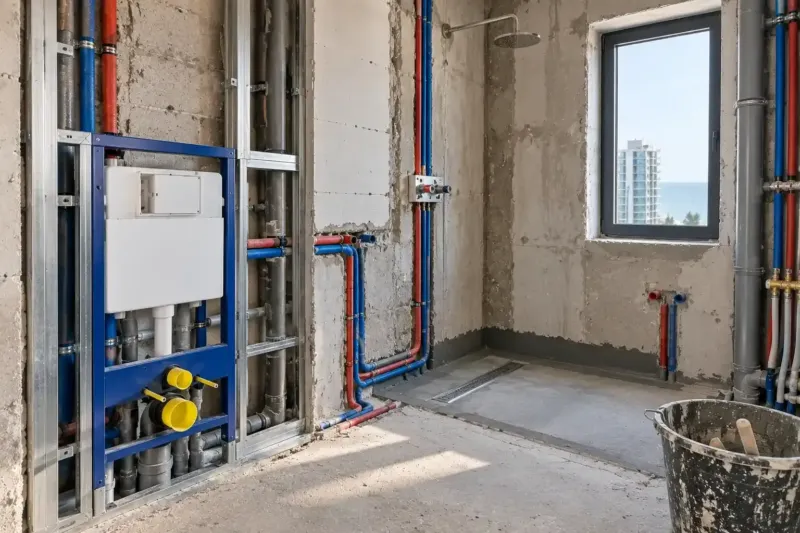
Wall-hung toilet installation in Batumi: installation frame and bowl
Wall-hung toilet installation in Batumi: we fit an installation frame with a concealed cistern and hang the toilet, in new builds and resale apartments. We anchor the frame to the floor slab and to the wall with fixings suited to the wall material, pressure-test the cistern supply and trial-fit the bowl before tiling. Fitting costs from 270 ₾ for labour, with the frame, toilet and boxing priced separately. We photograph every connection with measurements before it is clad.
from 270 ₾/pclabour only: fitting the frame and bowl, with the installation frame, toilet and boxing extra. The final price is confirmed once agreed.
- Timeline: 2–3 days for the frame and checks, then 3–5 days for the boxing and tiles; the bowl goes on once the grout is dry, 1–1.5 weeks in all
- Warranty: A 2-year warranty on fitting the frame and bowl
Who it’s for
In a white frame apartment, the developer left a drain outlet in the floor, but you want a wall-hung toilet
You are replacing a floor-standing toilet with a wall-hung one in a resale apartment and are ready to relay the tiles behind it
You bought the frame and bowl yourself and want someone to fit them to the instructions, with photos before closing up
The previous owners' wall-hung toilet wobbles, and the tiles on the boxing have cracked
You are building a plasterboard partition and want a frame built into it, with a shelf on top
What’s included
- checking the screed and wall for anchors, breaking out a weak section
- marking the centre line and finished floor level with a laser level
- setting the frame on its legs and fixing it to the wall with anchors suited to the wall material
- connecting the outlet bend to the drain and running the cistern supply in rigid pipe
- pressure-testing the supply and photographing the frame with measurements before cladding
- trial-fitting the bowl and load-testing the frame
- hanging the bowl on a sound-insulating pad and fitting the flush plate
- checking the flush and the outlet joint once the bowl is hung
- frame and valve models recorded in the handover file
Frame on the slab or on the finished floor
In a wall-hung toilet installation in Batumi, the legs of the installation frame stand either on the floor slab before the screed goes down, or on the finished floor. They extend with plenty of range: on a Geberit Duofix, for example, from 0 to 20 cm. If we are doing the screed, the frame goes on the slab: we anchor the legs into the concrete, and the screed then locks them in at the base.
In a white frame apartment, the developer has already poured the screed, and sometimes it is sandy and crumbles under the drill. An anchor holds poorly in screed like this, so we drill through it into the slab and use longer anchors. If the screed sounds hollow where the frame will stand, we break out that section.
Fixing to the wall: concrete, block, plasterboard
The frame carries the weight of a person sitting on a wall-hung toilet down to the floor through its legs, while the top brackets stop it tipping forward. These fixings work in pull-out, so we choose them to suit the wall material. In cast-in-place concrete and solid block we use the anchors supplied with the frame. In aerated concrete and hollow breeze block, an expansion anchor works a little looser every time someone sits down, so these walls need a chemical anchor, and in hollow block also a mesh sleeve, so that the resin doesn't run off into the cavity.
In a plasterboard partition, the frame is built into the partition's own framework: its mounting plates are fixed to the wall studs, and we space the studs next to the frame closer than usual. We board such a wall and the boxing by the same rules as other plasterboard structures, only with moisture-resistant board.
Finished floor level, centre line and outlet
The frame has a mark from which the manufacturer measures the height of the bowl and the flush plate. We set it to the finished floor level, that is, allowing for the screed, adhesive and tiles. Forget the thickness of the finish, and the toilet ends up a couple of centimetres lower than planned. We transfer this level to every wall of the bathroom with a laser level, and the basin and floor drain are later set from it.
We tie the centre line of the frame to the tile layout and to the neighbouring fixtures. In our experience, the centre line of the toilet should be at least 35–40 cm from the side wall or the basin, otherwise it feels cramped. We connect the frame's outlet bend to the drain pipe with the adaptor from the kit, with a fall towards the riser. Water reaches the cistern through a rigid pipe up to the angle valve inside the cistern: a flexible hose behind the tiling can't be replaced without opening up the wall.
Checks before cladding
Once a frame is closed in, redoing it means taking the boxing apart and laying new tiles, so before the boards go on we:
- hold the cistern supply under pressure and photograph the pressure gauge;
- trial-fit the bowl on the studs: this shows whether they are long enough and whether the bowl's outlet lines up with the bend;
- sit on the trial-fitted bowl and watch for any movement in the legs and top fixings;
- photograph the frame with a tape measure in shot: the height of the mark, the centre line, the distances to the corners.
You get these photos before the boarding, and later they go into the handover file.
Boxing, tiles and the flush plate opening
We clad the frame with two layers of moisture-resistant plasterboard, screwing the board directly to the frame, and check the thickness of the cladding against the instructions. A single layer of thin board flexes under the bowl, and the tiles around the studs crack.
The flush plate opening is covered by the protective cap from the kit, which stays on until the tiling is finished, so that no adhesive or dust gets into the cistern. Here we cut the tiles precisely to the frame of the opening, because the valves are later replaced through it. The mounting frame for the flush plate adjusts to the thickness of the finish within its own limits, and for thick stone we check this range in advance. How tiles are laid on the boxing so that the cuts don't catch the eye is explained on the page about wall and floor tiling.
Hanging the bowl and handover
We hang the bowl once the grout on the boxing has dried. We cut the studs and connector pipes to the thickness of the finish and fit a sound-insulating pad between the bowl and the wall. We tighten the nuts smoothly, without jerking: a crack in the ceramic from overtightening doesn't appear straight away, but a month or two later.
Then we run full and half flushes several times in a row and check the outlet joint through the flush plate opening. We usually don't run silicone around a wall-hung bowl: the pad closes the joint, and without sealant the bowl is easier to remove if it ever needs to come off.
Replacing a floor-standing toilet with a wall-hung one
This swap can't be done without tiling work. We remove the old toilet, open up the wall behind it, move the outlet to the frame and bring water to the cistern. Then we tile the boxing and cover the floor where the old base stood. If there are no tiles left from the same batch, the floor is relaid or an insert in a different colour is made.
When more than half the tiles have to be replaced, it makes more sense to order a complete toilet renovation straight away: the riser, boxing and floor then follow one schedule. If you would rather not touch the floor and wall, it is simpler to fit a new floor-standing toilet on the old outlet; this job is in the section on fitting toilets, basins and mixers.
How much wall-hung toilet installation costs in Batumi
Fitting the frame and wall-hung toilet costs from 270 to 360 ₾ for labour. The frame, toilet and boxing are not included in this price. A turnkey set with equipment and fitting costs 1,500–2,160 ₾, depending on the brand. Plasterboard boxing with tiling is priced separately, at 300–420 ₾.
When a floor-standing toilet is being replaced, its removal is added, at 57–72 ₾, plus moving the outlet and water, which is priced by plumbing points at 96–145 ₾ per point. A frame in aerated concrete, or in plasterboard that needs reinforcing, and a frame on weak screed cost more. The cheapest option is a frame on the slab against a structural wall next to the riser. The final cost is set after the site measurement and once the estimate is agreed.
Stages and timelines
-
Measurement and choice of frame
1 day
We measure the recess and the height to the window or vent grille, tap-test the screed and look at the wall. We suggest a frame by height and fixing method.
-
Setting out and outlet
1 day
We mark the finished floor level and the centre line and, if needed, move the outlet and water supply.
-
Fitting the frame
1 day
We set the frame in place, level it, anchor it to the floor and wall, and connect the outlet bend and the supply.
-
Checks before cladding
1 day
We hold the supply under pressure, trial-fit the bowl, load the frame and photograph everything with a tape measure.
-
Boxing and tiles
3–5 days
We clad the frame with two layers of moisture-resistant board, lay the tiles and cut out the flush plate opening.
-
Hanging the bowl and handover
1 day
Once the grout has dried, we hang the bowl, fit the flush plate, test the flush and hand over the work with a signed certificate.
Local specifics in Batumi
In summer, Batumi's humid air condenses on anything cold. An installation frame cistern fills with cold water, and without insulation, droplets form on it and run down inside the boxing. Cisterns from the major brands come with anti-condensation insulation fitted at the factory. We don't remove or cut it during installation, and we build the boxing from moisture-resistant board.
In a white frame apartment, the developer brings the drain up through the floor for a floor-standing toilet, wherever suits that kind of toilet. Such an outlet rarely lines up with the frame's bend. We move the pipe to the frame within the screed and check the fall, and if the screed has already been poured, we cut a channel in it as far as the riser.
Anchor holes in concrete are drilled with a hammer drill, and you can hear it several floors away. So we schedule this work for daytime hours: by law, noise is allowed from 08:00 to 23:00, and if the building's rules set shorter hours, we follow them.
Materials and brands
We choose the frame to suit the space. Geberit Duofix, for example, has a standard frame 112 cm high, and a low one, 82 cm, for under a window or a shelf. This brand's cisterns come 12 cm and 8 cm deep, and the slim one helps in a narrow toilet. Besides Geberit, we fit Grohe frames, and Alca as a cheaper option.
Stud spacing and outlet position differ from one bowl to another, so we check the bowl and frame instructions against each other before you buy. We clad the boxing with Knauf or AK Bulut moisture-resistant plasterboard and use stainless steel fixings.
What makes up the cost
Timeline: 2–3 days for the frame and checks, then 3–5 days for the boxing and tiles; the bowl goes on once the grout is dry, 1–1.5 weeks in all
- the frame, bowl and flush plate are paid for separately from fitting and vary noticeably by brand
What raises the cost
- weak developer screed: we drill through to the slab or break out a section
- a partition of hollow block, or plasterboard with a reinforced frame
- moving the outlet from the riser to another wall
- replacing a floor-standing toilet: removal and making good the floor around it
- cladding the boxing in stone or large-format tiles with an exact cut-out for the flush plate
What lowers the cost
- a frame on the slab before screeding, against a structural wall next to the riser
We prepare the exact estimate from measurements and photos. It’s free and comes with no obligation.
Get an estimateGuarantees
A 2-year warranty on fitting the frame and bowl. Pipes in the wall are covered for 5 years. If the frame shifts or the bowl wobbles because of the fixings, we redo the work at our own expense, and if we tiled the boxing, the tiles on it too. The frame, cistern, valves and flush plate carry the manufacturer's warranty.
Questions and answers
How much does wall-hung toilet installation with a frame cost in Batumi?
Fitting the frame and wall-hung toilet costs 270–360 ₾ for labour. If we buy the equipment, a set with the frame, bowl and installation comes to 1,500–2,160 ₾, and the difference depends on the brand of frame and toilet.
Tiled boxing is a separate line, at 300–420 ₾, and if you are replacing an old floor-standing toilet, its removal and moving the outlet are added. The final cost is set after the site measurement and once the estimate is agreed, when the screed and the wall can be seen.
Will a wall-hung toilet hold a heavy person?
Yes, if the frame stands on concrete and is fixed to the wall with anchors suited to its material. The manufacturer tests the frame with a safety margin, and the permitted load for a particular model is given in its technical data sheet. It is usually not the frame itself that fails but the fixings: anchors in crumbly screed or hollow block. The second weak point is the ceramic of the bowl, if the nuts are overtightened.
That is why, before cladding, we sit on the trial-fitted bowl and check whether the frame moves. Still, it is best not to stand on a wall-hung toilet: a point load on the edge of the bowl can crack it.
What should I do if my wall-hung toilet wobbles?
First check the nuts on the studs under the decorative caps. They are tightened with a spanner, smoothly and without force. If the bowl still moves after that, the cause lies deeper: the pad has compressed, the tiles around the studs have cracked, or the frame itself is coming away from the wall.
The last of these shows up as cracks on the boxing. Then we open up the cladding at the fixing, add anchors or replace them with chemical ones, and close the boxing again. It is not worth putting off: over time the rocking damages the outlet and the cistern.
Can an installation frame go under a window?
Yes, there are low frames for this, and Geberit's is 82 cm high. Their cistern sits lower, and the flush plate can be on top of the boxing rather than on the front. The windowsill and reveals stay clear, and the window opens fully.
The same approach works for a toilet under a sloping ceiling or with a shelf above it. We choose the model at the site measurement: we measure the height to the bottom of the window and see how it opens, so that the casement doesn't catch the boxing.
Does an installation frame need a separate access hatch?
Not for the cistern itself. The fill valve, flush valve, supply valve and flush mechanism are serviced through the flush plate opening, so the opening must be cut accurately and not covered by the tiling. The tiles on the boxing stay intact.
A hatch is needed if the same boxing houses a riser with an inspection opening, valves or water meters. Then we fit a tile-ready hatch and size it for the furthest valve: a hand holding a spanner must reach it without taking the boxing apart.
Terms used on this page
- White frame
- An apartment after rough work: partitions, plaster, screed, electrical and water points, but no finishing or sanitary ware.
Further reading
Send photos of the toilet and the frame model, and we'll price the fitting within 24 hours on business days
We reply within an hour during business hours. Message us or leave a request: we’ll call you back, go over the details and suggest the next step.
Mon–Fri 10:00–19:00, Sat 11:00–16:00