
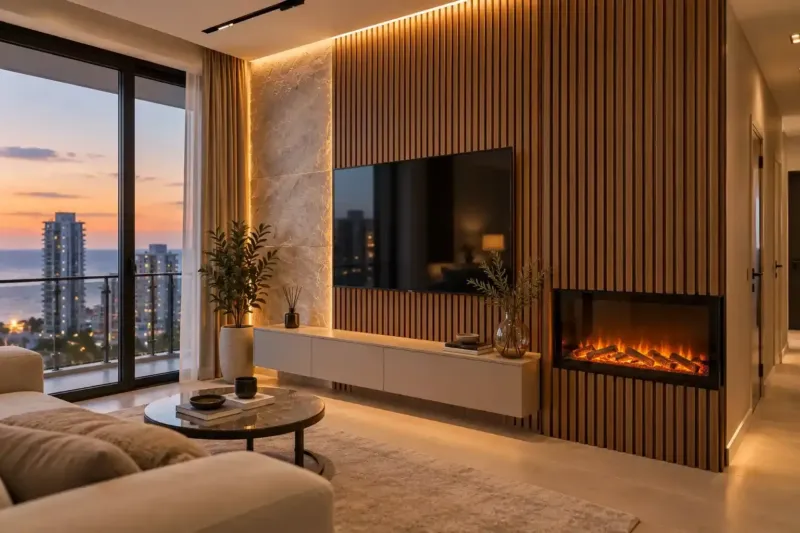
Decorative stone cladding in Batumi: gypsum, concrete, clinker and flexible brick
Decorative stone cladding in Batumi: we clad walls in gypsum and concrete stone, clinker tiles, and flexible brick and stone. Turnkey cladding, with the material, adhesive and grouting, costs from 155 ₾ per m². First we look at what the wall can carry: concrete stone is many times heavier than flexible stone, and gypsum doesn't tolerate water, so for a bathroom or a balcony we choose a different material.
from 155 ₾/m²material, adhesive, installation and grouting; sealer or lacquer extra. The final price is confirmed once agreed.
- Timeline: 3–4 days for an 8–10 m² wall in gypsum stone on level plaster, plus 1–2 days for grouting and sealing
- Warranty: A 2-year warranty on stone cladding
Who it’s for
You want a brick-effect wall in the living room or hallway and are choosing between gypsum and concrete
Your wall is plasterboard, and you need to know whether it will hold stone
You are planning stone in a bathroom or on a balcony and worry that it will get damp
You need to clad a column, an arch or a curved wall where tiles won't sit
You are building a surround for an electric fireplace and choosing cladding for it
What’s included
- inspecting the wall: plaster strength, flatness and moisture
- stripping old paint and wallpaper back to a sound layer, and priming
- choosing the material by weight and room, and a test section
- setting out from several boxes with the tones mixed
- fixing with the adhesive suited to the stone, and mechanical fixings for heavy pieces
- corner pieces, and trimming around windows, doors and sockets
- grouting in a matching colour, or laying tight with no joint
- a sealer or lacquer over the stone and joints
- bringing sockets out flush with the cladding, and fixing pads for a TV
Four materials under one name
Four different materials are sold as “decorative stone”. On the wall they look alike, but one weighs a couple of kilograms per square metre and another tens of kilograms, and gypsum doesn't tolerate water either.
| Material | What it is made of | Where it works well | Where we don't use it |
|---|---|---|---|
| Gypsum stone and brick | Pigmented gypsum cast in a mould | Living room, bedroom, hallway, an electric fireplace surround | Bathroom, kitchen splashback, balcony, a cold external wall |
| Concrete stone | Cement mortar with aggregate and pigment | Hallway, a staircase in a house, a glazed balcony | An ordinary plasterboard partition |
| Clinker tiles | Fired clay, thin brick-effect tiles | Kitchen, bathroom outside the shower, balcony | A base that flexes or crumbles |
| Flexible stone and brick | A slice of sandstone on a fabric backing, or polymer with quartz sand | Columns, curved walls, reveals | A crooked wall: the thin tile follows every wave |
Real marble or travertine is laid with a different method, with its own adhesive and polishing, described on the page about laying natural stone.
Cladding weight and the base
The weight per square metre is given on the packaging, and that is where we start. For flexible stone it is a few kilograms, for concrete stone it can be several dozen, and the plaster has to hold that weight without pulling away from the wall, not just look flat.
We strip old paint and wallpaper back to a sound layer: stone glued onto paint falls off together with it. We tap-test the plaster, open up hollow spots and take out noticeable steps in advance, because a thick bed of adhesive under stone takes a long time to dry and slips. How we straighten a crooked wall is described on the page about wall levelling.
Concrete stone above head height is fixed to the wall mechanically as well as with adhesive: Georgia is seismically active, and we don't leave heavy cladding overhead on adhesive alone. On plasterboard, such stone goes only onto a reinforced frame.
Decorative stone in the bathroom and on the balcony
We don't use gypsum stone in a bathroom, even under lacquer. Steam gets through the joints and hairline cracks in the coating, and the gypsum takes up water, darkens and crumbles near the floor. In a bathroom we use clinker or concrete stone with a water-repellent sealer, and flexible stone only if the manufacturer allows it in wet rooms. We don't recommend textured cladding where the shower spray hits: soap gets stuck in the texture, and the wall has to be scrubbed with a brush.
A glazed balcony is damp in winter and condensation forms on the cold wall, so clinker and concrete stone on exterior-grade adhesive suit it. On an open balcony by the sea, concrete stone develops white efflorescence over time, and there we recommend clinker. Falls, waterproofing and the rest of the finishing are covered on the page about balcony renovation.
Setting out, joints and corners
The tone of the stone varies from box to box, so we lay out a section of the wall on the floor from several boxes at once and mix them. Otherwise stripes will show on the wall, box by box. Brick is laid with a staggered bond, as in real brickwork.
Corners are finished with corner pieces: the smooth cut edge of trimmed stone on a corner immediately gives the imitation away. We either grout the joints in a matching colour or lay the stone tight with no joint, and decide which from a test section. Gypsum is cut with a saw, and concrete and clinker with a diamond blade and dust extraction.
Lighting, sockets and fixings on a stone wall
The relief of the stone shows in side lighting: a light fitting or a strip running along the top of the wall picks out every projection. The same light also shows up crooked joints, so we decide on the lighting before cladding and check the setting-out with the lamp on. The cables for it are laid together with the rest of the lighting plan for the room.
Back boxes are brought forward by the thickness of the cladding, and the stone around them is cut neatly to the size of the plate. A TV and shelves are hung on anchors through the stone into the wall, and their positions are marked before installation. We clad a fireplace surround the same way, and check that the adhesive and stone can take the heat according to the fireplace instructions.
How much decorative stone cladding in Batumi costs
Turnkey wall cladding in decorative stone or brick costs from 155 to 215 ₾ per m², covering the material, adhesive, installation and grouting. The material on its own: gypsum or concrete decorative stone from 36 to 48 ₾ per m², flexible brick or stone veneer from 63 to 72 ₾, and decorative facing brick from 87 to 120 ₾. A sealer or lacquer is a separate line, from 17 to 24 ₾ per m²: gypsum stone always needs one, while clinker in a dry room usually doesn't.
Clinker and concrete in a bathroom or on a balcony, columns, reveals and lots of corners, mechanical fixings and an uneven wall come out more expensive. A level, dry wall in a room and gypsum brick cost less. The final cost is set after the site measurement and once the estimate is agreed.
Sealing and accepting the cladding
Uncoated gypsum stone absorbs grease from hands, and within a year a grey patch appears around the light switch. So after grouting we coat it with lacquer or sealer, matt or with a slight sheen, chosen from a sample. Concrete stone and clinker in a hallway or on a balcony are treated with a water-repellent sealer.
We accept the wall in daylight and with the lighting on. The tones are mixed, the joints are of even width, the corners are covered, and the stone doesn't sound hollow when tapped. The rest of the same batch stays in the storeroom, so that a chip by a socket can later be covered with your own stone rather than a similar one from a different box.
Stages and timelines
-
Wall inspection and test section
1–2 days
We look at the wall and the room, work out the weight of the cladding, show samples and make a test section.
-
Wall preparation
1–3 days
We strip weak coatings, tap-test the plaster, take out steps and prime.
-
Setting out
1 day
We lay out stone from several boxes on the floor and mark the corners, sockets and fixing points on the wall.
-
Installation
2–4 days
We fix the stone from the bottom up with a staggered bond, and fit corner pieces and mechanical fixings where they are needed.
-
Grouting and sealing
1–2 days
We grout the joints, and once the adhesive has dried, coat the stone with a sealer or lacquer.
-
Handover
1 day
We fit the socket plates, accept the wall in daylight and with the lighting on, and leave spare stone.
Local specifics in Batumi
In Batumi, decorative stone is more often spoiled by damp behind it than on it. In winter an external wall is colder than the air in the room, and condensation forms on it in the corners. Gypsum stone on such a wall draws in water from the adhesive side, darkens in patches and comes away. So on the external walls of corner rooms we use concrete or clinker, and before cladding we prime the wall with an antifungal primer.
On open balconies on the seafront, salt soaks into the pores of concrete stone together with water and comes out as a white bloom. It can be washed off, but without a sealer it comes back, so there we renew the sealer every season or two. Clinker absorbs almost no water and copes with salt better.
Boxes of concrete stone and clinker are heavy. In high-rise buildings we agree with the building in advance on bringing the material up, and split the delivery into several lift trips.
Materials and brands
Gypsum stone is fixed with gypsum-based adhesive, for example Knauf, unless the stone manufacturer requires its own product. Concrete stone and clinker go on cement-based Ceresit or Mapei adhesive, and on a balcony we use the exterior products from the same ranges. For flexible stone and brick, the adhesive is specified by the tile manufacturer, and that is the one we use.
We choose dense gypsum stone, with no pinholes on the face and a flat back. For concrete stone and clinker we check the batch number on every box. We test the sealer on an offcut, because some products darken gypsum and give it a wet-look sheen. The stone brand and batch are recorded in the handover file.
What makes up the cost
Timeline: 3–4 days for an 8–10 m² wall in gypsum stone on level plaster, plus 1–2 days for grouting and sealing
- the laying pattern: a staggered bond and matching the stone by tone take time
What raises the cost
- concrete stone and clinker instead of gypsum
- columns, reveals, lots of corners and trimming around sockets
- mechanical fixings for heavy stone above head height
- an uneven wall, or an old coating stripped back to the substrate
- cladding in a bathroom or on a balcony with a water-repellent sealer
What lowers the cost
- a level, dry wall in a room and gypsum brick
We prepare the exact estimate from measurements and photos. It’s free and comes with no obligation.
Get an estimateGuarantees
A 2-year warranty on stone cladding, joints and fixings.
If stone comes away, a joint cracks or a piece falls because of the wall preparation or the installation, we refix it at our own expense. Chips from knocks, stains on stone where the sealer hasn't been renewed, and a difference in tone with a batch bought later are not warranty cases. The stone and adhesive carry the manufacturer's warranty.
Questions and answers
How much does decorative stone wall cladding cost per m² in Batumi?
Turnkey wall cladding in decorative stone or brick costs from 155 to 215 ₾ per m², with the material, adhesive and grouting. The difference depends mainly on the material: gypsum or concrete decorative stone itself costs from 36 to 48 ₾ per m², and flexible stone from 63 to 72 ₾. A sealer or lacquer is a separate line, from 17 to 24 ₾ per m².
Send a photo of the wall, its dimensions and an example of the stone, and we'll send a preliminary estimate within 24 hours on business days. The final cost is set after the site measurement and once the estimate is agreed, when it is clear whether the plaster is sound and how many corners the wall has.
Can decorative stone be fixed to plasterboard?
Yes, if the board and the frame are designed for the weight. Gypsum and flexible stone hold on an ordinary partition: we prime the board, reinforce the joints and fix the stone with gypsum adhesive or the one the manufacturer recommends. Concrete stone is heavier, so for it we build the frame with closely spaced studs and fit two layers of board.
If the partition is already up, we check it first: we tap it, find the studs and see whether the board flexes. When the frame is weak, it is easier to use flexible stone with a similar pattern than to take the wall apart.
Can a kitchen splashback be made of decorative stone?
We don't recommend gypsum: by the hob it absorbs grease and by the sink water, and the texture can't be cleaned afterwards. If you want a brick texture, we put clinker tiles or concrete stone with a water-repellent sealer on the splashback, with a grout that grease doesn't affect.
Even such a splashback is harder to clean than smooth tiles, because splashes stay in the texture. So behind the hob we sometimes leave an insert of glass or porcelain tiles and run the stone over the rest of the wall.
How is flexible brick different from ordinary decorative brick?
Flexible tiles are only a few millimetres thick, weigh many times less than gypsum and concrete, and bend around a column or a rounded corner without cutting. Brick of this type is made from polymer with quartz sand, and stone from a thin slice of sandstone on a fabric backing.
The downside is the same thinness: every wave in the wall shows through, so we level the base more carefully than for three-dimensional stone. The relief on flexible tiles is shallower, and close up they look flat. For a large feature wall in a living room we more often recommend gypsum or concrete brick.
Which decorative stone should I choose for a hallway?
In a hallway, stone gets knocked by suitcases and bags and rubbed by coats, and by the door water from shoes gets on it. So we clad the lower part of the wall, roughly to waist height, in concrete stone or clinker, and put gypsum higher up, or in the hallway of a home you live in yourself. Projecting corners are finished with corner pieces, because the sharp edge of cut stone is the first thing to chip.
We use through-coloured gypsum stone: a chip on it is the same colour as the face, whereas on stone coloured only on the surface a chip shows white. After grouting we coat it with matt lacquer, and hand marks come off with a damp sponge. For a rental apartment we recommend concrete or clinker for the full height.
Related services
Further reading
Send a photo of the wall and a stone you like, and we'll suggest the material and price it
We reply within an hour during business hours. Message us or leave a request: we’ll call you back, go over the details and suggest the next step.
Mon–Fri 10:00–19:00, Sat 11:00–16:00