
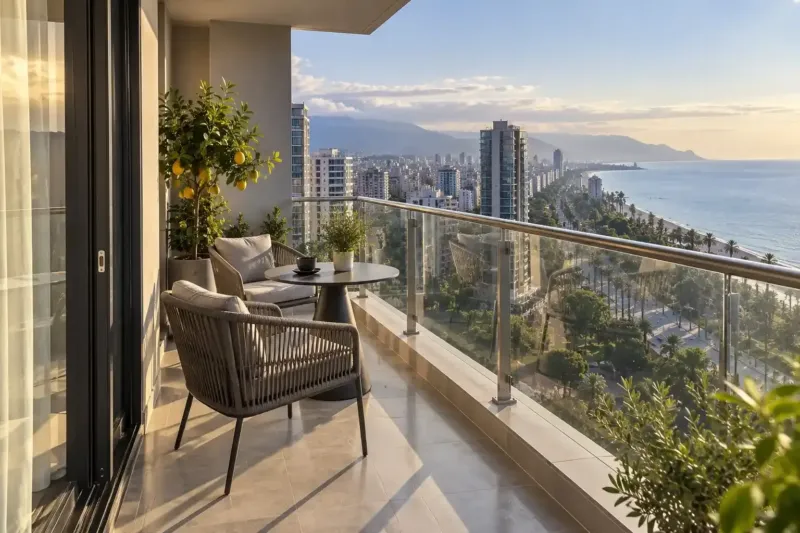
Balcony insulation in Batumi without condensation or mould
We do balcony insulation in Batumi together with warm glazing: with a cold frame, a layer of insulation only moves the condensation from the glass to the walls. We work out where the dew point will be, insulate the floor, walls and ceiling, fit a vapour barrier with taped joints on the room side, and photograph every layer before the lining goes on. Prices start from 130 ₾ per m² of surface, glazing extra.
from 130 ₾/m²labour and materials per m² of insulated surface, glazing extra. The final price is confirmed once agreed.
- Timeline: 2–3 weeks for a balcony with 4–6 m² of floor, with underfloor heating, lining and painting, not counting the glazing
- Warranty: A 2-year warranty on the balcony insulation, lining and finishing
Who it’s for
In winter water collects on the glass and in the corners of the balcony, and mould has appeared behind the wardrobe
You want to turn the loggia into a study or a children's corner for year-round use
The balcony already has warm glazing, but the concrete walls and floor are still cold
The apartment is let for the winter, and damp creeps into the room from the cold balcony
Previous builders insulated the balcony with polystyrene foam, and the lining has started to go dark
What’s included
- inspection of the glazing, signs of condensation and the joint around the frame
- calculating the insulation thickness for your walls and glazing
- treating the concrete with an antifungal solution and sealing cracks
- insulating the floor with extruded polystyrene, then screed or bearers
- insulating the walls, parapet and ceiling in a frame
- a vapour barrier with taped joints on the room side
- lining with moisture-resistant plasterboard
- electric underfloor heating with a thermostat, if you want it
- photos of every layer before closing up, in the report and the handover file
When to insulate a balcony and when not to
Balcony insulation in Batumi makes sense if you want to use the balcony as a room in winter: for a desk, a children's corner or a wardrobe. That takes warm glazing with double-glazed units, an insulated floor, walls and ceiling, and a source of heat. If any of these is missing, the insulation starts working against you.
The most common mistake looks like this: the walls are insulated under a cold aluminium frame with single glass. Warm, moist air from the apartment reaches the glass and frame and settles on them as water, the water runs down onto the sill and into the insulation, and by spring there is mould behind the lining. If you don't plan to change the frame, the balcony is better left cold. If you do, we fit the warm frame first. The types of frames with double glazing are covered on the page about balcony glazing.
If the balcony is being joined to a room, the wall between them is checked first. What can be done with it is covered in the section on room design.
Dew point: where the water on a balcony comes from
In winter the air in a Batumi apartment is humid. At +20 °C and 65% humidity the dew point is about +13 °C, and any surface colder than that gets covered in water. The concrete parapet, the floor slab and the ceiling slab of a balcony are colder than that in winter, so without insulation condensation settles on them even behind good double glazing.
Insulation moves the dew point inside the construction: it ends up within the insulation itself or on the concrete behind it. If vapour from the room gets there, it turns into water where nobody can see it. That is why we fit a vapour barrier on the room side and tape its joints and its junctions with the frame, slabs and walls. We calculate the insulation thickness so that the inner lining stays warmer than the dew point.
Floor, walls and ceiling: what we use
| Surface | Insulation | On top |
|---|---|---|
| Floor | Extruded polystyrene (XPS) over waterproofing | Screed, or bearers with moisture-resistant board and a floor covering |
| Parapet and side walls | Extruded polystyrene, or mineral wool in a frame | Vapour barrier, moisture-resistant plasterboard, filler, paint |
| Ceiling | Mineral wool in a frame, or foil-faced boards | Vapour barrier, plasterboard or panels |
For the floor and parapet we use extruded polystyrene: it absorbs almost no water and doesn't compress under the screed. Mineral wool goes into the frame on the walls and ceiling, where the vapour barrier covers it reliably. We don't use white expanded polystyrene on balconies, as it is brittle and takes on more moisture than the extruded kind.
The balcony slab continues under the wall into the room, and cold travels along it into the apartment: in winter there can be a cold strip on the floor by the balcony door. We take the insulation right up to the threshold and the walls, and fill the joints between boards with foam. The waterproofing under the insulation is done the same way as in an ordinary balcony renovation, carried up the walls and under the threshold.
Underfloor heating, heat and ventilation
An insulated balcony needs its own heat source: the air conditioner in the room if the balcony opens into it, an electric convector heater or underfloor heating. The floor by the glazing is the coldest spot, and warming it gets rid of condensation in the bottom corners, so underfloor heating works better here than a convector.
We lay the electric mat in the tile adhesive bed or under a thin screed and connect it on a separate circuit through an RCD, with a thermostat and a floor sensor. Its cable runs in the wall and is photographed before it is covered. We don't lay the mat under wardrobes and cabinets, because it overheats under furniture.
Without fresh air, even a warm balcony mists up by morning. We leave a panel with a micro-ventilation setting or fit a trickle vent, and if laundry is dried on the balcony, it also needs an extractor fan or a dehumidifier.
How much balcony insulation in Batumi costs
Insulation costs from 130 to 180 ₾ per m² of surface. The price covers labour and materials: insulation, vapour barrier, tapes, frame and lining. We count the area across all the surfaces being insulated, that is the floor, walls, parapet and ceiling together, so for a balcony with five square metres of floor it comes to several times that.
Priced separately are skim coating the walls for painting, from 23 to 36 ₾ per m², laying electric underfloor heating on up to 5 m² for 210–240 ₾ (not including the mat and thermostat), and electrical points at 42–66 ₾ for each socket, switch or light. Warm glazing isn't included in this price: thermally broken aluminium costs 895–1,080 ₾ per m² of opening, and uPVC with double glazing is cheaper.
It costs more when the walls are damp and have to be treated and dried first, when the ceiling is uneven, or when someone else's insulation has to be redone. It costs less if a warm frame is already in and the joint around it has been done properly. The final cost is set after the site measurement and once the estimate is agreed.
How we check the layers before the lining goes on
Insulation is concealed work: once the lining is on, neither the insulation nor the vapour barrier can be seen. We photograph each layer before it is closed up: the joints between boards, the taped membrane, the junctions with the frame and threshold, and the underfloor heating cable route. The photos come in the weekly report and go into the handover file.
During the first winter it is worth keeping an eye on the corners at floor and ceiling level. Dark patches or damp reveals after insulation point to a gap in the vapour barrier or a cold bridge, and with the photos of the layers such a spot can be found without opening up the whole balcony. If our work is the cause, it is a warranty case.
Stages and timelines
-
Inspection and calculation
1–2 days
The foreman looks at the glazing and any signs of water and mould, and measures the surfaces. The engineer calculates the layer thicknesses for your walls and frame.
-
Preparation and drying
1–3 days
We remove any old lining, treat the concrete with an antifungal solution, and seal the frame joint and the cracks.
-
Floor
2–3 days
We lay the insulation over waterproofing, then screed or bearers with moisture-resistant board on top, and an underfloor heating mat if needed.
-
Walls and ceiling
2–3 days
We fit the frame, the insulation and the vapour barrier with taped joints. Each section is photographed before the lining goes on.
-
Lining and finishing
3–5 days
We line with plasterboard, fill, paint with moisture-resistant paint and connect the lights and sockets.
-
Acceptance
1 day
We check the underfloor heating and electrics, sign the certificate on site or by video and hand over the photos of the layers in the handover file.
Local specifics in Batumi
Batumi winters are rarely very cold; the problem is humidity. Outside it is usually above zero, but the air in the apartment is full of vapour from the shower, the kitchen and drying laundry, and it finds every cold surface. So here, balcony insulation is first of all protection against condensation, and only then against cold.
An empty apartment is especially vulnerable in winter: nobody airs it, the air conditioner is off, and on an insulated balcony without fresh air, vapour builds up for weeks. For apartments like this we leave micro-ventilation and recommend a dehumidifier.
In summer, a west-facing balcony behind glass heats up almost the same whether it is insulated or not. Curtains or blinds for the glazing are worth including in the estimate from the start, otherwise you won't be able to sit on such a balcony during the day without air conditioning.
Materials and brands
For the floor and parapet we use extruded polystyrene, and for the frame on the walls and ceiling, mineral wool or foil-faced boards. Profiles and moisture-resistant plasterboard are Knauf, or AK Bulut moisture-resistant board in the budget option, and both are sold in Georgia. The filler for a balcony is moisture-resistant, and the paint is washable.
The brand of insulation matters less than its density and a continuous layer without gaps. We take the vapour barrier membrane and the tapes from one system, so the tape adhesive holds on the membrane for years.
What makes up the cost
Timeline: 2–3 weeks for a balcony with 4–6 m² of floor, with underfloor heating, lining and painting, not counting the glazing
- we count the area across all insulated surfaces, the ceiling included
What raises the cost
- damp walls and mould that we treat and dry first
- underfloor heating with a thermostat
- an uneven ceiling and walls that need a complex frame
- redoing incorrect insulation by previous builders
What lowers the cost
- a warm frame is already in, and the joint around it has been done properly
- a small loggia enclosed at the sides by the building's walls
We prepare the exact estimate from measurements and photos. It’s free and comes with no obligation.
Get an estimateGuarantees
A 2-year warranty on the balcony insulation, lining and finishing. Wiring to the underfloor heating and sockets in walls and floors has 5 years. The heating mat and thermostat carry the manufacturer's warranty, and we hand over the documents.
Questions and answers
How much does balcony insulation cost per m² in Batumi?
Insulation costs from 130 to 180 ₾ per m² of insulated surface, with labour and materials: insulation, vapour barrier, frame and plasterboard. We count the floor, walls, parapet and ceiling together.
Laying underfloor heating on a balcony of up to 5 m² costs 210–240 ₾ without the mat, and skim coating for painting from 23 ₾ per m². Warm glazing is priced separately: thermally broken aluminium from 895 ₾ per m² of opening, uPVC less. We send a preliminary estimate from photos within 24 hours on business days, and the final cost is set after the site measurement and once the estimate is agreed.
Why does my balcony sweat in winter and how do I stop it?
Water appears where warm, moist air from the apartment meets cold glass, a cold frame or a cold concrete corner. The more humid the air, the sooner this starts, and in a Batumi apartment humidity is high in winter, especially if laundry is dried indoors.
With cold glazing, it is simpler to keep the balcony door closed and air the balcony itself. With warm glazing, insulating the corners and slabs, micro-ventilation and heating the floor by the glass all help. A dehumidifier solves the problem for a while, but it won't close a gap in the insulation.
Can you insulate a balcony from the outside?
On an apartment block, usually not. Working outside at height needs rope access teams, and insulation and finishes on the outside change the facade, which requires the building's consent. So we insulate apartment balconies from the inside.
External insulation is done when the whole building gets a new facade, or on a private house where the facade is yours. Then the balcony insulation becomes part of the overall facade layer, and there are fewer cold bridges at the joints.
Do you need to insulate the balcony ceiling if there are neighbours above?
Yes. Above you is the slab of the neighbours' balcony, with the open air or their cold balcony on top of it, so in winter it is almost as cold as an external wall. Without ceiling insulation, condensation collects in the top corners, and that is usually where mould starts.
We insulate the ceiling with the same layer as the walls, with a vapour barrier and a taped joint where it meets the frame. If the balcony above is open and has no waterproofing, we first come to an agreement with the neighbours about doing it, otherwise water from their slab will get into your insulation.
How much space does a balcony lose after insulation?
Each insulated wall gets thicker by the insulation, frame and plasterboard, usually by 6–10 cm. The floor rises by the insulation and the screed, and a step appears at the balcony door unless the level is planned in advance.
On a narrow balcony this is noticeable, so we calculate the thickness on site and, where the calculation allows, use thinner foil-faced boards on the parapet. We agree the floor height with you before work starts, so that the door opens freely and nobody trips over the step.
Further reading
Send photos of the balcony and frames, and we'll price the insulation within 24 hours
We reply within an hour during business hours. Message us or leave a request: we’ll call you back, go over the details and suggest the next step.
Mon–Fri 10:00–19:00, Sat 11:00–16:00