
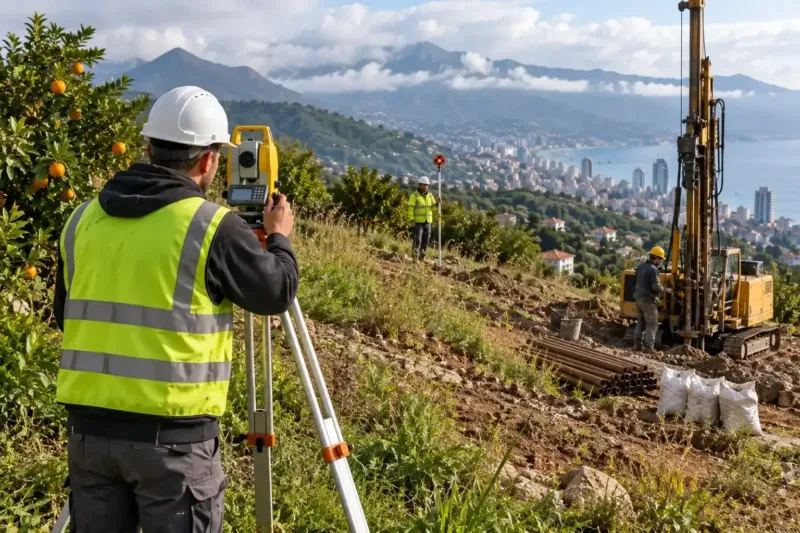
Plot boundary staking in Batumi: points, markers, checks against the fence
Plot boundary staking in Batumi transfers the plot corners onto the ground from Public Registry coordinates and fixes them with boundary markers. That shows whether the fence matches the documents, whether there is room for the house with setbacks and whether there are overlaps with neighbours. If the registry boundary is inaccurate, we prepare a measurement drawing for correction. Boundary staking up to 6 points from 510 ₾.
from 510 ₾boundary staking with boundary markers, up to 6 points. The final price is confirmed once agreed.
- Timeline: boundary staking usually takes one visit and 2–4 days including the diagram; correcting data takes longer
- Warranty: 2 years on the work, 5 years on concealed pipes and wiring
Who it’s for
You are buying a plot and want to check it before the deposit
You are putting up a new fence and are not sure where the boundary is
The neighbour thinks your fence is on their land
You are starting a design and need to keep the setbacks
The plot was divided or merged and the new corners need marking
What’s included
- checking the extract and plot coordinates
- checking for overlaps with neighbouring plots
- staking out the plot corners with an instrument
- setting boundary markers
- showing the points to you and the neighbour
- a diagram with coordinates and discrepancies
- photos and video for an owner abroad
- a measurement drawing where data is inaccurate
Plot boundary staking in Batumi: what it is and why
Plot boundary staking in Batumi transfers the plot corners onto the ground from the coordinates in the Public Registry. The surveyor finds the points with an instrument and fixes them with boundary markers, and you see where your land really ends. The fence, old posts and what the seller or neighbour says often do not match the documents: a fence may have stood for half a century, but half a metre to one side. Boundary staking shows this before you pay a deposit, put up a new fence or start a design.
When boundary staking is needed
- before buying a plot, to check it on the ground;
- before designing a house, to keep the boundary setbacks;
- before putting up a new fence;
- in a dispute with a neighbour about where the boundary runs;
- after plots are divided or merged.
A new fence is put up strictly on the staked points; more on the fences page. On narrow plots, where every half metre decides whether the house will fit, boundary staking is especially important; more on the houses on narrow plots page.
How the work goes
We take a fresh Public Registry extract with the plot coordinates and check for overlaps with neighbouring plots. On site the surveyor finds the points, sets boundary markers and shows them to you and, if needed, to the neighbour. You receive a diagram with coordinates, point numbers and discrepancies with the actual fence. If you are abroad, we send a photo of each marker and a video walk along the boundary.
If the boundary does not match
There are three situations. The fence is not on the boundary but the registry is correct: then the fence is moved, ideally by agreement with the neighbour. The boundary was entered in the registry long ago and inaccurately, and the staked points clearly differ from actual land use: then a measurement drawing and a correction of the registry data are needed. Plots overlap each other in the registry: this is resolved by measurement, agreement with the neighbour and submitting corrections. Such questions are best settled before buying or before the design. How we support a plot purchase and check documents is described on the transaction support page.
Boundary staking when buying
Before buying a plot, boundary staking is best done together with an inspection. We check whether other people's buildings stand on the plot, whether a road, path or pipe used by the neighbours crosses it, and how the plot relates to the street. If the seller shows the boundary along the fence but the points fall elsewhere, that is a reason to clarify the terms before the deposit, not after registration.
Boundary markers
We set markers so they can be seen and are hard to move by accident: steel pins set in concrete, or painted pegs for the duration of construction. Machinery on site easily knocks them out, so before the fence and foundation we check the points again. The diagram with coordinates stays with you, and any point can be staked again even if the marker is lost.
How much boundary staking costs
Staking out plot boundaries on site with boundary markers, up to 6 points, costs from 510 ₾, and each additional point from 66 ₾. A plot measurement drawing for the Public Registry from 600 ₾, a topographic survey of a plot up to 1 000 m² from 1 020 ₾, setting out the house axes from 600 ₾. The final cost is set after checking the extract and an agreed estimate.
Stages and timelines
-
Documents
1–2 days
Extract, coordinates, neighbours.
-
Site visit
1 day
Staking points, boundary markers.
-
Comparison
1 day
Fence, buildings, discrepancies.
-
Diagram
1–2 days
Coordinates, photos, video.
-
Correction
1–3 weeks
Measurement drawing if needed.
Local specifics in Batumi
In Batumi and the villages of Adjara there are many plots that were divided for generations by fences, ditches and verbal agreements and only later entered in the registry. Some of them have inaccurate coordinates or overlap with neighbours, and fences stand somewhere other than the boundary in the extract. In the dense development of the city, every half metre decides whether the house will fit with its setbacks.
On slopes and overgrown plots the corners can be hard to find and fix: a point may turn out to be in a ravine or a bamboo thicket. We clear access to the point and set the marker where it can be seen, and if a marker cannot be set, we stake out a line and show the direction of the boundary.
Materials and brands
GNSS receivers and total stations for staking out points in registry coordinates. Boundary markers: steel pins, concrete posts, painted pegs for the duration of construction. Software for processing and diagrams, Public Registry extracts. A photo of each marker and a video walk along the boundary. Measurement drawings for correcting registry data. Before the visit we check the coordinates against neighbouring plots to see any overlaps straight away.
What makes up the cost
Timeline: boundary staking usually takes one visit and 2–4 days including the diagram; correcting data takes longer
- number of points and plot complexity
What raises the cost
- many corners and a complex plot shape
- vegetation, a slope, difficult access to the points
- discrepancies with the registry and neighbours
- a measurement drawing for correction
What lowers the cost
- a simple rectangular plot
- staking together with a topographic survey on one visit
We prepare the exact estimate from measurements and photos. It’s free and comes with no obligation.
Get an estimateGuarantees
We stand behind staking the points accurately from registry coordinates. If an error in our staking is found, we stake the points again and cover the cost of redoing the fence where we were at fault. The diagram with coordinates goes into the building file.
Questions and answers
How much does plot boundary staking in Batumi cost?
Boundary staking up to 6 points with markers costs from 510 ₾, each additional point from 66 ₾. A measurement drawing for the Public Registry from 600 ₾. If staking is done together with a topographic survey on one visit, it works out cheaper. The final cost is set after checking the extract and an agreed estimate.
The fence is not on the boundary: what to do?
First work out who is right: the registry or the fence. If the registry is correct, the fence is best moved by agreement with the neighbour. If the registry boundary was entered inaccurately, a measurement drawing and a correction of the data are needed. Either way, it is not worth building a house or a new fence until the question is settled.
Is boundary staking needed before buying a plot?
We strongly recommend it. It shows whether the plot on the ground matches the documents, whether someone else's fence, shed or road stands on it, and whether there is room for the house with setbacks. It does not cost much and is done before the deposit.
What if plots overlap in the registry?
The plots need measuring, the boundary agreed with the neighbour and corrections submitted to the Public Registry. This takes time, so the question is best settled before buying or before the design. We prepare the measurement drawing and help with submitting the documents. Until the correction is entered, it is better not to start the design or the fence.
What if a boundary marker is lost?
Not a problem: you keep the diagram with coordinates, and any point can be staked again. On a building site markers are often knocked out by machinery, so before the fence and foundation we check the points again. Re-staking one or two points costs little and takes about an hour.
Terms used on this page
- Public Registry extract
- A document from Georgia's state registry: the owner, cadastral code, area, legal use and encumbrances of a property on the date of issue.
Further reading
Send the cadastral code or extract: we will price the boundary staking within 24 hours
We reply within an hour during business hours. Message us or leave a request: we’ll call you back, go over the details and suggest the next step.
Mon–Fri 10:00–19:00, Sat 11:00–16:00