
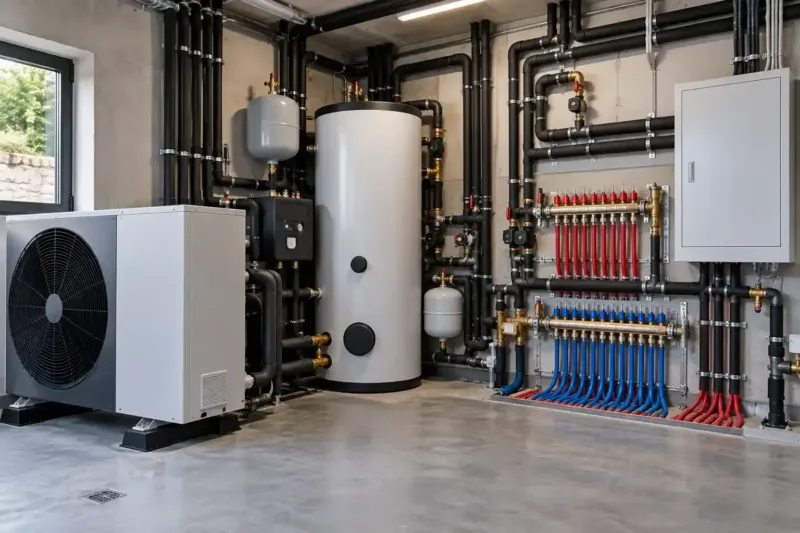
Underfloor heating in a private house: wet and electric
We install wet underfloor heating in a private house from a boiler or heat pump, and electric for bathrooms and single rooms. We lay insulation and an edge strip, PEX pipe in circuits of up to 80–100 m, build a manifold with flow meters and a mixing unit, and pressure test before screeding. Wet underfloor heating with materials from 120 ₾ per m².
from 120 ₾/m²insulation, edge strip, pipe and fixings, without screed. The final price is confirmed once agreed.
- Timeline: wet underfloor heating in a 120–150 m² house usually takes 1–2 weeks to install and 3–4 weeks for the screed
- Warranty: Underfloor heating installation carries a 2-year warranty
Who it’s for
You are building a house and want heating without radiators on the walls
You are fitting a heat pump and need low-temperature emitters
Tiles in bathrooms and on the ground floor are cold in winter
You want underfloor heating in a single room or bathroom
An old underfloor system heats in stripes or not at all
What’s included
- circuit and pipe spacing calculation
- insulation and edge strip
- pipe laid in circuits by room
- manifold with flow meters
- mixing unit where there are radiators
- pressure test before screeding
- room thermostats
- balancing and gradual screed warm-up
Underfloor heating in a private house: wet or electric
Underfloor heating in a private house warms gently and evenly, takes up no wall space and does not stir up dust. A wet system runs from a boiler or heat pump and suits heating the whole house. An electric one is handy for a bathroom, a single room or a house the owners rarely visit: it is cheaper to install but more expensive to run if it heats large areas. In a new house we almost always fit a wet system and keep electric for specific tasks.
The floor build-up
- a level base: a ground-bearing slab or a floor slab;
- insulation: 50–100 mm on the ground floor, thinner on upper floors;
- edge expansion strip around the room;
- film or castellated panels to hold the pipe;
- PEX pipe at 10–20 cm centres;
- 5–7 cm of screed over the pipe and the final floor finish.
Without insulation on the ground floor half the heat goes into the ground. Without an edge strip the screed cracks at the walls when heated. Before screeding the pipes are pressure tested and left under pressure until the screed has gained strength.
Circuits and manifold
Each room gets its own circuit no longer than 80–100 m, and large rooms are split into several. All circuits meet at a manifold with flow meters, where they are balanced so that rooms heat evenly. If the house also has radiators, we fit a mixing unit that lowers the water temperature for the floor. Each room has its own thermostat, and bathrooms can be warmed in summer too, with the heating off, if a separate electric loop is fitted.
Which floor finish
Tiles, porcelain and stone conduct heat best. Engineered wood, laminate and vinyl floors work if the manufacturer approves them for underfloor heating and the surface temperature stays within the limit. Thick rugs and soft underlays act as insulation and reduce output. We plan the furniture layout in advance: no pipe goes under a fitted kitchen or wardrobes.
Underfloor heating and a heat pump
A wet floor is the best partner for a heat pump: water at 30–35 °C is enough for it, and the pump runs in its most economical mode. In summer cool water can be sent through the same pipes, carefully and with an eye on humidity so that condensation does not form on the floor. With a gas boiler a floor also works well, through a mixing unit. How to choose the heat source is described on the heating page.
Common mistakes
A screed that is too thin cracks and heats in stripes, pipe joints in the screed will leak sooner or later, and circuits of different lengths without balancing give cold rooms. Another mistake is to turn the floor on at full power right after pouring: the screed is warmed up gradually on a schedule. If you need underfloor heating in an apartment rather than a house, see the underfloor heating in an apartment page.
How much underfloor heating costs
Wet underfloor heating with materials costs from 120 ₾ per m²: insulation, edge strip, pipe and fixings, without screed. Laying a wet system with the client's materials from 48 ₾ per m², electric underfloor heating with materials from 110 ₾ per m². A manifold with mixing unit from 1 860 ₾, screed to levelling rails from 40 ₾ per m², a room thermostat or sensor from 160 ₾. The final cost is set after the circuit calculation and an agreed estimate.
Stages and timelines
-
Calculation
2–5 days
Heat loss, circuits, pipe spacing, manifold location.
-
Preparation
1–3 days
Base, insulation, edge strip, film.
-
Laying
2–5 days
Pipe in circuits, manifold, pressure test, photos.
-
Screed
3–4 weeks
Pouring with the pipes under pressure, curing.
-
Start-up
1–2 weeks
Gradual warm-up, balancing, thermostat settings.
Local specifics in Batumi
Winter in Batumi is damp, and a tiled ground floor without heating feels icy even at plus ten outside. Underfloor heating is valued here not only for warmth: it dries the floor and the bottom of the walls, and in bathrooms it dries the tiles quickly after a shower. So in houses by the sea we often fit wet underfloor heating across the whole ground floor and in the bathrooms.
In a house with a ground-bearing slab on the coast, groundwater is close, and insulation under the slab and the pipes is especially important, otherwise heat drains into the wet ground. Under the screed along external walls we lay the pipe closer together, since the floor loses more heat there. In the mountains, where heating runs for a long time, underfloor heating with a boiler or heat pump is noticeably more economical than radiators.
Materials and brands
PEX or PE-RT pipes with an oxygen barrier, castellated panels or polystyrene with film, extruded polystyrene under a ground-bearing slab. Edge strip, manifolds with flow meters and actuators, mixing units, room thermostats. Cement screed with fibre or semi-dry screed. Electric mats and cables with thermostats for individual rooms.
What makes up the cost
Timeline: wet underfloor heating in a 120–150 m² house usually takes 1–2 weeks to install and 3–4 weeks for the screed
- area and number of circuits
What raises the cost
- thick insulation on the ground floor
- many rooms with individual thermostats
- a mixing unit and complex controls
- a complex layout around furniture and alcoves
What lowers the cost
- large open-plan spaces
- working with a heat pump without a mixer
We prepare the exact estimate from measurements and photos. It’s free and comes with no obligation.
Get an estimateGuarantees
Underfloor heating installation carries a 2-year warranty. Pipes in the screed carry a 5-year warranty. The circuit layout with reference to the walls and photos before screeding go into the building file.
Questions and answers
How much does underfloor heating in a private house cost?
Wet underfloor heating with materials costs from 120 ₾ per m²: insulation, strip, pipe and fixings, without screed. A manifold with mixing unit from 1 860 ₾, an electric floor with materials from 110 ₾ per m². The final cost is set after the circuit calculation and an agreed estimate.
Wet or electric underfloor heating for a house?
For heating the whole house, wet: it runs from a boiler or heat pump and is cheaper to operate. Electric suits a bathroom, a single room or a house used rarely. It is cheaper to install but more expensive to run over large areas.
Can parquet or laminate go over underfloor heating?
Yes, if the flooring manufacturer approves it for underfloor heating and the surface temperature stays within the limit. Tiles and stone conduct heat best. Engineered wood is suitable, solid wood and thick underlays less so. Rugs reduce heat output. Before laying wood the screed must be dried and its moisture content measured.
Why does underfloor heating heat in stripes?
Usually the screed over the pipe is too thin or the pipe spacing too wide. Other causes: circuits of different lengths without balancing, air in the system, a weak pump. We start at the manifold, checking flows and bleeding air, and if the screed is the problem, only relaying helps.
Is underfloor heating suitable for a heat pump?
It is the best option: water at 30–35 °C is enough for the floor, and the pump runs in its most economical mode. In summer cool water can be sent through the same pipes for light cooling, keeping an eye on humidity so that condensation does not appear on the floor.
Further reading
Send the floor plan: we will price the underfloor heating within 24 hours
We reply within an hour during business hours. Message us or leave a request: we’ll call you back, go over the details and suggest the next step.
Mon–Fri 10:00–19:00, Sat 11:00–16:00