
Heating for a private house in Batumi: boiler, heat pump, underfloor
We size heating for a private house in Batumi from heat loss, and choose the heat source to suit the plot: a gas boiler, heat pump, electric boiler or a solid fuel boiler in the mountains. We fit radiators under windows or underfloor heating, and build a plant room with separate circuits, weather compensation and phone control. A turnkey heating system from 145 ₾ per m² of house.
from 145 ₾/m²boiler, radiators or underfloor heating, distribution and controls, per m² of house. The final price is confirmed once agreed.
- Timeline: heating for a 150–200 m² house usually takes 3–6 weeks, distribution before screed and plaster
- Warranty: Heating installation carries a 2-year warranty
Who it’s for
You are building a house and choosing how to heat it
The house is damp and cold in winter and the old boiler cannot cope
There is no gas at the plot and you need an alternative
A house in the mountains where power is cut in winter
You leave for the winter and want to keep the house dry and warm remotely
What’s included
- heat loss and output calculation
- choice of heat source for the plot
- radiators, underfloor heating or both
- plant room: boiler, cylinder, pump groups
- hydraulic separator, expansion vessel, safety
- weather compensation and thermostats
- a flue for the boiler
- pressure test, start-up, settings, phone control
Heating for a private house in Batumi: how much heat is needed
Winter in Batumi is mild but damp. Heating for a private house here runs for a few months a year, but in those months it keeps the house not only warm but also dry: in a cold house by the sea walls, furniture and textiles soon get damp. We size the system from the heat loss of the specific house rather than its floor area: an insulated aerated concrete house needs several times less heat than an old stone house without insulation.
Heat source
| Source | Advantages | When it fits |
|---|---|---|
| Gas boiler | Inexpensive heat, works in any weather | Gas main at the plot, year-round living |
| Heat pump | Heats in winter, cools in summer, cheap to run | No gas, insulated house, cooling needed too |
| Electric boiler | Cheap to install, no flue | Small house, occasional use, backup |
| Solid fuel or pellet boiler | Independent of networks | Mountain villages without gas, backup during power cuts |
Gas and heat pumps are compared in detail on the heat pump or gas page. There are separate pages on gas connection and heat pumps.
Radiators or underfloor heating
Radiators heat a room quickly and suit a gas boiler. We place them under windows so that warm air cuts off the cold from the glass and the glass does not mist up. Underfloor heating warms more gently and evenly, takes up no wall space and works well with a heat pump at low water temperature. We often combine them: underfloor heating on the ground floor and in bathrooms, radiators in the upstairs bedrooms. How a wet underfloor system is built is described on the underfloor heating page.
Plant room and pipework
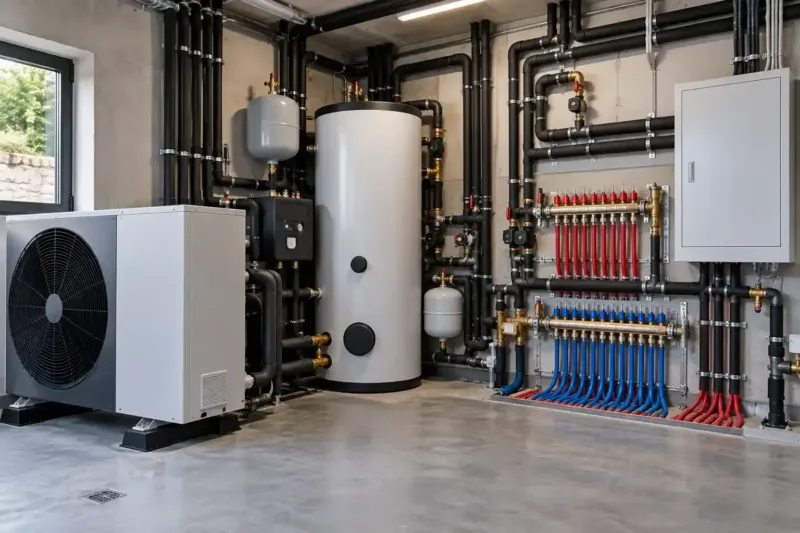
The boiler or heat pump hydro module goes in the plant room together with an indirect cylinder, pump groups, a hydraulic separator, an expansion vessel and a safety group. Each circuit, radiators, underfloor heating, cylinder, runs with its own pump and its own temperature. Controls with an outdoor sensor lower the water temperature by themselves in mild weather, and a communication module lets you control heating from your phone.
- separate circuits for radiators, underfloor heating and hot water;
- weather compensation and room thermostats;
- valves on each emitter for repairs without draining the system;
- a filter and dirt separator so the boiler does not clog;
- a flue to the boiler manufacturer's requirements.
An empty house in winter
If nobody lives in the house in winter, heating is switched to a holding mode of plus 8–12 °C. Temperature and humidity sensors send alerts to the phone, and the boiler and pumps are connected to backup power so that a night-time power cut does not end in frozen pipes in a mountain house. Frosts are rare in Batumi, but it is still worth keeping some heat on: that way damp does not set in.
How much heating for a private house costs
A turnkey heating system with a boiler, radiators or underfloor heating, distribution and controls costs from 145 ₾ per m² of house. A 24 kW gas boiler installed from 2 760 ₾, a condensing boiler with cylinder from 5 400 ₾, a 9–12 kW electric boiler from 2 820 ₾, a solid fuel or pellet boiler from 9 600 ₾. A radiator with connection from 275 ₾, wet underfloor heating with materials from 120 ₾ per m². Plant room pipework from 6 300 ₾, an insulated stainless flue from 450 ₾ per linear metre. The final cost is set after the heat loss calculation and an agreed estimate.
Stages and timelines
-
Calculation
3–7 days
Heat loss, output, choice of source and emitters.
-
Distribution
1–3 weeks
Pipes to radiators and manifolds, underfloor before screed.
-
Plant room
1–2 weeks
Boiler or heat pump, cylinder, pipework, flue, controls.
-
Emitters
3–5 days
Radiators after finishing, thermostats, manifolds.
-
Start-up
1–3 days
Pressure test, filling, commissioning, owner training.
Local specifics in Batumi
By the sea the main job of heating in winter is to keep the house dry. Outdoor humidity stays high for weeks, and in a house without constant heat the damp moves into walls and wardrobes. So even in a house the owners visit only now and then, we advise against switching heating off completely for the winter: keeping a low temperature costs less than fighting mould in spring.
In the mountain villages of Adjara winter is real, with snow and frost, gas is often absent and power gets cut. There we more often install a solid fuel or pellet boiler with a thermal store, or a heat pump with a backup boiler, and connect the heating pumps to backup power. We fill the system so that it can be drained quickly if the house is to be left without heat for long.
Materials and brands
Wall-hung and condensing gas boilers, air-to-water heat pumps, electric and solid fuel boilers with an official warranty in Georgia. Steel panel or aluminium radiators, PEX or multilayer pipes, manifolds with flow meters. Pump groups, hydraulic separators, indirect cylinders, expansion vessels, dirt separators. Concentric flues or insulated stainless steel flues, weather-compensated controls with a communication module.
What makes up the cost
Timeline: heating for a 150–200 m² house usually takes 3–6 weeks, distribution before screed and plaster
- floor area and heat loss of the house
What raises the cost
- a heat pump or pellet boiler
- underfloor heating throughout the house
- many circuits and complex controls
- an old uninsulated house with high heat loss
What lowers the cost
- a gas boiler and radiators in an insulated house
- a compact house with a central plant room
We prepare the exact estimate from measurements and photos. It’s free and comes with no obligation.
Get an estimateGuarantees
Heating installation carries a 2-year warranty. Concealed pipes in walls and floors carry a 5-year warranty. The manufacturer's warranty covers boilers, pumps and controls, and the system drawing and route photos go into the building file.
Questions and answers
How much does heating for a private house in Batumi cost?
A turnkey heating system with a boiler, radiators or underfloor heating, distribution and controls costs from 145 ₾ per m² of house. A gas boiler installed from 2 760 ₾, a radiator with connection from 275 ₾. The final cost is set after the heat loss calculation and an agreed estimate.
Which is cheaper in Batumi, gas or a heat pump?
If there is gas at the plot, a boiler is cheaper to install, but you need separate air conditioners for summer. A heat pump costs more up front, but heats in winter, cools in summer and runs economically in a mild winter. Without gas a heat pump almost always beats an electric boiler.
Radiators or underfloor heating?
Radiators heat faster and cost less, underfloor heating is more comfortable and works better with a heat pump. We often combine them: underfloor heating on the ground floor and in bathrooms, radiators in bedrooms. The decision depends on the heat source, the floor finish and how you live in the house.
Can house heating be controlled remotely?
Yes. Boilers and heat pumps with a communication module and weather compensation are controlled from a phone: you change the temperature, see faults and get an alert if the house gets cold. For a house the owners visit occasionally we fit this as standard.
What heating suits a house in the mountains of Adjara?
Where there is no gas, we usually install a solid fuel or pellet boiler with a thermal store, or a heat pump with a backup boiler. Heating pumps are connected to backup power because power is cut in winter. We build the system so that it is easy to drain.
Further reading
Send the house plan and address: we will price the heating within 24 hours
We reply within an hour during business hours. Message us or leave a request: we’ll call you back, go over the details and suggest the next step.
Mon–Fri 10:00–19:00, Sat 11:00–16:00