Condensation on windows in winter: why a Batumi apartment gets damp and what to do about it
Condensation on windows in winter has one cause: warm, humid air touches cold glass and gives up its water. In Batumi outdoor humidity rarely drops below 70 %, so the air in an apartment saturates faster than in a dry climate. We look at where the extra water in a home comes from, what humidity to keep, what helps without renovation and when it is time to call a specialist.
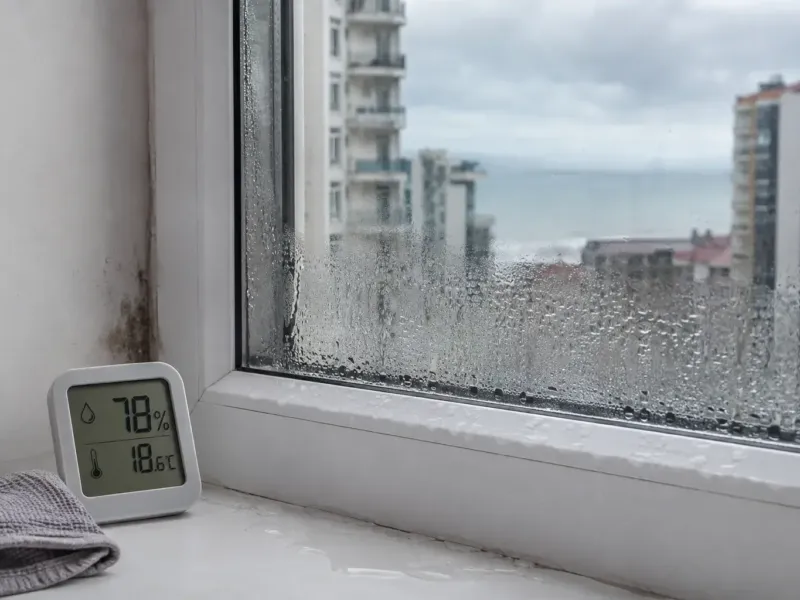
Every winter apartment owners in Batumi tell us almost the same story: condensation on windows in winter mornings, a small puddle on the sill and grey dots in the corner behind the wardrobe. Most of the time it is not about bad windows or the developer. The apartment simply holds more water than it manages to let out.
Where the water on the glass comes from
Air has a dew point: the temperature at which the vapour it holds turns into droplets. The more humid the air, the higher that point. At +20 °C indoors and 60 % humidity, dew forms on any surface colder than about +12 °C. In winter the glass, the lower part of the frame, the window reveals and the outer corners are exactly that cold, and that is where the water settles.
That is why windows sweat at the bottom, along the edge of the glazing unit and in the corners of the frame: these are the coldest spots. If the glass is dry and only the wall corner next to the window is wet, that particular spot is cold, and the question is insulation of the reveal or of the joint with the balcony slab.
Why it happens more often by the sea
Batumi gets more than 2,400 mm of rain a year, and outdoor humidity rarely drops below 70 %. In a dry climate airing quickly pulls vapour out of an apartment; here the air coming in from outside carries a lot of water too. Winters are mild, with an average January temperature of about +7 °C, but that is enough for glass and outer walls to cool below the dew point.
The building adds moisture as well. Concrete in a new building releases water for months, sometimes for the first two seasons. If you got the keys in summer and moved in in autumn, the first winter is almost always the wettest. It passes, but during that time the apartment needs more drying than usual.
Where the extra moisture comes from
A family of three adds several liters of water to the air every day. The main sources are:
- drying laundry in a room or on a closed balcony, the biggest source;
- showers and baths without a working extract fan;
- cooking without a hood, or with a hood that only recirculates air;
- breathing, especially in a small bedroom with the door shut;
- house plants and an aquarium;
- damp concrete in a new building.
The bathroom extract deserves a separate check. New buildings almost always have a grille on the wall, but sometimes there is no draught behind it: the duct was never finished, is blocked with construction debris or was closed off by neighbours. The test is simple: hold a sheet of paper to the grille. If it does not stick, there is effectively no extraction.
What humidity to keep
Living rooms are comfortable and safe for finishes at 40–55 % humidity. Above 60 % the windows will sweat almost every morning, and above 70 % mould starts to grow behind furniture and in corners. Buy a simple hygrometer and write down the readings morning and evening for a week. You will see whether it is a one-off after laundry or the constant background.
| Humidity | What happens | What to do |
|---|---|---|
| below 40 % | Dry, happens when the air conditioner heats for a long time | Nothing urgent, you can humidify |
| 40–55 % | Normal for living and for finishes | Keep it as it is |
| 55–65 % | Windows sweat in the morning, reveals get damp | Air more often, check the extract fans |
| above 65 % | Mould in corners, behind wardrobes, on reveals | Dehumidifier, fresh air supply, find the source |
What helps without renovation
Start with what is free. Air the rooms briefly and fully: windows wide open for 5–10 minutes two or three times a day instead of a window ajar all day. The apartment will not cool down in that time, and the humid air will leave. Use the hood when cooking and leave the bathroom fan on for about 20 minutes after a shower. Move wardrobes and sofas 5–10 cm away from outer walls so that air can move behind them.
The most noticeable effect comes from not drying laundry in the rooms. Without a dryer, dry it in the bathroom with the door closed and the fan on, or put a dehumidifier next to it. An air conditioner in dry mode also removes moisture, but it works poorly in a cold room, and in heating mode it takes almost no water out: the air just warms up and relative humidity drops only for a while.
A household dehumidifier rated at 12–20 liters a day covers an apartment of 50–60 m² if you put it in the middle and close the windows. In the first winter in a new building it is often needed all the time, later only in wet weeks. Draining it through a hose into a sink or floor drain is easier than emptying the tank every evening.
If you leave for the winter
The most common Batumi story: a seaside apartment stands empty from November to April with the windows shut and no heating. By spring there is mould on the walls, the furniture smells damp and leather items are covered in bloom. A closed, cold apartment by the sea dries itself worse than one that is lived in.
Before leaving, set up a dehumidifier draining into the sewer or the air conditioner on low heating around +16 °C. Leave wardrobe doors ajar, pack textiles into vacuum bags, shut off the water. Someone should come in every two or three weeks to check the humidity and air the rooms. How we prepare an apartment for winter is described on the seasonal apartment closing page.
When to call a specialist
If airing and a dehumidifier do not help, the cause is in the apartment itself. The signs are:
- mould comes back in the same place a couple of weeks after treatment;
- a wet patch on the wall appears after rain rather than after a cold night;
- water between the panes of the glazing unit rather than on its surface;
- the corner at the balcony slab or above the window gets damp;
- the bathroom or kitchen extract does not pull at all.
A patch after rain usually means a leak through the facade, the window joint or the balcony of the neighbours above, and it needs an inspection from outside. Condensation between the panes means the glazing unit has lost its seal and is replaced as a whole. A cold corner is fixed by insulating the reveal or the wall from inside, and mould is removed down to the base and treated with an antiseptic in two coats, otherwise it comes back. How we do it is on the mould and fungus removal page.
If the air in the apartment simply stands still, the answer is fresh air supply. A wall air inlet brings in fresh air without open windows, and supply and extract ventilation is installed during renovation, see the apartment ventilation page. If the glass sweats even at normal humidity, look at the windows themselves: old single-chamber frames get colder, see the window replacement page.
Related service
Where damp comes from in an apartment by the sea, when a dehumidifier is enough, and when you need fresh air supply or insulation of a cold…
How much it costs
A household dehumidifier rated at 12–50 liters a day, selected for your apartment, costs from 840 ₾ with us, a wall air inlet with core drilling from 330 ₾, and mould treatment of walls with cleaning and a two-coat antiseptic from 24 ₾ per square meter. The final cost is set after inspecting the apartment and agreeing the scope of work. You can start for free: a hygrometer, airing on a schedule and a check of the extract fans. Often that is enough for the windows to stop crying in the morning.