
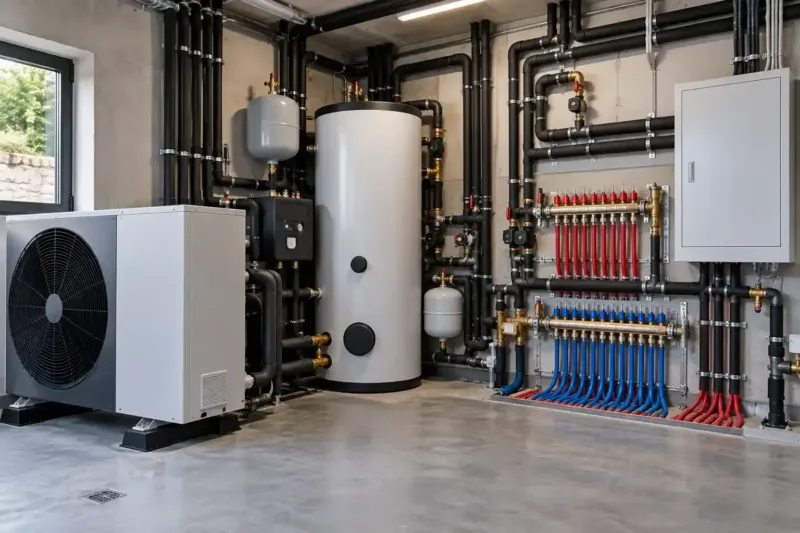
Smart home for a private house: scenarios, equipment, installation
We start a smart home for a private house with scenarios: leak and gas protection, climate by room, an alert when the power fails, gates and locks from the phone, lighting on the plot. Cables to sensors, relays and blinds are laid with the electrics, the core is wired and wireless sensors are added where needed. A turnkey smart home from 19 800 ₾.
from 19 800 ₾/projectlighting, climate, leaks and gates with design, equipment and installation, 150–250 m² house. The final price is confirmed once agreed.
- Timeline: a smart home for a 150–250 m² house usually takes 4–8 weeks including cabling during construction
- Warranty: Smart home installation and set-up carry a 2-year warranty
Who it’s for
You live abroad and want to see the house from your phone
You are building a house and want automation laid straight away
You let the house and need to give guests access codes
You want leak protection and an alert when the power goes
You need automatic gates and lighting on the plot
What’s included
- list of scenarios and system design
- choice of a wired or hybrid system
- cables to sensors, relays, blinds and the boiler
- a panel with space for relays and modules
- leak, smoke and temperature sensors
- climate and lighting control
- gates, wicket gate and locks with phone access
- app set-up and training
Smart home for a private house: what it does
A smart home for a private house is not fancy switches but a set of scenarios that save money and nerves. The house shuts off water by itself if there is a leak, keeps temperature and humidity steady, switches on the lights on the plot, opens the gate for the owner's car and tells your phone if something goes wrong. We always start with the question of what you want the house to do without you, not with choosing equipment.
Wired or wireless system
| System | Advantages | When it fits |
|---|---|---|
| Wired | Reliable, independent of Wi-Fi and batteries | A new house, lots of lighting and blinds, long service life |
| Wireless | Can be fitted in an existing house, cheaper at the start | A renovation without chasing, small tasks |
| Hybrid | Wired for the core, wireless sensors where a cable cannot go | Most private houses |
For an apartment wireless devices are usually enough, see the smart home in an apartment page.
What to automate first
- safety: leaks, gas, smoke, temperature in the house and plant room;
- climate: heating and air conditioners by room and schedule;
- power: an alert when the power fails and the switch to backup;
- gates, the wicket gate and locks with access by phone and code;
- lighting on the plot, "away" and "night" scenarios.
Blinds, multiroom audio and complex lighting scenes are added later if they make sense. Cables for them are laid straight away, which is cheaper than chasing later. Leak protection and climate bring benefits first: one prevented leak in a house where nobody is home costs more than the whole sensor system.
A house whose owner lives abroad
For an owner who visits Batumi only now and then, a smart home is eyes and hands on site. You see temperature and humidity in the rooms, get an alert about a leak or a power cut, watch the cameras, give a temporary code to the cleaner or guests. Before you arrive you switch on the heating or air conditioning, and the house greets you warm. Together with a management company this covers almost all household risks, more on the villa management page.
What we lay during construction
So that a smart home does not turn into a pile of batteries, its cables are laid together with the electrics. Deep back boxes and a neutral in every switch box, separate circuits to blinds and roller shutters, a cable to every leak sensor and to the boiler, network cables to the cabinet. The panel is built with spare ways for relays. If the core is wired, in ten years it will not have to be replaced because the maker of the wireless devices has stopped producing them. How the data networks in a house are arranged is described on the low-voltage systems page, and cameras on the CCTV page.
How much a smart home costs
A smart home for a 150–250 m² private house with design, equipment and installation costs from 19 800 ₾: lighting, climate, leaks and gates. A basic package for a 50–80 m² apartment from 5 100 ₾, a hub and scenario set-up from 570 ₾, a smart switch or relay from 125 ₾. Turnkey leak protection from 1 200 ₾, sliding gate automation with phone control from 3 360 ₾, a smart lock installed from 780 ₾. The final cost is set after the list of scenarios and an agreed estimate.
Stages and timelines
-
Scenarios
2–5 days
What the house should do without you, budget, priorities.
-
Design
1–2 weeks
Equipment, cables, panel, hub location.
-
Cables
1–2 weeks
Laying with the electrics before plaster.
-
Installation
1–2 weeks
Relays, sensors, switches, actuators after finishing.
-
Set-up
2–5 days
Scenarios, app, access rights, training.
Local specifics in Batumi
In Batumi a smart home is most often wanted by owners who live in another country or let the house. What matters to them is knowing that the house is dry, warm and everything works. So the core is almost always leak protection, humidity and temperature sensors, a power failure alert and cameras, rather than lighting scenes.
Power is cut in the suburbs and mountains, and after it returns some devices lose their settings or do not go back to the right mode. The hub, router and boiler are connected to an uninterruptible power supply, and we test the scenarios against a "power lost and restored" case. By the sea we choose wireless sensors with plenty of battery life and moisture-protected versions for outdoors.
Materials and brands
Wired relay and dimmer modules in the panel, wireless sensors and switches where a cable cannot be run. A hub or controller that runs the main scenarios without the internet. Leak sensors with motorised valves, smoke, gas, temperature and humidity sensors. Blind and roller shutter actuators, sliding gate automation, smart locks, communication modules for the boiler and air conditioners.
What makes up the cost
Timeline: a smart home for a 150–250 m² house usually takes 4–8 weeks including cabling during construction
- number of rooms and devices
What raises the cost
- a wired system for the whole house
- blinds, roller shutters and lighting scenes
- a large plot with gates and outdoor lighting
- installation in an existing house
What lowers the cost
- safety and climate scenarios without extras
- cables laid during construction
We prepare the exact estimate from measurements and photos. It’s free and comes with no obligation.
Get an estimateGuarantees
Smart home installation and set-up carry a 2-year warranty. Concealed cables carry a 5-year warranty. The manufacturer's warranty covers equipment, and the system diagram and list of scenarios go into the building file.
Questions and answers
How much does a smart home for a private house cost?
A smart home for a 150–250 m² house with design, equipment and installation costs from 19 800 ₾: lighting, climate, leaks and gates. A basic apartment package from 5 100 ₾, turnkey leak protection from 1 200 ₾. The final cost is set after the list of scenarios and an agreed estimate.
Where should a smart home start?
With safety and climate: leak protection, temperature and humidity sensors, a power failure alert, control of heating and air conditioners from the phone. This brings benefits first and matters especially if you do not live in Batumi. Lighting, blinds and multiroom audio can be added later.
Will a smart home work without the internet?
The main scenarios must run locally, without the internet: leak protection, climate, lighting. For that we choose a hub that controls the house locally. Without the internet only phone access is lost, and it returns with the connection. That is why we do not build the house around cloud services that might shut down.
Can a smart home be added to an existing house?
Yes, with wireless devices: relays behind switches, sensors, actuators, smart locks. This is cheaper at the start, but batteries need changing and the connection depends on distance and walls. In a new house it pays to lay cables and make the core wired.
How do I give access to guests and the cleaner?
Through a smart lock or an intercom with codes: each person gets their own code for the required days and hours, which is deleted afterwards. The app shows who opened the door and when. For a house let by the night this replaces handing over keys.
Further reading
Describe what the house should do without you: we will price the smart home within 24 hours
We reply within an hour during business hours. Message us or leave a request: we’ll call you back, go over the details and suggest the next step.
Mon–Fri 10:00–19:00, Sat 11:00–16:00