
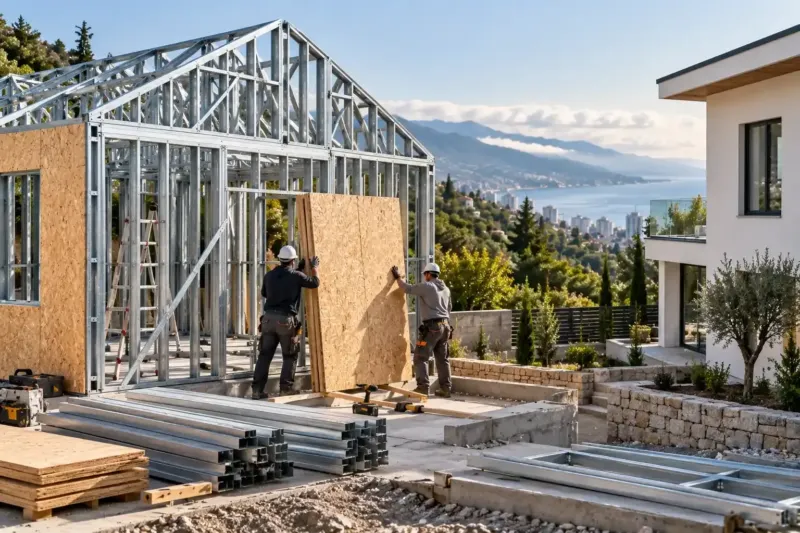
3D-printed houses in Batumi: what is realistic on a plot in Georgia
3D-printed houses in Batumi, and in Georgia as a whole, are still a rarity: we know of no construction printers in Adjara, and we have found no completed printed homes with publicly available documentation. The technology works, but in a seismic zone the wall needs reinforcement and calculations, and the printer and mix would have to be brought in. By our estimate, such a house would cost from 2,880 ₾ per m² turnkey. We compare printing with cast-in-place concrete, permanent formwork and a modular house on cost and timing for your plot.
from 2 880 ₾/m²turnkey house: wall printing, foundations, floor slab, roof, services and finishing. The final price is confirmed once agreed.
- Timeline: By our estimate, a 100 m² single-storey house with printed walls takes 6–10 months to build, plus 2–4 months for the design and permit
- Warranty: Our work carries a 2-year warranty
Who it’s for
You've seen printed houses abroad and want to know whether you can build that way in Batumi
You want a house with smooth, round walls and think printing will give you them for less
You need to put up a guest cabin quickly before the season, and printing seems the fastest route
A company with a printer has made you an offer, and you want to check it before signing a contract
You're comparing methods for a warm wall without thermal bridges and looking closely at printing
What’s included
- An analysis of the technology and its limitations for your plot
- A review of the printing company's offer: tests of the mix and wall, completed houses, the contract
- Structural engineer's calculations: whether a printed wall meets the Georgian seismic code
- A comparison of the printing estimate with cast-in-place concrete, permanent formwork and a modular house
- Design of a house with curved walls in cast-in-place concrete or masonry
- Preparation of the permit documents together with the architect
- Design and construction of the house using the method chosen after the comparison
We are asked about 3D-printed houses in Batumi and elsewhere in Georgia more and more often, yet the local market has almost no answers. We have not built a printed house ourselves. But in a seismic zone such a house is structurally closest to cast-in-place concrete and reinforced masonry, which we build all the time, so we can assess a printing project in practical terms. Below is what is known about the technology worldwide, what Georgian conditions change about it, and what we can offer if you like the idea itself.
How a house is printed
A construction printer looks like a giant piping bag mounted on a gantry or a robotic arm. Layer by layer, it extrudes a special cement mix along the outline of the walls, and a wall rises to full storey height in a few shifts. Usually two thin skins are printed with a cavity between them, and the cavity is later filled with insulation or with reinforced concrete.
Only the walls are printed. The foundations, floor slabs, roof, windows, services and finishes are done just as in an ordinary house, and they account for most of the estimate. Printing's strength is shape: the printer makes smooth curves and round walls without formwork, while on an ordinary build a wall like that is expensive.
3D-printed houses in Georgia: what we know as of 2026
Printed houses have been built in Europe, the US, China and the Middle East since the mid-2010s, mostly single-storey and two-storey ones. Almost every such project went through its own approval: the mix and the wall were tested in a laboratory, and the calculations were done for that particular house. In some places dedicated test methods for printed walls have already appeared, but there is no common standard recognised by every country.
We have found no information on completed printed homes in Georgia with publicly available documentation. Nor have we come across specific rules for such walls in the Georgian codes, so the wall would have to be justified by calculations and testing, like any non-standard structure. As for any house, the permit procedure depends on the class of the structure; there is more about the classes in our section on construction. But a project like this will face more questions.
Earthquakes and reinforcement
The main constraint in Batumi comes from earthquakes. A printed wall is made of layers, and the joint between them is weaker than the concrete itself. In a tremor the wall is pulled and sheared, and unreinforced concrete performs poorly in tension and shear. So in a seismic zone vertical reinforcement is placed in the cavities and encased in concrete, horizontal bars or mesh are laid between the layers during printing, and a reinforced concrete ring beam is cast along the top of the walls under the slab.
At that point the printed wall essentially becomes permanent formwork for reinforced cores. It works well, but some of the advantage is lost: the reinforcement is tied by hand, the concrete is poured as a separate stage, and every joint needs a calculation. The closest familiar equivalent to such a wall is permanent formwork: its blocks are assembled by hand on the plot and filled with reinforced concrete in the same way. How we build seismic resistance into a structure in general is described on the page about earthquake-resistant houses.
Rain, heat and salt during printing
The printer works in the open air, and fresh layers must not get wet or dry out too much. In Batumi a downpour can come in any month, so the site needs a tent over it for the whole time printing is under way. In summer heat the mix sets faster, and printing has to be done early in the morning or in the evening, otherwise the next layer bonds poorly to the one below.
By the sea, an outer skin of cement mix needs protection like any concrete: salt and moisture get into its pores. On the outside the printed wall is covered with vapour-permeable render or a ventilated facade anyway, and the ribbed texture of the layers, which looks so good in photos, often ends up hidden under the finish.
Printer, mix and crew
The equipment and operators would have to be brought in from abroad, and the cost of delivering the gantry and assembling it on site falls entirely on the estimate for a single house. The printing mix has to hold its shape as soon as it leaves the nozzle and still bond with the layer below. Ordinary concrete from a local plant doesn't behave like that, so the mix is ordered from the printer manufacturer or developed from local materials, with testing. Either route adds months before construction can start.
The economics of printing are better when a series of identical small houses is printed on one site: the printer is assembled once, and the crew gets into its stride. For a single private house this advantage almost disappears.
What we offer instead of printing
Interest in 3D printing usually comes from one of three wishes: an unusual shape, a warm wall without thermal bridges, or a fast build. Each of them can be achieved in Batumi with familiar methods:
- smooth and round walls are made in cast-in-place concrete with curved formwork or in masonry laid to a template, and we work out the shape together with the facade design;
- a warm wall with a concrete core comes from permanent formwork, or from a cast-in-place concrete frame with block infill and continuous insulation on the outside;
- a fast build comes from a factory-made modular house, if a truck carrying a module can get to the plot.
If you still want a printed house and have found a company with a printer, start with a check. The structural engineer will review the test results for the mix and the wall and tell you whether such a structure passes the calculation under the Georgian code on your ground. If it does, we can discuss an arrangement in which the company with the printer prints the walls under its own contract and we carry out the rest of the work. We agree on this after the check, once the structure is clear and so is who is responsible for what.
How much a 3D-printed house costs in Georgia
There is no market price for a 3D-printed house in Georgia, so there is nothing to compare it with. Based on European projects and Georgian finishing prices, we estimate that such a house would cost from 2,880 ₾ per m² turnkey. That price covers printing the walls on the plot, the foundations, floor slab, roof, building services and mid-range finishing. The shell, meaning the walls, foundations, floor slab and roof, would cost from 1,470 ₾ per m² by the same estimate.
For comparison, our prices are: a cast-in-place concrete house shell from 1,110 ₾ per m², an aerated concrete one from 750 ₾, a mid-range turnkey house from 1,680 ₾, and a factory-built modular house, turnkey, from 1,830 ₾. The design is priced separately in any case, from 100 ₾ per m². Printing costs more because of the delivery of the printer, the reinforcement of the cavities for seismic loads, the tent for the duration of the work and the testing needed for the permit. The final cost is set on the basis of the design, after a visit to the plot and once the estimate is agreed, and for printing it may differ from our estimate in either direction.
Stages and timelines
-
Understanding the brief
2–3 days
We find out what matters to you about printing: the shape, the speed or a warm wall. That determines what to compare it with.
-
Checking the printing contractor
2–4 weeks
We request test results for the mix and the wall, addresses of completed houses, and the terms for delivering the printer and working on site.
-
Wall calculation
2–3 weeks
The structural engineer checks the reinforced printed wall for seismic loads on your ground.
-
Comparing the options
1–2 weeks
We price and schedule printing, cast-in-place concrete, permanent formwork or a modular house on the same layout.
-
Design and permit
2–4 months
Architecture, structural design and building services for the chosen method, and the document package for your class of structure.
-
Construction
6–10 months
Foundations, walls built the chosen way, floor slabs and roof, then services and finishing, with acceptance stage by stage.
Local specifics in Batumi
Printing needs a level site where the printer's gantry can stand and a truck with the mix can turn round. In Batumi and its suburbs many sea-view plots are on a slope, and there a terrace and a slab would have to be built for the printer first, which is exactly the part of the work that already takes a lot of time and money. Narrow streets in areas of private houses, where a concrete mixer truck barely gets through, raise another question: how to bring in and assemble the printer itself.
The printing season in Adjara is shorter than the sunny summer suggests: between seasons downpours come in spells of several days, and in July and August the heat speeds up setting. In winter in the Adjara highlands printing is impossible altogether, because the mix must not freeze before it gains strength. And then there are earthquakes: here a printed wall is reinforced in any case, and that changes the economics that projects abroad are based on.
Materials and brands
The printing mix is fine-grained and cement-based, with admixtures that help it hold its shape and gain strength quickly. It is matched to a specific printer, and we have found no ready-made printing mixes on retail sale in Georgia. The wall cavities take reinforcement and concrete for the cores, and insulation or a lightweight fill, with a reinforced concrete ring beam along the top of the walls.
On the outside the wall is covered with vapour-permeable render or a ventilated facade, and on the inside it is usually plastered, because dust collects in the grooves between the layers. Construction printers and mixes for them aren't available in Georgia, so we don't name brands. In a real project the materials would be specified by the company with the printer, and we would check their documents and test results.
What makes up the cost
Timeline: By our estimate, a 100 m² single-storey house with printed walls takes 6–10 months to build, plus 2–4 months for the design and permit
- the roof, services and finishes cost the same as in an ordinary house
What raises the cost
- a printer, mix and operators brought in from abroad
- reinforcement and concrete in the wall cavities for seismic loads
- a tent over the site for the whole printing period
- testing of the mix and wall for the design and the permit
What lowers the cost
- a series of identical small houses on one site
- a single-storey house on a level plot with good access
We prepare the exact estimate from measurements and photos. It’s free and comes with no obligation.
Get an estimateGuarantees
Our work carries a 2-year warranty, whatever the walls are made of.
Wiring, water pipes and drains in walls and floors carry a 5-year warranty if we installed them. If another company prints the walls, they remain under its warranty and its contract, and materials and equipment carry the manufacturer's warranty.
Questions and answers
How much does a 3D-printed house cost in Georgia?
There are no ready prices in Georgia, because printed houses aren't sold here. By our estimate, based on European projects and Georgian finishing prices, such a house would cost from 2,880 ₾ per m² turnkey, and the shell from 1,470 ₾. That is more than the shell of a cast-in-place concrete house, which costs from 1,110 ₾ per m² with us.
The difference comes from delivering the printer and the mix, reinforcing the walls for seismic loads and the testing needed for the permit. The final cost is set on the basis of the design, after a visit to the plot and once the estimate is agreed.
Are there companies in Georgia that print houses?
We don't know of any. We haven't come across a construction printer among contractors in Adjara, and we have found no completed printed homes in Georgia with publicly available documentation. Companies in Europe and other countries have printers, and in theory the equipment could be brought in, but the terms, timing and cost of delivery would have to be worked out for the specific project.
If someone offers you printing, ask for test results for the mix and the wall, a list of completed houses with addresses, and seismic calculations. Without these documents it is better not to sign a contract.
Will a printed house survive an earthquake?
An unreinforced wall isn't suitable for a seismic zone. A printed wall can withstand the design load if it has reinforced concrete cores in the cavities, mesh between the layers and a ring beam along the top, in other words a house in which the printing serves as formwork for reinforced concrete.
This can only be verified by a structural engineer's calculations under the Georgian code for your ground and by testing the mix. Don't take promises like “a printed house is stronger than an ordinary one” at face value: strength depends on the reinforcement and the joints, not on the way the concrete was placed.
Can you get a permit for a 3D-printed house in Batumi?
We don't know of a separate procedure for printed houses. As for any house, the permit depends on the class of the structure: a private house is usually Class II, and in Batumi the permit for it is issued by City Hall. In a project like this, the results of testing the mix and the structure will be added to the calculations required for your class.
We haven't come across any applications for a printed house in Batumi, so we don't promise timescales. Realistically, expect more questions and comments than for a cast-in-place concrete house design. We confirm the class of the structure before the concept design, and prepare the document package together with the architect.
Is a printed house quicker to build?
The printer puts up the walls themselves in a few days, but that is a small part of the build. The foundations, floor slab, roof, windows, services and finishing follow the usual sequence, and in a seismic zone the reinforcement and concreting of the cavities are added. Before the build there is also the delivery of the printer, the development of the mix and testing, which an ordinary house doesn't need.
If speed is what matters most to you, a modular house will be quicker: the modules are made in a factory while the foundations are prepared on the plot. For a house meant to last for years we more often recommend a cast-in-place concrete frame with block infill: it takes longer on site, but there are no unknowns.
Further reading
Tell us what attracts you to printing, and we'll compare it with cast-in-place concrete and a modular house
We reply within an hour during business hours. Message us or leave a request: we’ll call you back, go over the details and suggest the next step.
Mon–Fri 10:00–19:00, Sat 11:00–16:00